
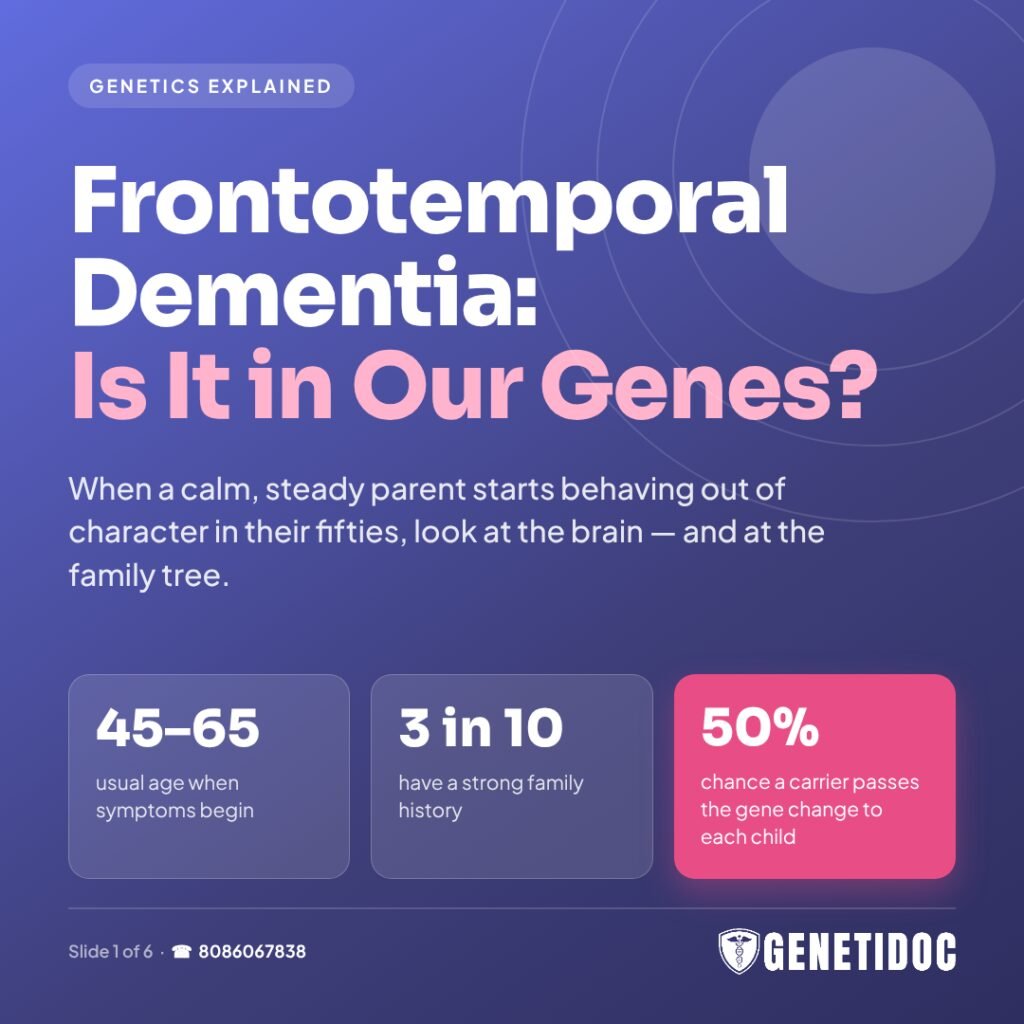
Your father was always the calm one. Then, in his mid-fifties, he started saying things that embarrassed the family. He lost interest in people he loved. He spent money in ways that made no sense. Everyone said it was stress, or depression, or “just his age.”
Months or years later, a neurologist used a term you had never heard: frontotemporal dementia.
And then came the question that keeps many families awake at night: Is this in our genes? Will it happen to me, or to my children?
This guide answers that question honestly. We explain which genes are involved, who should consider genetic testing, what testing can and cannot tell you, and how a genetic answer can help your family, even though there is no cure yet.
Quick Answer: Is Frontotemporal Dementia Genetic?
Sometimes. About 3 in 10 people with frontotemporal dementia have a strong family history. In these families, a single gene change, most often in C9orf72, GRN or MAPT, is passed from parent to child. Each child of a carrier has a 50% chance of inheriting it. Even without a family history, a genetic cause is found in some people. That is why genetic counseling and testing are now offered to everyone diagnosed with this condition.
What Is Frontotemporal Dementia?
Frontotemporal dementia (FTD) is a group of brain conditions in which nerve cells in the frontal lobes (the front of the brain) and temporal lobes (the sides of the brain) slowly stop working.
These parts of the brain control personality, judgement, behaviour, emotions and language. That is why FTD often changes who a person is before it affects memory.
This is the key difference from Alzheimer’s disease. In Alzheimer’s, memory loss usually comes first. In FTD, memory may stay fairly good in the early years, while behaviour or speech changes.
Who Gets It?
FTD usually begins between the ages of 45 and 65, although it can start earlier or later. It is one of the most common causes of dementia in people under 65, second only to Alzheimer’s disease.
Because it strikes people in the middle of their working and family lives, its impact on families, finances and careers is often heavy.
The Main Types of Frontotemporal Dementia
- Behavioural variant: The most common type. Changes in personality, loss of social filters, impulsive decisions, loss of empathy, apathy, new food cravings (often sweets), or repetitive habits.
- Semantic variant primary progressive aphasia: “Aphasia” means a language problem. The person slowly loses the meaning of words and may not recognise familiar objects or faces.
- Non-fluent variant primary progressive aphasia: Speech becomes slow, effortful and broken, with grammar mistakes, while understanding is often better preserved.
- Movement-related overlap conditions: Some people develop stiffness, slowness or balance problems similar to Parkinson’s disease, or conditions called progressive supranuclear palsy and corticobasal syndrome.
- FTD with motor neuron disease: Some people develop muscle weakness and wasting along with dementia. Motor neuron disease is also called amyotrophic lateral sclerosis (ALS).
“When a calm, responsible person in their fifties starts behaving completely out of character, families naturally look for an emotional explanation. We gently ask them to consider the brain as well, and to look carefully at the family tree.”
— Dr. Roshan Daniel, Clinical Geneticist, Genetidoc
Why Frontotemporal Dementia Is So Often Missed
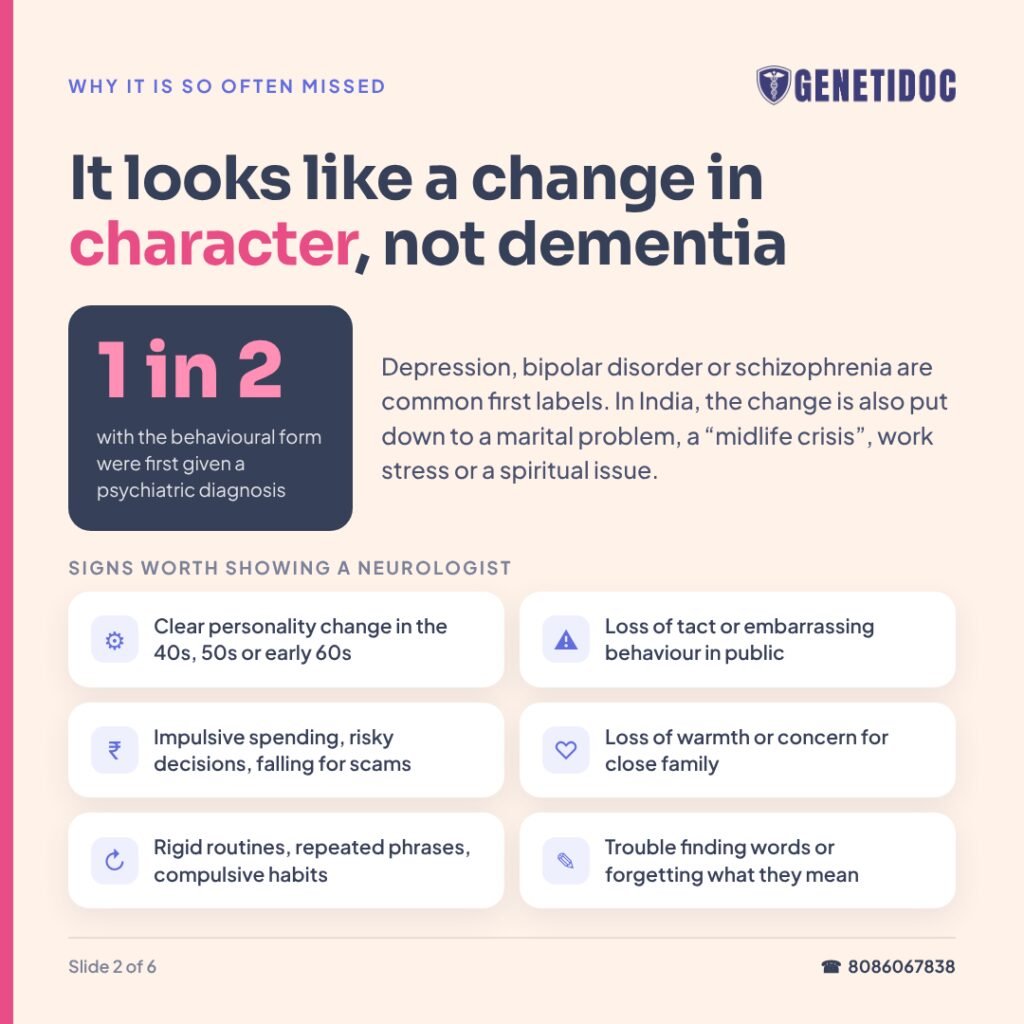
Early FTD rarely looks like “dementia” to a family. It looks like a change in character.
Published research shows this is a real and common problem. In a large study from the University of California, San Francisco, about half of people with the behavioural form had first been given a psychiatric diagnosis such as depression, bipolar disorder or schizophrenia. Younger patients were more likely to be mislabelled.
In India, there is often another layer. Behaviour changes may be explained as a marital problem, a “midlife crisis”, work stress, or even a spiritual issue. Precious years can pass before anyone thinks of a brain condition.
Warning Signs Worth Discussing With a Neurologist
- A clear personality change starting in the 40s, 50s or early 60s
- Loss of tact, embarrassing or inappropriate behaviour in public
- New impulsive spending, risky decisions or falling for scams
- Loss of warmth or concern for close family members
- Rigid routines, repeated phrases or compulsive habits
- Major change in eating habits, especially overeating sweets
- Difficulty finding words, or forgetting what common words mean
- Psychiatric symptoms appearing for the first time later in life
None of these signs alone means FTD. But a pattern of them, especially with a family history, deserves a specialist assessment. That assessment usually includes a brain scan, memory and thinking tests, and a detailed family history.
How Frontotemporal Dementia Is Inherited
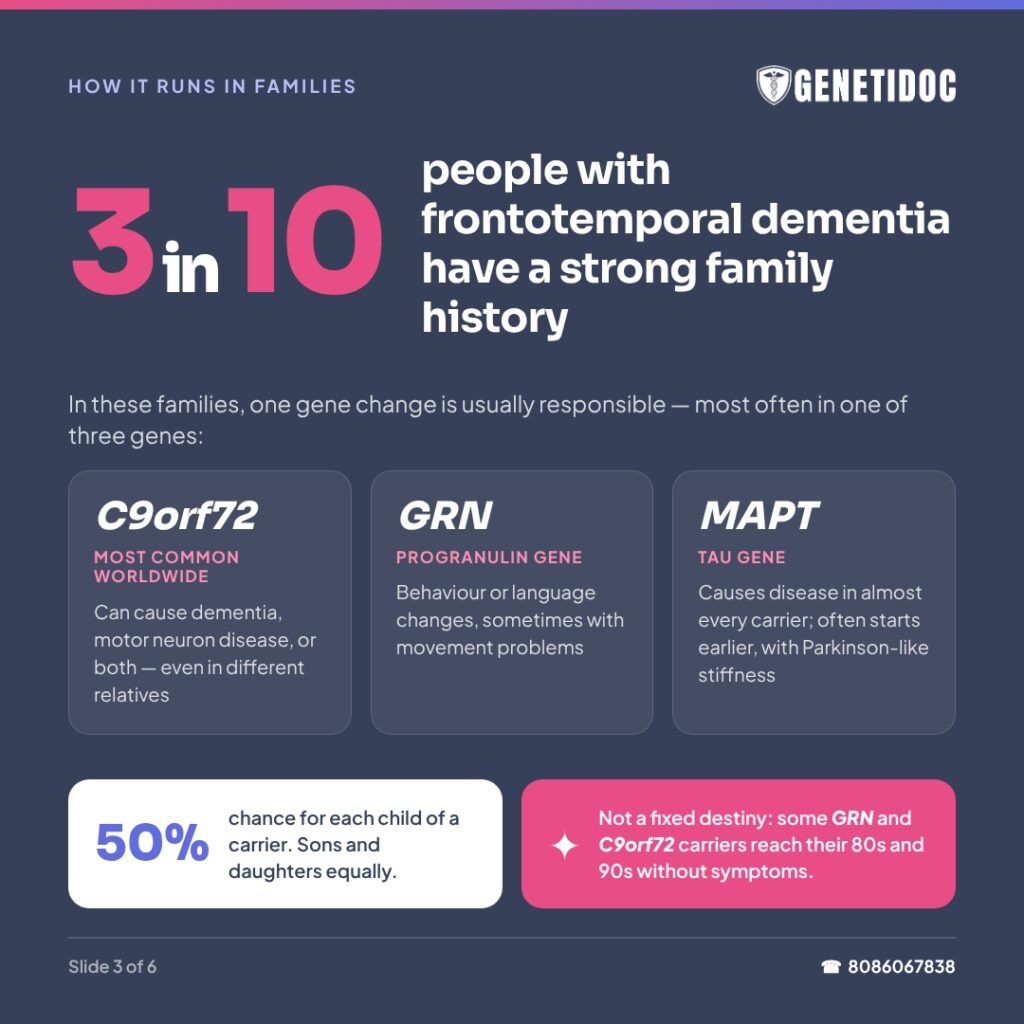
Among dementias, FTD has one of the strongest genetic links. About 30% of people with FTD have a strong family history of the condition.
The 50% Rule: Autosomal Dominant Inheritance
Most inherited FTD follows a pattern called autosomal dominant inheritance. In simple terms:
- We each have two copies of most genes, one from each parent.
- In dominant conditions, a change in just one copy is enough to cause disease.
- A person who carries the change has a 50% chance of passing it to each child.
- It does not skip generations in the usual sense. When it seems to, there is usually another explanation, such as a parent who died young of other causes, or symptoms that were labelled differently.
- Sons and daughters are equally likely to inherit it.
What About People With No Family History?
Many people with FTD have no known affected relatives. Usually this is called “sporadic” FTD. But a missing family history does not always rule out genetics.
The Association for Frontotemporal Degeneration reports that a genetic cause is found in 5–10% of people whose FTD appears sporadic. Common reasons include:
- A parent who died young, before symptoms could appear
- Relatives who were given a different diagnosis, such as “mental illness”, Parkinson’s disease or “nerve weakness”
- Small families, or limited information about past generations
- Genes that do not cause disease in every carrier
This is why the Association for Frontotemporal Degeneration updated its recommendation in October 2025. It now advises that everyone diagnosed with FTD should be offered genetic counseling and testing.
The Main Genes Behind Frontotemporal Dementia
Most inherited FTD is explained by three genes: C9orf72, GRN and MAPT. Worldwide, C9orf72 is the most common, followed by GRN and then MAPT.
| Gene | What It Does | Typical Features | Does Every Carrier Develop Symptoms? |
| C9orf72 | A short stretch of DNA is repeated hundreds or thousands of times | Behavioural FTD, motor neuron disease, or both; sometimes early psychiatric symptoms | Not always; risk rises with age |
| GRN (progranulin) | Makes progranulin, a protein that helps brain cells survive and clean up waste | Behavioural FTD or language problems, sometimes with movement problems | Not always; risk rises with age |
| MAPT (tau) | Makes tau, a protein that supports the internal skeleton of nerve cells | Behavioural FTD, often with Parkinson-like stiffness; tends to start earlier | Almost always |
Rarer Genes
Changes in several other genes, including TARDBP, VCP, TBK1, CHMP2B, FUS and OPTN, can also cause FTD.
For example, VCP changes can cause a combination of muscle weakness, a bone condition called Paget disease of bone, and dementia in the same family. Patterns like this are easy to miss unless someone looks at the whole family together.
“Penetrance”: Why a Positive Gene Result Is Not a Fixed Destiny
Penetrance means the chance that someone who carries a gene change will actually develop the condition.
MAPT changes cause disease in almost every carrier. But GRN and C9orf72 show “age-related penetrance”. The risk grows with age, and a small number of carriers in their 80s and 90s have not developed symptoms.
Age at onset can also differ widely, even within one family. Researchers have found other genes, such as TMEM106B, that seem to modify risk and timing.
“A positive result tells a family which door is open. It does not tell them exactly when, or in some genes even whether, someone will walk through it. That difference matters enormously for how people plan their lives.”
— Dr. Roshan Daniel, Clinical Geneticist, Genetidoc
Connecting the Dots: Dementia and Motor Neuron Disease in One Family
This is one of the most important and least understood points for families.
The same gene change, especially in C9orf72, can cause FTD in one relative and motor neuron disease in another. C9orf72 repeat expansions are the most common known cause of both conditions.
So when a family says, “My father had dementia, but my uncle died of a muscle weakness disease,” these may not be two separate stories. They may be one genetic story.
Illustrative scenario (a composite, not a real patient)
A 52-year-old bank manager from Kerala was treated for depression for two years after becoming withdrawn and making unusual financial decisions. A neurologist later found shrinkage in the frontal lobes on a brain scan.
When the family history was taken carefully, it emerged that his mother had been labelled “mentally ill” in her late fifties. His maternal uncle had died of “nerve weakness” with difficulty swallowing and walking. A genetic panel done earlier had been reported as negative. A dedicated C9orf72 repeat test then confirmed the family’s genetic cause.
His adult children could now receive accurate counseling about their own 50% risk, and decide for themselves whether and when to be tested.
Frontotemporal Dementia Genetics in India: What We Know So Far
Most FTD genetics research comes from Europe and North America. Indian data is still limited, and what exists suggests the picture here may be different.
- Family history is common. Across Indian studies, the proportion of familial FTD ranges from 9.5% in Kolkata and 15% in Trivandrum to 24.6% in Hyderabad, and as high as 40% in a recent study from Bangalore.
- Early studies found few known gene changes. A South Indian study found no disease-causing MAPT changes in 116 people with FTD. The same group found one new GRN change in a familial case. A 2015 study suggested C9orf72 changes may be rare in Indian patients.
- Newer technology is finding more. A 2025 study from South India used whole exome sequencing and identified disease-causing MAPT changes in seven patients. Its authors noted that earlier Indian studies had mostly returned negative results, even in families with a clear history.
What does this mean for families? Indian patients may carry genetic causes that are different from, or less studied than, those in Western populations. The test chosen, the technology used and the expertise of the person interpreting the result matter even more here.
“Indian research on frontotemporal dementia genetics is still catching up with the rest of the world. That is exactly why careful test selection and expert interpretation matter more here, not less. A report generated without clinical context can easily miss what a family needs to know.”
— Dr. Roshan Daniel, Clinical Geneticist, Genetidoc
Who Should Consider Genetic Testing for Frontotemporal Dementia?
Genetic counseling is worth considering if any of the following apply to you or your family:
- A person has been diagnosed with FTD, primary progressive aphasia or FTD with motor neuron disease.
- Symptoms began before about age 65.
- Two or more relatives had dementia, Parkinson-like illness, motor neuron disease or late-onset psychiatric illness.
- A close relative has already been found to carry an FTD gene change.
- You are a healthy adult with an affected parent or sibling and want to understand your own risk.
- You are planning a pregnancy and a gene change is known in your family.
When Testing May Not Be Useful
Genetic testing is not the right step for everyone, and that is fine. It may be less helpful when:
- The diagnosis itself is still uncertain. A neurologist’s assessment should come first.
- A healthy relative wants testing, but no affected family member has been tested. A negative result in this case cannot rule out an unknown family cause.
- The person is not yet emotionally ready for the result, or feels pressured by others.
- The request comes from a consumer DNA kit result. These kits are not designed to detect the C9orf72 repeat expansion and do not replace clinical testing.
Diagnostic Testing vs Predictive Testing
Families often mix up two very different types of genetic testing.
| Diagnostic Testing | Predictive Testing | |
| Who | A person who already has symptoms | A healthy adult relative |
| Question answered | “Is my illness caused by a gene change?” | “Have I inherited the family’s gene change?” |
| Test used | Multi-gene panel or exome, plus a C9orf72 repeat test | Targeted test for the one known family change |
| Typical turnaround | Panel about 3–4 weeks; exome about 1–2 months | About 1 week |
| Counseling | Before and after the test | Several sessions before, with time to reflect, and follow-up after |
Why the Affected Person Should Be Tested First
Whenever possible, testing starts with the family member who has symptoms. Once their gene change is found, healthy relatives can be tested quickly and accurately for that one change.
If the affected relative has already passed away, a stored blood or tissue sample may still be usable. If none is available, a genetic counselor will explain what testing a healthy relative can and cannot tell you.
How Genetic Testing for Frontotemporal Dementia Works
Step-by-Step: What to Expect
- Pre-test genetic counseling. A clinical geneticist or genetic counselor reviews symptoms, scan reports and a three-generation family tree. They explain what the test can find, what it cannot, and how results may affect relatives.
- Choosing the right test. Usually a multi-gene panel or whole exome sequencing, plus a dedicated C9orf72 repeat test.
- Sample collection. A simple blood sample, which can be collected through home sample pickup in many places.
- Laboratory analysis and expert interpretation. Accredited partner laboratories run the test. Each finding is then reviewed against the patient’s own symptoms and family history.
- Post-test counseling. Results are explained in plain language, along with what they mean for the patient, their children, brothers, sisters and other relatives.
- Written summary and follow-up. Families receive a written summary they can use to share information with relatives, and a plan for future follow-up.
Why the C9orf72 Gene Needs Its Own Test
This is one of the most common gaps we see in genetic testing for dementia.
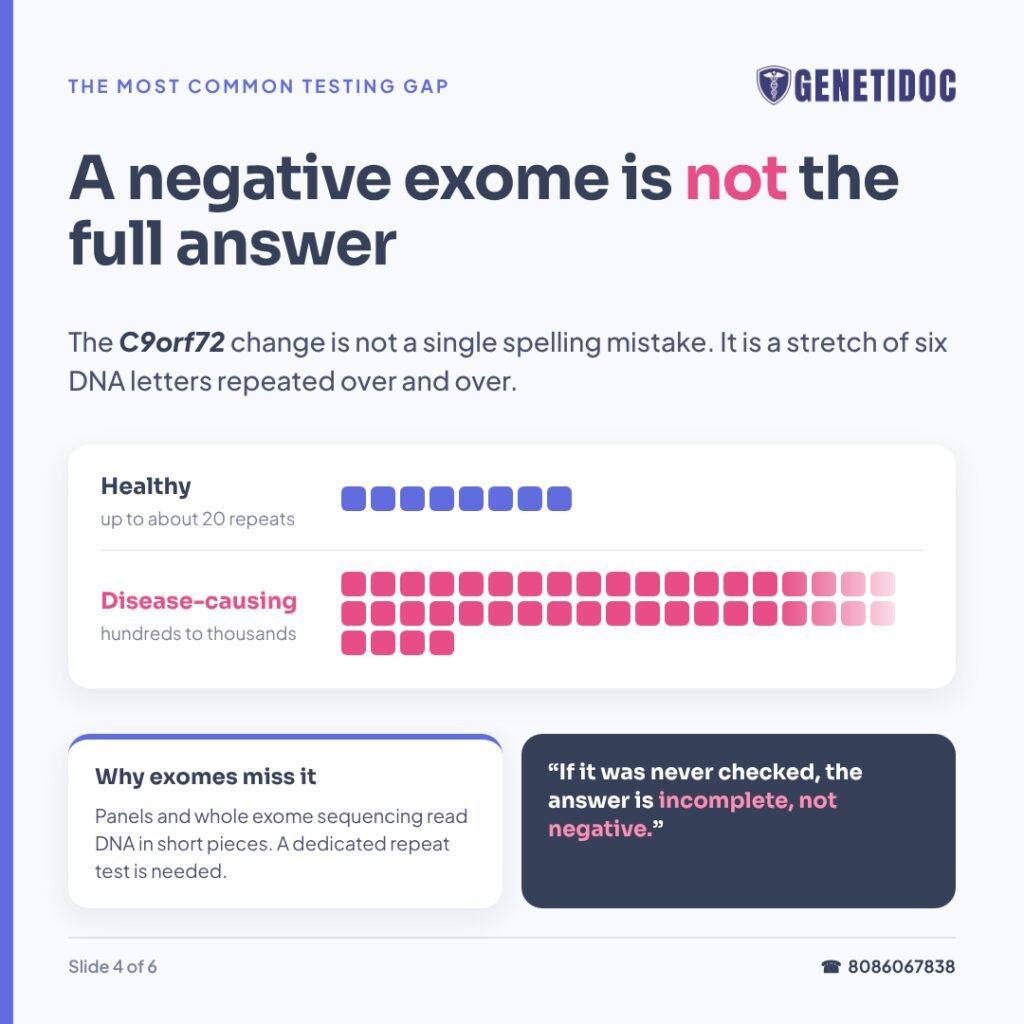
The C9orf72 change is not a simple spelling mistake in the DNA. It is a short stretch of six DNA letters repeated over and over. Healthy people usually have up to about 20 repeats. People with C9orf72-related disease often have hundreds to thousands.
Standard panels and exome sequencing read DNA in short pieces. They are not designed to measure a repeated stretch that long. This region is also very rich in two particular DNA letters, which makes it hard to copy in the laboratory. So laboratories use a special technique called repeat-primed polymerase chain reaction to detect it.
The practical message: a “negative” exome report does not rule out C9orf72 unless the repeat was tested separately.
“A negative exome report does not close the question of frontotemporal dementia. The most common genetic cause worldwide, C9orf72, needs its own dedicated test. If it was never checked, the answer is incomplete, not negative.”
— Dr. Roshan Daniel, Clinical Geneticist, Genetidoc
When the C9orf72 Result Falls in a “Grey Zone”
Sometimes the repeat number falls between clearly normal and clearly disease-causing. The meaning of these “intermediate” results is still uncertain.
Different laboratories even use different cut-offs. In one published case, two laboratories gave conflicting reports on the same patient. An intermediate result should always be interpreted by a specialist who knows the patient’s history, never read from the printout alone.
Understanding Your Results
Positive (Pathogenic or Likely Pathogenic)
A disease-causing gene change was found. This explains the illness, and relatives can now be offered accurate counseling and targeted testing if they wish.
Negative
No reportable finding was found in what was tested. It does not prove the condition is not genetic. Some genes may not have been covered, and some genetic causes are still unknown, especially in Indian populations.
Variant of Uncertain Significance (VUS)
A variant of uncertain significance (VUS) is a DNA change that science cannot yet classify as harmful or harmless. A VUS is not a diagnosis.
At Genetidoc, a VUS is never used to test healthy relatives or to make pregnancy decisions. Where possible, the team checks whether the same variant appears in other affected family members, which can help clarify its meaning. Reanalysis is advised after 6 months to 1 year, because scientific knowledge keeps improving.
Illustrative scenario (a composite, not a real patient)
A 61-year-old retired school teacher began forgetting the meaning of everyday words. She was diagnosed with the semantic variant of primary progressive aphasia. She had no family history of dementia.
Her genetic panel and C9orf72 test showed no reportable finding. Her children were told that this lowers, but does not completely remove, the chance of an inherited cause. They were advised to stay in touch with the clinic, because future reanalysis or new research could still add information.
Predictive Testing: A Personal Choice for Healthy Relatives
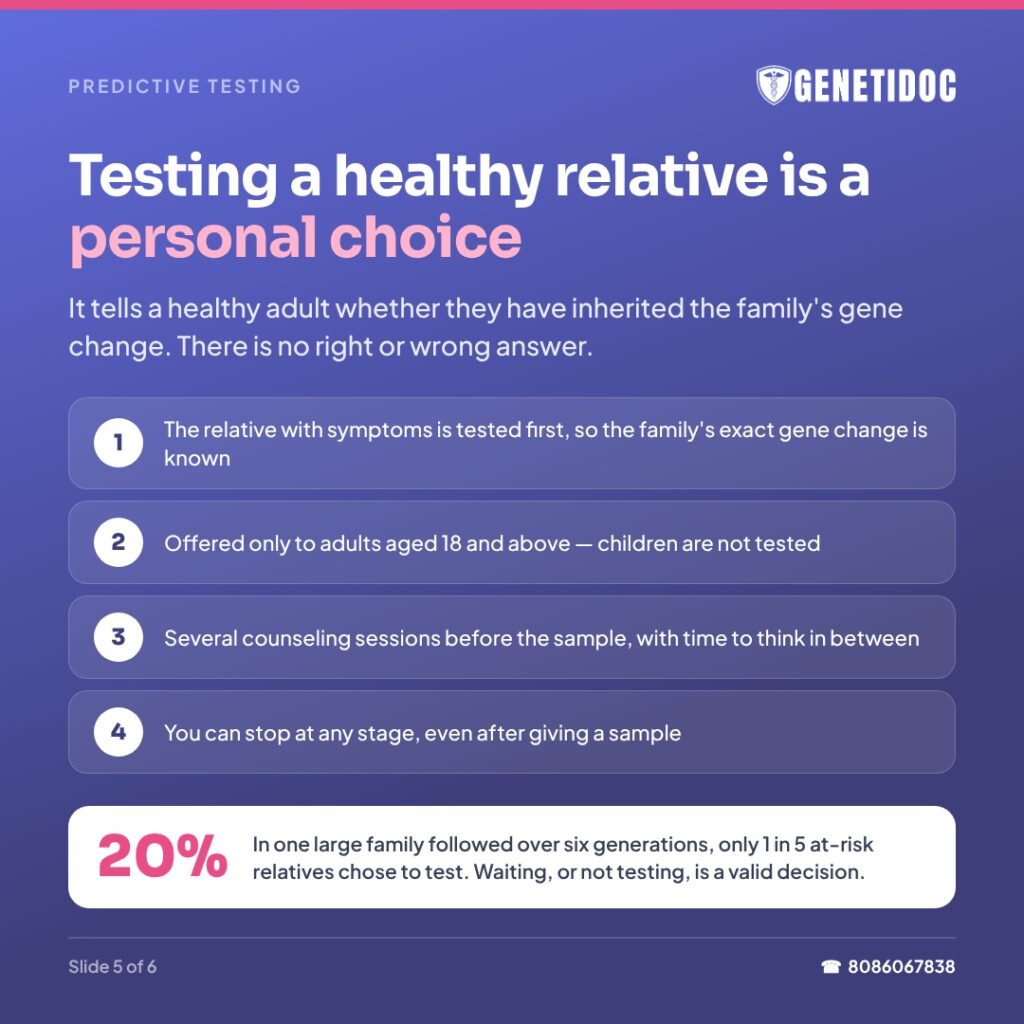
If a gene change has been found in your family, you may be offered predictive testing. This is a test that tells a healthy person whether they have inherited the family’s gene change.
This is one of the most personal decisions in medicine. There is no right or wrong answer.
How Predictive Testing Is Done Safely
- It is offered only to adults aged 18 and above.
- It is done only after the family’s gene change is confirmed in an affected relative.
- Several counseling sessions take place before the sample is taken, with time to think in between.
- You can stop at any stage, even after giving a sample.
- Results are given in person or by video consultation, ideally with a trusted support person present.
- Follow-up support is planned after the result.
Published experience shows this careful approach is normal. A UK study found people needed a median of four counseling appointments before predictive testing, compared with two for diagnostic testing. Many at-risk relatives choose not to test at all. In one large family studied over six generations, only 20% chose predictive testing.
“Predictive testing should never be rushed. Some of the most important conversations we have are with people who decide not to test, or not yet. That choice deserves exactly the same respect as the decision to go ahead.”
— Dr. Roshan Daniel, Clinical Geneticist, Genetidoc
Reasons People Choose to Test, or Not
Reasons to test:
- To end years of uncertainty
- To plan careers, finances and caregiving
- To make decisions about having children
- To become eligible for research studies and future clinical trials
Reasons to wait or decline:
- There is no treatment yet that prevents the condition
- Fear of how the result may affect mental health, marriage or relationships
- Concerns about insurance or employment
- Simply not being ready
What About Children?
Children are generally not offered predictive testing for FTD. The condition starts in adulthood, and there is nothing that needs to be done differently in childhood. Testing is left as a decision the person can make for themselves once they are an adult.
Illustrative scenario (a composite, not a real patient)
A 33-year-old software engineer’s father had FTD caused by a GRN change. She was getting married and felt pressure from relatives to “find out”.
Over three counseling sessions, she worked through what each possible result would mean for her plans. She chose to postpone testing until she and her partner were ready to start a family. She knew that if she later tested positive, options to avoid passing the change on would be available.
Genetic Information and Insurance in India
Many families worry about genetic discrimination. In 2018, the Delhi High Court held that broadly excluding “genetic disorders” from health insurance was unconstitutional. However, in August 2018 the Supreme Court stayed key parts of that judgment, so the legal position remains unsettled.
The Society for Indian Academy of Medical Genetics has stated that genetic information should not be used to discriminate in health insurance or employment. Discuss these concerns openly with your genetic counselor before you test.
What a Genetic Diagnosis Changes, Even Without a Cure
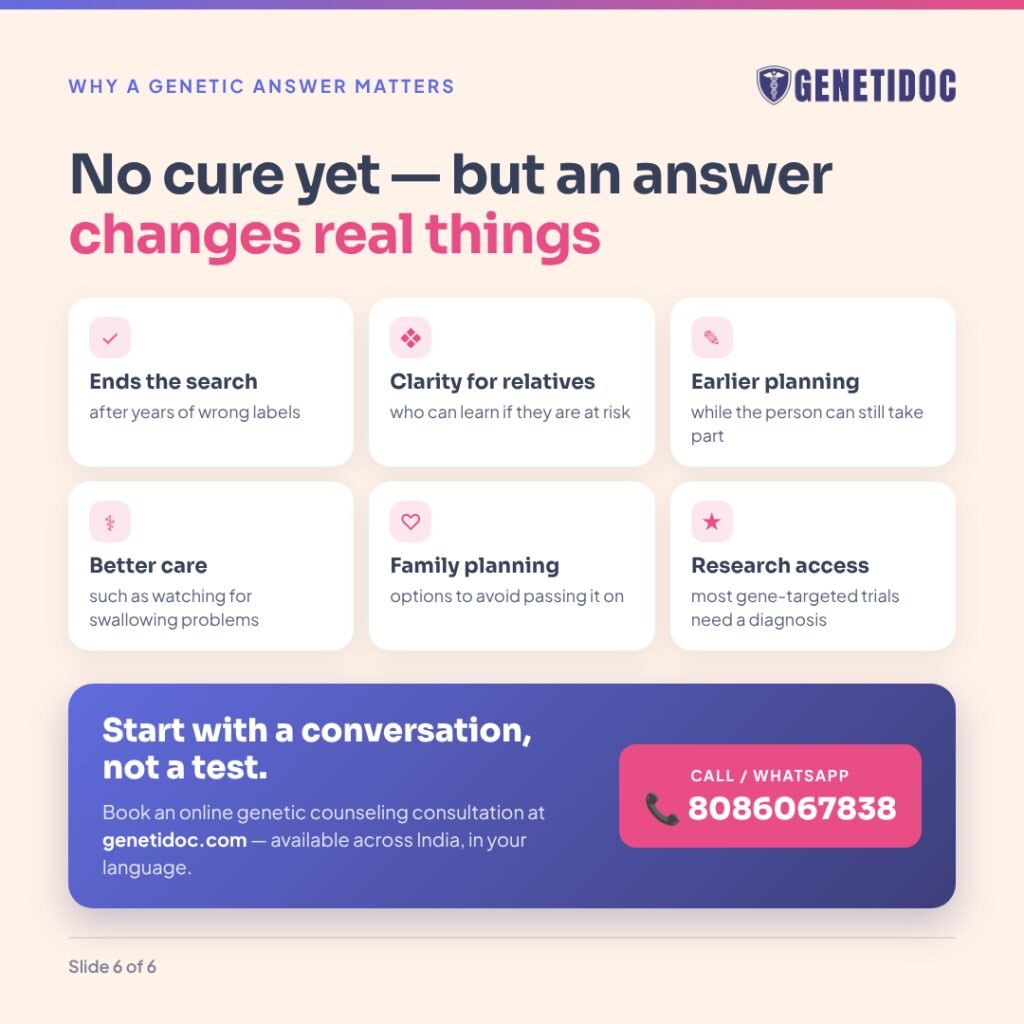
Families sometimes ask, “If there’s no cure, why test at all?” It is a fair question. Here is what a genetic answer can offer:
- An end to the search. Many families have spent years on the wrong diagnoses and treatments.
- Clarity for relatives. Brothers, sisters and children can find out whether they are at risk, or learn that they are not.
- Better planning. Families can arrange wills, nominations, joint accounts, power of attorney and an advance medical directive while the person can still take part in decisions.
- Better care. Knowing the gene can help doctors anticipate problems, such as watching for swallowing or muscle weakness in C9orf72
- Family planning options. Carriers can explore ways to avoid passing the change on.
- Access to research. Most gene-targeted clinical trials require a confirmed genetic diagnosis.
“Even without a cure, a genetic answer changes real things. It ends a long search, it gives healthy relatives a genuine choice, and it prepares families for research that is moving forward every year.”
— Dr. Roshan Daniel, Clinical Geneticist, Genetidoc
Where Treatment Research Stands
There is currently no approved medicine that stops or slows FTD. Treatment focuses on managing behaviour, mood, speech and daily function, and on supporting caregivers.
Research is active, but progress is uneven. In October 2025, a major trial of a drug called latozinemab for GRN-related FTD did not meet its main goal. The drug raised progranulin levels, but this did not lead to a measurable clinical benefit.
Other approaches, including gene therapy and small-molecule medicines, are still being studied. Families should be cautious of anyone promising a cure, and should discuss any trial they hear about with their neurologist or clinical geneticist.
Planning a Family When FTD Runs in Your Family
If a disease-causing gene change is confirmed in your family, you have options:
- Preimplantation genetic testing (PGT): During IVF, embryos are tested for the family’s gene change, and an unaffected embryo is transferred.
- Prenatal testing: Testing during pregnancy, arranged through your obstetric team.
- Natural conception without testing, with a full understanding of the 50% chance.
- Donor eggs or sperm, or adoption.
These options depend on a confirmed, clearly disease-causing family variant. They are not offered on the basis of a VUS. Your genetic counselor will help you weigh them without pressure. The final decision always belongs to you.
Common Myths About Frontotemporal Dementia and Genetics
- Myth: “Dementia only happens to old people.” FTD often starts in the 40s to 60s.
- Myth: “It’s just depression or a personality change.” Behaviour changes in midlife can be the first sign of a brain condition and deserve proper assessment.
- Myth: “No family history means it isn’t genetic.” A genetic cause is found in some people with no known affected relatives.
- Myth: “My exome was negative, so it’s not genetic.” C9orf72 needs its own test, and some causes are still undiscovered.
- Myth: “If I carry the gene, I’ll get it at the same age as my parent.” Age at onset varies, and some carriers never develop symptoms.
- Myth: “Dementia and motor neuron disease in my family are unrelated.” They can share a single genetic cause.
Why Expert Interpretation Matters More Than the Report
A genetic report is only as useful as the questions asked before the test and the interpretation after it. For FTD, a lot can go wrong:
- The wrong test is ordered, and C9orf72 is never checked
- A healthy relative is tested before the affected person
- A VUS is mistaken for a diagnosis
- An intermediate C9orf72 result is over- or under-called
- A negative result is misread as “no risk” for the whole family
At Genetidoc, every test is selected by a clinical geneticist after reviewing the patient’s symptoms, scans and family tree. Results are interpreted against that clinical picture. Every report is explained through genetic counseling, so families leave with clear next steps, not just a document.
Consultations are available online across India, with counseling in many Indian languages. Couples or siblings in different cities can join the same session.
Practical Steps for Families Right Now
- Draw your family tree across three generations. Include anyone with dementia, psychiatric illness later in life, Parkinson’s disease, falls, walking or swallowing problems, or “nerve weakness”.
- Collect medical records, including brain scan reports and any previous genetic test reports.
- Ask whether a DNA sample can be stored from an affected relative, especially if their health is declining.
- Book genetic counseling before testing, not after.
- Start legal and financial planning early, while the affected person can still take part.
- Look after the caregivers. FTD is hard on families, and support matters.
Frequently Asked Questions
1. Is frontotemporal dementia hereditary?
Sometimes. About 3 in 10 people with FTD have a strong family history. In these families, it is usually caused by a single gene change, with a 50% chance of passing it to each child.
2. Which genes cause frontotemporal dementia?
The three most common are C9orf72, GRN (progranulin) and MAPT. Rarer genes include TARDBP, VCP, TBK1 and CHMP2B.
3. If my parent had frontotemporal dementia, will I get it?
Not necessarily. If your parent’s FTD was caused by a dominant gene change, your chance of inheriting it is 50%. Even carriers may develop symptoms late or, for some genes, not at all.
4. Who should get genetic testing for frontotemporal dementia?
Anyone diagnosed with FTD can be offered counseling and testing. It is especially useful with onset before 65, a relevant family history, or a known family gene change.
5. Can whole exome sequencing detect the C9orf72 change?
Not reliably. The C9orf72 change is a very long repeated stretch of DNA that needs a separate repeat-expansion test.
6. Is there a treatment for genetic frontotemporal dementia?
No approved treatment stops the disease yet. Symptoms can be managed, and research on gene-targeted treatments continues.
7. How long do genetic test results take?
A multi-gene panel takes about 3–4 weeks and whole exome sequencing about 1–2 months. Testing a relative for a known family change takes about 1 week.
8. Can children be tested?
Generally no. FTD starts in adulthood, so predictive testing is left to the person to decide once they are an adult.
9. Can frontotemporal dementia be mistaken for depression?
Yes. In one large study, about half of people with the behavioural form were first given a psychiatric diagnosis.
10. Can carriers have children without passing it on?
Yes. Options include preimplantation genetic testing during IVF and prenatal testing, once the family’s gene change is confirmed.
11. Does a negative test mean FTD is not genetic?
No. It means no reportable finding in what was tested. Some genes may not have been covered, and some causes are still unknown.
12. Are frontotemporal dementia and motor neuron disease related?
Yes. They can share a genetic cause, especially C9orf72, and can appear in different members of the same family.
Key Takeaways
- FTD changes behaviour, personality or language, usually starting between 45 and 65.
- About 30% of cases run strongly in families. Most of these are linked to C9orf72, GRN or MAPT.
- Each child of a carrier has a 50% chance of inheriting the change, but a positive result is not a fixed destiny.
- C9orf72 needs its own test. A negative exome alone is not the full answer.
- Indian genetic data is still emerging, which makes expert test selection and interpretation especially important.
- Predictive testing is a personal choice and should always follow careful counseling.
- Even without a cure, a genetic answer helps with planning, family decisions and access to research.
Worried That Frontotemporal Dementia Runs in Your Family?
Whether a loved one has just been diagnosed, a previous test came back “negative” without a C9orf72 check, or you are a healthy adult wondering about your own risk, start with a conversation, not a test. Genetidoc’s clinical geneticists will review your family history and existing reports, and help you decide whether testing is right for you and which test would answer your family’s question. Online consultations are available across India in your preferred language.
Book a Frontotemporal Dementia Genetic Counseling Consultation
Have a question about dementia genetics? Ask our specialists on the Genetidoc Rare Disease Forum: genetidoc.com/rarediseaseforum/
Related Reading
- Migraine and Genetics: Is It Hereditary?
- Rett Syndrome and Its Genetic Basis: What Every Parent Should Know About the MECP2 Gene
- Mucopolysaccharidosis: Signs Parents Should Not Ignore
- Genetic Causes of Intellectual Disability: A Complete Guide for Indian Families
- Seizures in Infancy: When Genetic Testing Helps
- Chimerism: When One Person Carries Two Sets of DNA
References
- Greaves CV, Rohrer JD. An update on genetic frontotemporal dementia. Journal of Neurology. 2019;266(8):2075–2086.
- Association for Frontotemporal Degeneration. Tips & Advice: Genetic Testing and FTD. Updated recommendation, October 2025.
- Woolley JC, Khan BK, Murthy NK, Miller BL, Rankin KP. The diagnostic challenge of psychiatric symptoms in neurodegenerative disease: rates of and risk factors for prior psychiatric diagnosis in patients with early neurodegenerative disease. Journal of Clinical Psychiatry. 2011;72(2):126–133.
- Rascovsky K, et al. Sensitivity of revised diagnostic criteria for the behavioural variant of frontotemporal dementia. Brain. 2011;134(9):2456–2477.
- Gorno-Tempini ML, et al. Classification of primary progressive aphasia and its variants. Neurology. 2011;76(11):1006–1014.
- Sirkis DW, Geier EG, Bonham LW, Karch CM, Yokoyama JS. Recent advances in the genetics of frontotemporal dementia. Current Genetic Medicine Reports. 2019;7(1):41–52.
- Underlying genetic variation in familial frontotemporal dementia: sequencing of 198 patients. Neurobiology of Aging. 2021;97:148.e9–148.e16.
- Aswathy PM, Jairani PS, Verghese J, Srinivas G, Mathuranath PS. Microtubule-associated protein tau genetic variations are uncommon cause of frontotemporal dementia in south India. Neurobiology of Aging. 2014;35(2).
- Aswathy PM, Jairani PS, Raghavan SK, Verghese J, Gopala S, Srinivas P, Mathuranath PS. Progranulin mutation analysis: identification of one novel mutation in exon 12 associated with frontotemporal dementia. Neurobiology of Aging. 2016;39:218.e1–218.e3.
- Mukherjee O, Das G, Sen S, Dutt A, Alladi S, Ghosh A. C9orf72 mutations may be rare in frontotemporal lobar degeneration patients in India. Amyotrophic Lateral Sclerosis and Frontotemporal Degeneration. 2015.
- Alladi S, Ramakrishnan S, Arshad F, et al. Familial FTD in India. Alzheimer’s & Dementia. 2023 (conference abstract).
- MAPT mutations in an Indian frontotemporal dementia cohort identified by whole exome sequencing. BMC Neurology. 2025.
- Roggenbuck J. C9orf72 and the care of the patient with ALS or FTD: progress and recommendations after 10 years. Neurology: Genetics. 2021;7(1):e542.
- Validation of a long-read PCR assay for sensitive detection and sizing of C9orf72 hexanucleotide repeat expansions. Journal of Molecular Diagnostics. 2018;20(6):871–882.
- Crook A, Williams K, Adams L, Blair I, Rowe DB. Predictive genetic testing for amyotrophic lateral sclerosis and frontotemporal dementia: genetic counselling considerations. Amyotrophic Lateral Sclerosis and Frontotemporal Degeneration. 2017;18(7–8):475–485.
- Genetic testing in motor neuron disease and frontotemporal dementia: a 5-year multicentre evaluation. University of Southampton, 2021.
- Roos P, et al. Six generations of CHMP2B-mediated frontotemporal dementia: clinical features, predictive testing, progression, and survival. Acta Neurologica Scandinavica. 2022;145(5):529–540.
- Alector, Inc. Topline results from the Phase 3 INFRONT-3 trial of latozinemab in frontotemporal dementia due to a GRN mutation. October 21, 2025.
- United India Insurance Co. Ltd. v. Jai Parkash Tayal, Delhi High Court, 26 February 2018; Supreme Court of India order, 27 August 2018.
- Society for Indian Academy of Medical Genetics. Position statement: Equal rights to health insurance and employment — prevention of discrimination based on genetic information. 2018.
This article is for educational purposes and does not replace personal medical advice. Please consult a neurologist or clinical geneticist about your individual situation.