
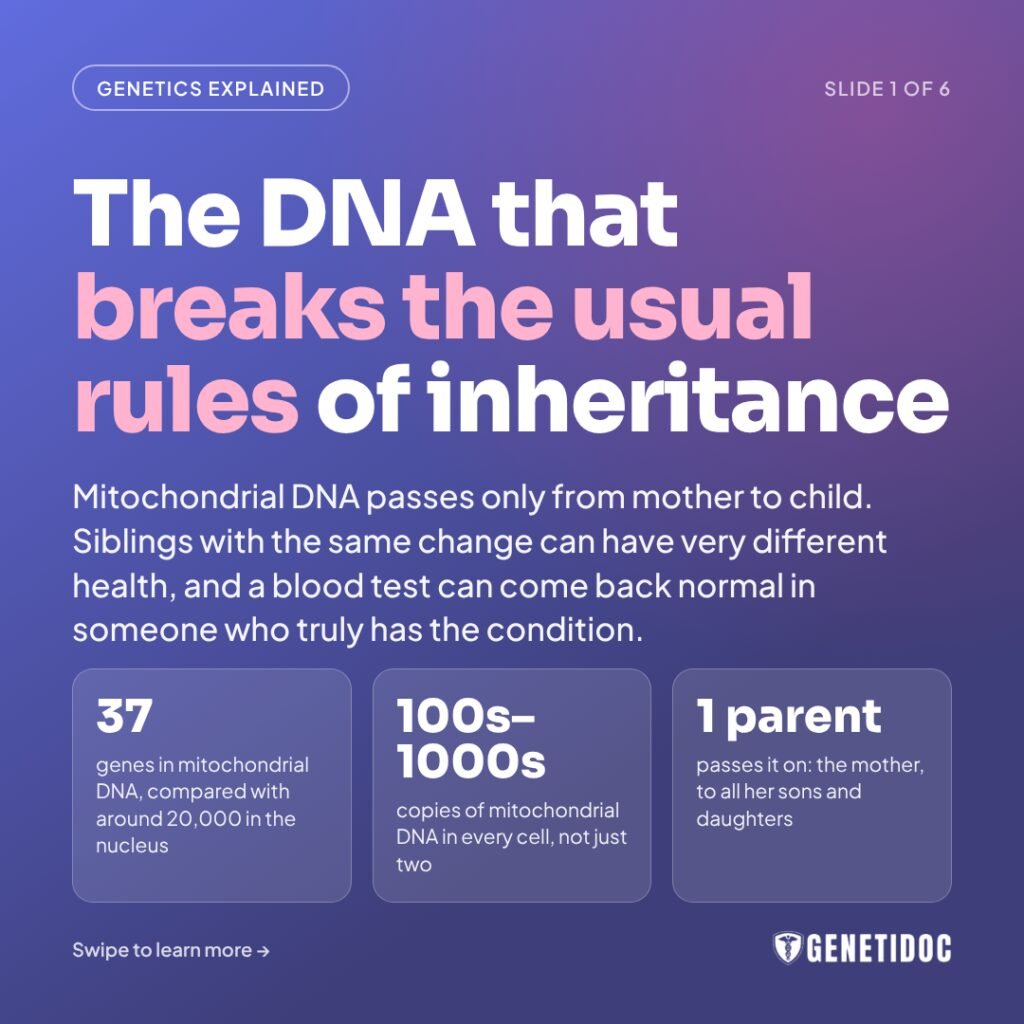
Most families learn the basic rules of inheritance at school. You get half your genes from your mother and half from your father. A condition is either “dominant” or “recessive”. Brothers and sisters face the same odds.
Mitochondrial DNA breaks nearly all of those rules. It passes only from mother to child. Two siblings with the same genetic change can have very different health. A mother with almost no symptoms can have a severely affected child. And a blood test can sometimes come back normal in a person who genuinely has the condition.
This guide explains how mitochondrial inheritance works, why it is so unpredictable, how it is tested, and what it means for you, your children and your wider family.
Quick answer
Mitochondrial inheritance is the pattern by which mitochondrial DNA (mtDNA) passes from parent to child. Because mtDNA comes almost entirely from the egg, it is inherited only from the mother. A mother passes her mtDNA to all her children, sons and daughters alike, but only daughters pass it on to the next generation. How severely each child is affected depends on what share of their mtDNA carries the change, which can differ greatly between siblings.
What Are Mitochondria, and Why Do They Have Their Own DNA?
Mitochondria are tiny structures inside almost every cell. Their main job is to turn food and oxygen into energy the cell can use. Organs that need the most energy, such as the brain, muscles, heart, eyes, ears, liver and kidneys, depend on them the most.
Mitochondria are unusual because they carry a small DNA of their own, separate from the main DNA in the cell’s nucleus. This mitochondrial DNA is a small circle with just 37 genes. In comparison, the DNA in the nucleus (called nuclear DNA) holds around 20,000 genes.
Two more features make mtDNA different:
- Many copies per cell. Each cell holds hundreds to thousands of copies of mtDNA, not just two.
- Shared responsibility. Mitochondria need over a thousand proteins to work, but mtDNA makes only 13 of them. The rest are made from instructions in nuclear DNA. This matters a great deal for inheritance, as you will see below.
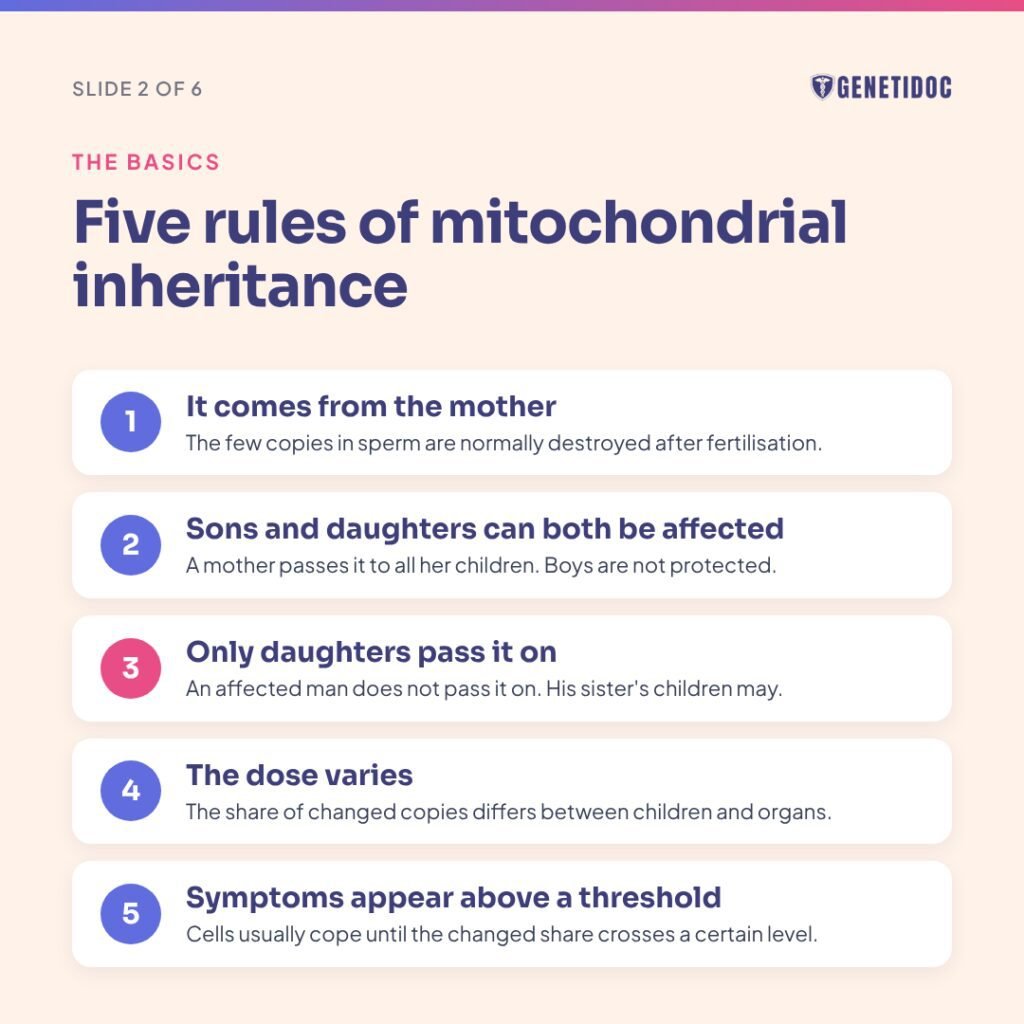
The Five Rules of Mitochondrial Inheritance
- It comes from the mother. The egg carries hundreds of thousands of copies of mtDNA. The few copies in sperm are normally destroyed soon after fertilisation. So a child’s mtDNA comes from the mother.
- Both sons and daughters can be affected. A mother passes her mtDNA to all her children. Boys are not protected.
- Only daughters pass it on. An affected or carrier man does not pass his mtDNA to his children. His sister’s children, however, may inherit it.
- The dose varies. A person can carry a mix of changed and normal mtDNA. The share of changed copies can differ from one child to another, and from one organ to another.
- Symptoms appear above a threshold. Cells usually cope until the share of changed mtDNA crosses a certain level. That level differs by genetic change and by organ.
Researchers have occasionally reported mtDNA passed down from a father. These reports remain debated, and some have since been explained by fragments of mtDNA stored in nuclear DNA. For practical genetic counseling, fathers are not considered to pass on mtDNA disease.
Heteroplasmy: The Key to Understanding Mitochondrial Disease
Because each cell has so many copies of mtDNA, a person does not simply “have” or “not have” a change. They can carry it in some copies and not others.
- Homoplasmy means all copies of mtDNA are the same. Either every copy carries the change, or none does.
- Heteroplasmy means a mixture of changed and normal copies in the same person. Laboratories report this as a percentage, called the heteroplasmy level or mutant load.
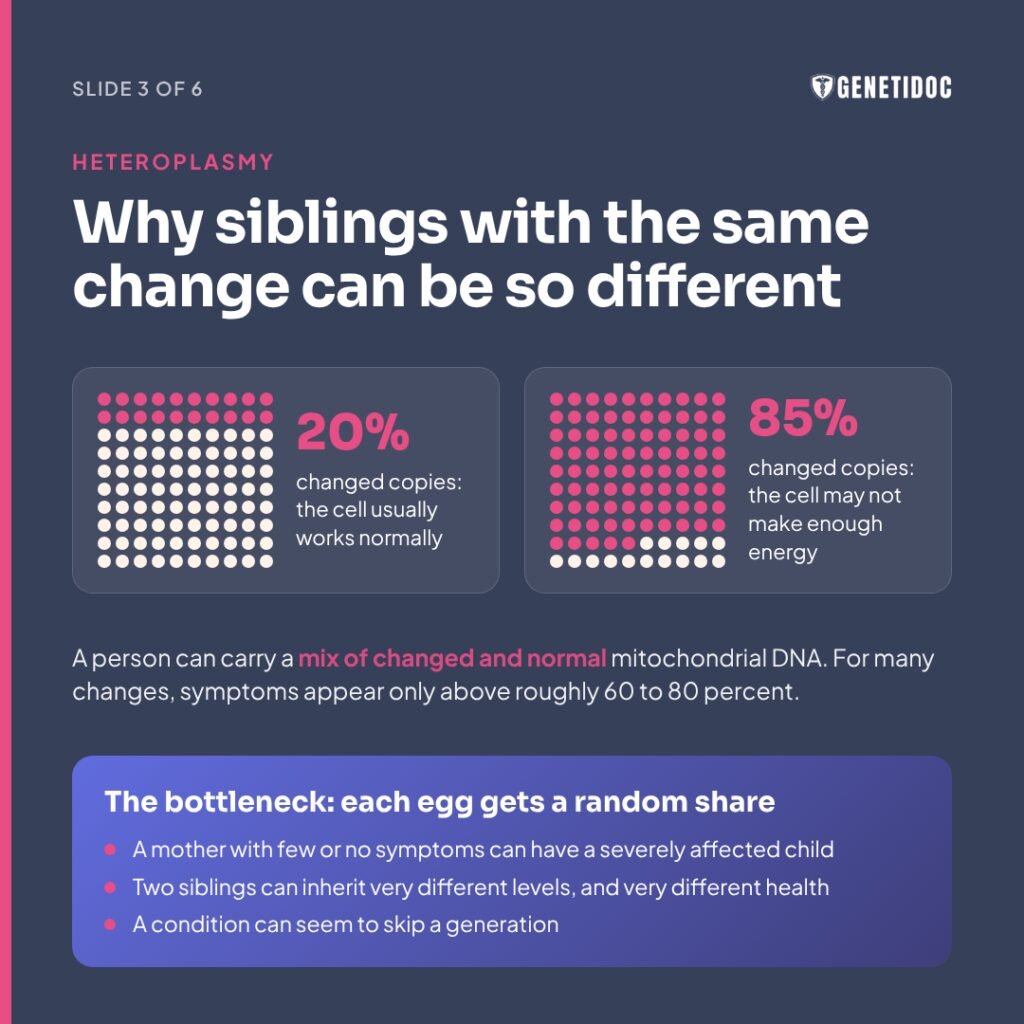
Think of it like a jar of beads. If 20 out of every 100 beads are red, the jar still looks mostly white. If 85 out of 100 are red, it looks red. In the same way, a cell with a small share of changed mtDNA usually works normally, while a cell with a high share may not produce enough energy.
For many mtDNA changes, symptoms appear only once the level rises above roughly 60 to 80 percent. The exact level differs for each change and each organ. High-energy organs such as the brain and heart are usually affected first.
The “bottleneck”: why siblings can be so different
While a woman’s eggs are forming, only a small number of mtDNA copies are carried forward into each egg. This is called the mitochondrial bottleneck. Because of this random sampling, the share of changed mtDNA can differ greatly from one egg to the next.
This explains some of the most confusing patterns families see:
- A mother with a low level and few or no symptoms can have a child with a high level and serious illness.
- Two siblings can inherit very different levels and have very different health.
- A condition can seem to “skip” a generation, or appear for the first time in a family.
The size of the bottleneck also differs between genetic changes. This is why some mtDNA changes behave more predictably in families than others.
Illustrative example
A woman in her thirties has mild hearing loss and was diagnosed with diabetes at 32. She has always assumed both were “just bad luck”. Her 9-year-old son then develops seizures, muscle weakness and stroke-like episodes. Testing shows a heteroplasmic mtDNA change in both of them, at a much higher level in her son. Because of the bottleneck, the same change produced very different illness in mother and child. Her daughter, who has no symptoms, is offered counseling before any decision on testing.
Not All Mitochondrial Disease Comes From the Mother
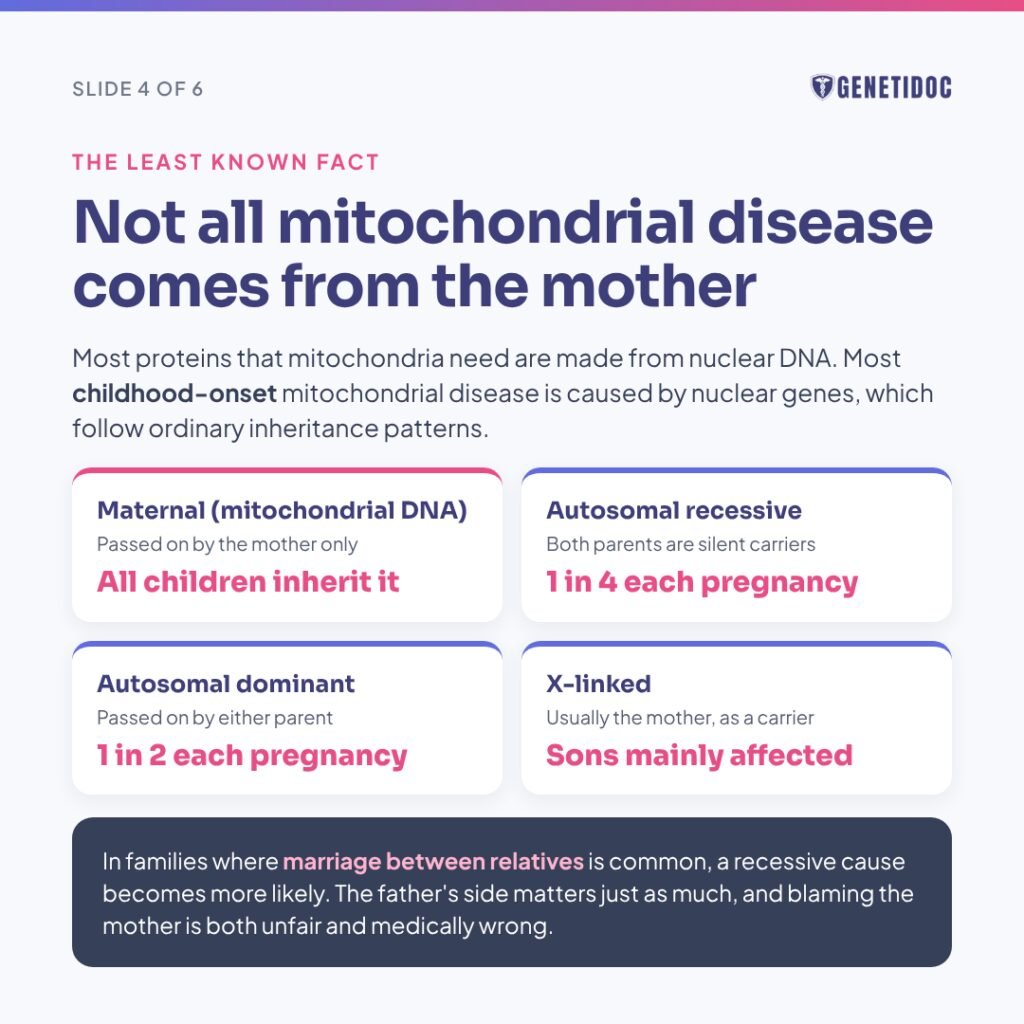
This is the most important and least known fact about mitochondrial disease. Most of the proteins mitochondria need are made from nuclear DNA. Changes in hundreds of nuclear genes can cause mitochondrial disease, and these follow ordinary inheritance patterns, not the maternal pattern.
In general, most childhood-onset mitochondrial disease is caused by nuclear genes. In adults, mtDNA changes account for a larger share of cases.
| Inheritance pattern | Who passes it on | Typical risk to children | Examples |
| Maternal (mtDNA) | Mother only | All children inherit the change. Severity is hard to predict when heteroplasmic. | Leber hereditary optic neuropathy, MELAS, maternally inherited diabetes and deafness |
| Autosomal recessive (nuclear) | Both parents are silent carriers | 1 in 4 in each pregnancy | POLG-related disease, SURF1-related Leigh syndrome |
| Autosomal dominant (nuclear) | Either parent | 1 in 2 in each pregnancy | OPA1-related optic atrophy, some forms of progressive external ophthalmoplegia |
| X-linked (nuclear) | Usually the mother, as a carrier | Sons mainly affected | PDHA1-related pyruvate dehydrogenase deficiency |
| Sporadic (new) | Usually no one | Usually low | Single large mtDNA deletions, such as Kearns-Sayre syndrome |
This has real consequences in India, where marriage between relatives (consanguineous marriage) is common in some communities. In these families, a recessive nuclear cause becomes more likely. Blaming the mother’s side is then both unfair and medically wrong. The father’s side matters just as much.
Single large deletions of mtDNA are another exception. They usually arise new in the affected person and are rarely passed on. For an affected woman, the chance of having an affected child has been estimated at around 1 in 24.
Common Conditions Caused by Mitochondrial DNA Changes
Leber hereditary optic neuropathy (LHON)
LHON causes sudden, painless loss of central vision, often in one eye and then the other within weeks or months. It most often affects young men in their teens or twenties. In European populations, three well-known mtDNA changes cause around 90 to 95 percent of cases, and these are usually present in every copy (homoplasmic).
Indian patients are different. Studies from southern India have found these three changes in a much smaller share of families with LHON. So when the standard three-change test is negative, sequencing the whole mitochondrial genome is often the better next step, rather than ruling out LHON.
Not everyone who carries the change loses vision. Roughly half of male carriers and about 1 in 10 female carriers are affected. Smoking and heavy alcohol use are known to increase the risk of vision loss in carriers. A large neuro-ophthalmology centre in southern India has reported a high number of LHON cases, suggesting the condition is under-recognised in the region.
MELAS and maternally inherited diabetes and deafness
MELAS stands for mitochondrial encephalomyopathy, lactic acidosis and stroke-like episodes. It typically begins in childhood or early adulthood with seizures, headaches, vomiting, muscle weakness and episodes that look like strokes. The most common cause is a change known as m.3243A>G.
The same change at a lower level can cause a milder picture: diabetes and hearing loss in adults, often running down the mother’s line. This is called maternally inherited diabetes and deafness. Many such adults are first labelled as having ordinary type 1 or type 2 diabetes.
Leigh syndrome
Leigh syndrome is a severe brain disorder that usually begins in infancy, often with loss of milestones after an illness. It can be caused by mtDNA changes (such as in the MT-ATP6 gene) or by many nuclear genes. Because both routes are possible, identifying the exact cause is essential for counseling the family.
Hearing loss after certain antibiotics
A change in the MT-RNR1 gene makes some people highly sensitive to a group of antibiotics called aminoglycosides, such as gentamicin, amikacin and streptomycin. Even a single course can cause permanent hearing loss. Carriers usually have no other symptoms, so many families only discover the change after it is too late.
This is particularly relevant in India, where these antibiotics are widely used for newborn infections and in some tuberculosis treatment. International pharmacogenomic guidance from the Clinical Pharmacogenetics Implementation Consortium (CPIC) advises avoiding aminoglycosides in known carriers, unless the infection is severe and no safe alternative exists. Because the change is maternally inherited, a carrier’s mother, brothers, sisters and her sisters’ children may all carry it too.
Other mtDNA conditions
- Myoclonic epilepsy with ragged red fibres (MERRF): muscle jerks, seizures, unsteady walking and weakness.
- Neuropathy, ataxia and retinitis pigmentosa (NARP): numbness, poor balance and night-vision loss.
- Chronic progressive external ophthalmoplegia and Kearns-Sayre syndrome: drooping eyelids and weakness of the eye muscles, sometimes with heart rhythm problems.
- Pearson syndrome: bone marrow and pancreas problems in infancy.
Signs That Should Make Doctors Think of Mitochondrial Disease
Mitochondrial disease is often called “the great mimicker” because it can affect any organ at any age. Individually, these features are common. Together, or when they run down the mother’s line, they deserve a closer look:
- Problems in several unrelated organs, such as the brain, muscles, eyes, ears, heart and hormones, without one clear explanation.
- Diabetes with hearing loss, especially if relatives on the mother’s side have the same.
- Sudden vision loss in a young adult, particularly a young man.
- Stroke-like episodes in a child or young adult with no usual stroke risk factors.
- A child who loses developmental milestones, often after a fever or infection.
- Drooping eyelids and limited eye movements.
- Unusual tiredness and muscle weakness after mild exercise.
- Raised lactate (a by-product of energy production) in the blood or spinal fluid, or typical changes on an MRI scan.
- Hearing loss after a course of aminoglycoside antibiotics in the person or a maternal relative.
How Is Mitochondrial Disease Tested?
Diagnosis has changed a great deal over the past decade. Muscle biopsy used to be one of the first steps. Today, genetic testing usually comes first, and a biopsy is kept for cases where genetic results are unclear.
The main test options
| Test | What it looks at | When it is used |
| Targeted variant testing | One or a few known mtDNA changes | Classic features of one condition, or testing relatives once the family change is known |
| Whole mitochondrial genome sequencing | All 37 mtDNA genes, with heteroplasmy levels | A suspected mtDNA condition, especially with a maternal family pattern |
| Nuclear gene panel or whole exome sequencing | Nuclear genes linked to mitochondrial function | Childhood onset, consanguinity, or no maternal pattern |
| Combined nuclear and mitochondrial testing | Both genomes together | Unclear features, where either route is possible |
| Muscle biopsy | Muscle structure, energy enzyme activity and muscle mtDNA | When genetic tests on easier samples are negative but suspicion remains high |
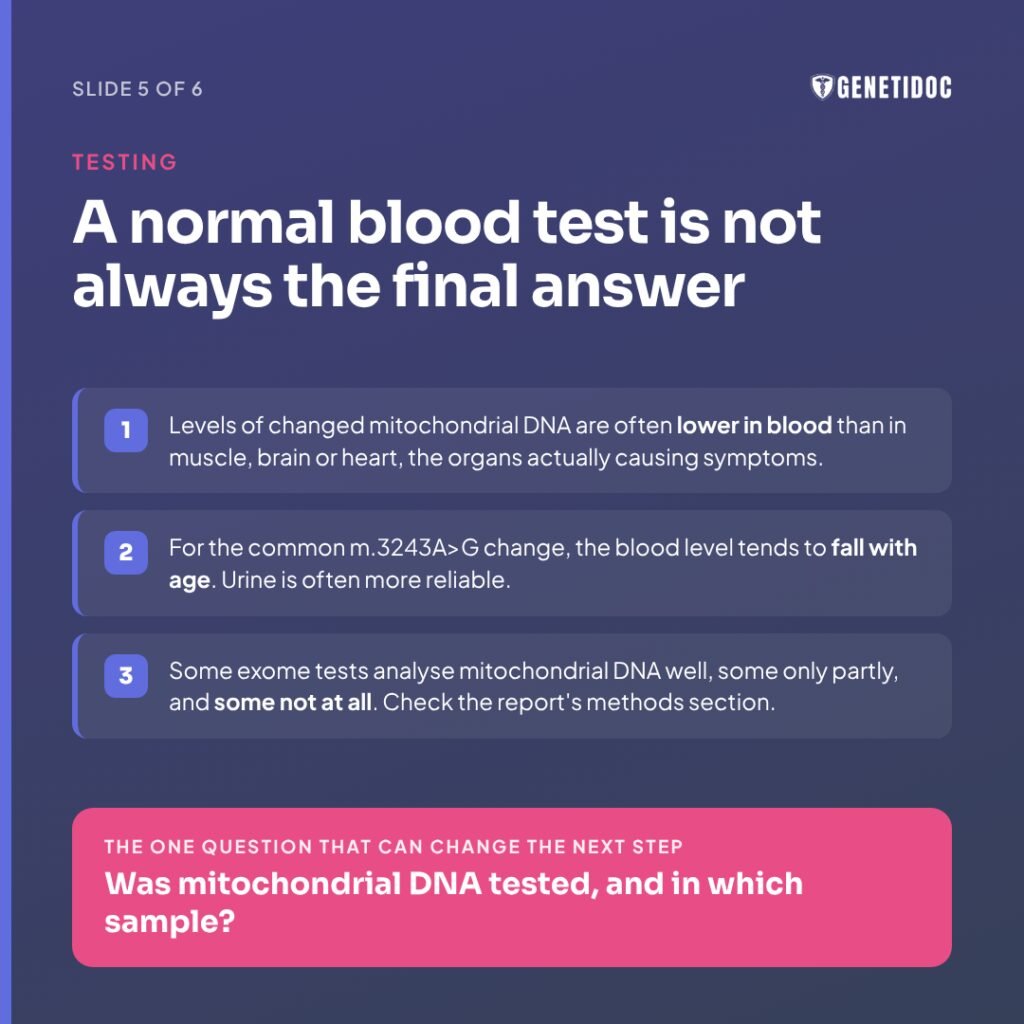
Why the sample matters: a normal blood test may not be the final answer
Heteroplasmy levels can differ greatly from one tissue to another. Blood often has a lower level of changed mtDNA than muscle, brain or heart. For the common MELAS change, the level in blood also tends to fall with age, as blood cells with the change are gradually replaced.
So a person can have a low or undetectable level in blood but a high level in the organs that are actually causing symptoms. For this reason, doctors may ask for a different sample, such as urine, a cheek swab or, occasionally, a muscle biopsy. Urine is often more reliable than blood for the MELAS change.
“A normal report means no reportable finding in the sample and the test that was used. It is not a guarantee,” says Team Genetidoc. “With mitochondrial disease, we ask not only which test was done, but which tissue was tested and whether the test covered mitochondrial DNA at all.”
Does your earlier exome test cover mitochondrial DNA?
Not always. Some exome and genome tests analyse mtDNA well, some only partly, and some do not report it at all. If you have had a previous negative exome test and mitochondrial disease is still suspected, check the report’s methods section or ask your genetic counselor. Your raw data may be reanalysed, or a dedicated mitochondrial genome test may be needed.
How long does testing take, and what does it cost?
Targeted tests are usually faster than broad sequencing. Larger panels and exome tests take longer, especially when the results need careful interpretation. Costs vary with the type and breadth of testing, so the right starting test is best chosen during a consultation, based on symptoms and family history.
How a Diagnosis Changes Care
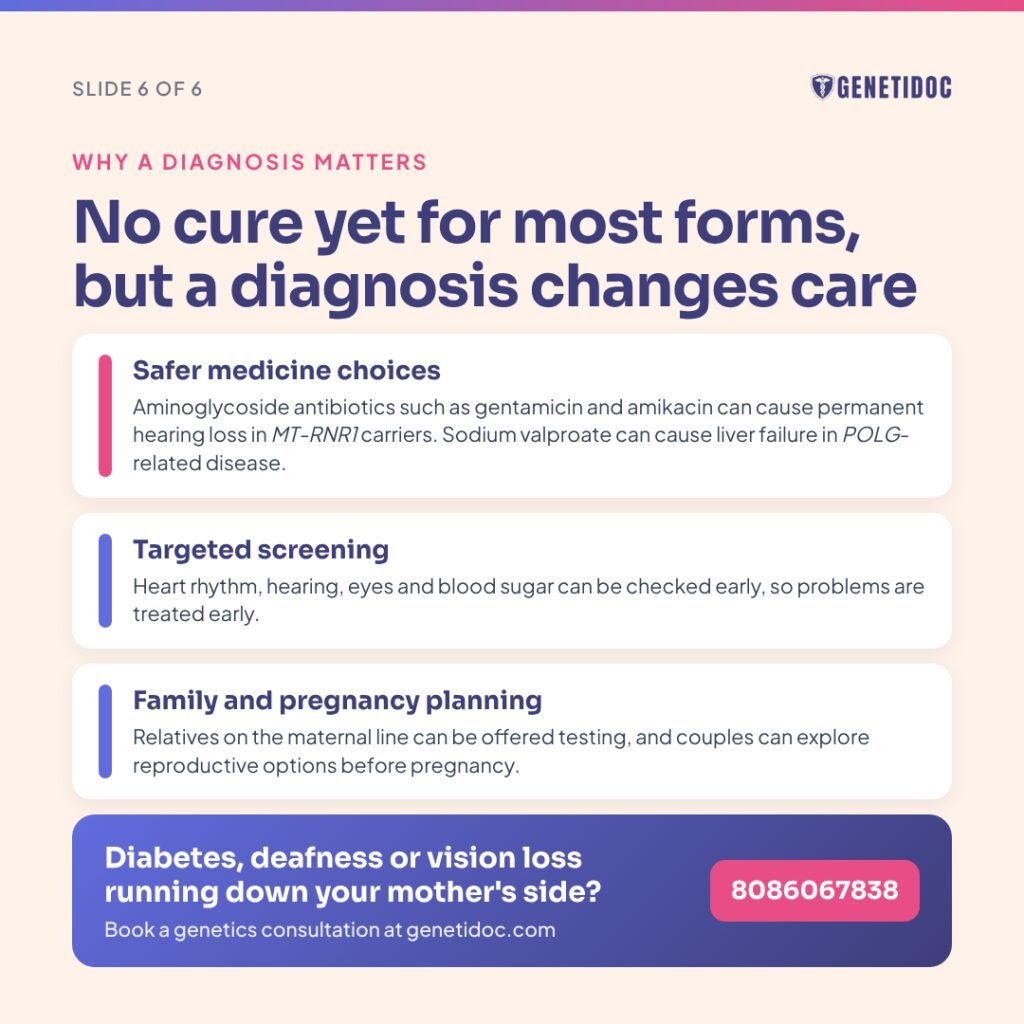
There is no cure yet for most mitochondrial diseases. But a precise genetic diagnosis still changes a great deal:
- It prevents harm from medicines. Sodium valproate, a common seizure medicine, can cause serious liver failure in people with POLG-related disease. Aminoglycoside antibiotics can cause deafness in MT-RNR1 Knowing the diagnosis allows doctors to choose safer options.
- It guides screening. Depending on the condition, this may include regular heart rhythm checks, hearing and eye tests, blood sugar monitoring and kidney or liver tests. Problems found early can be treated early.
- It shapes acute care. Illness, fever, fasting and surgery can trigger worsening. Families can carry an emergency plan, and anaesthetists can plan ahead.
- It opens specific treatments. Idebenone is approved in Europe for LHON. Arginine is used by many specialists during MELAS stroke-like episodes. Some rare nuclear forms respond to specific vitamins.
- It sets realistic expectations about supplements. Combinations such as coenzyme Q10, riboflavin and carnitine are widely used, but evidence for them is limited. They should support, not replace, proper medical care.
- It ends the search. Many families have seen several specialists over years. A clear diagnosis brings answers and access to clinical trials.
The Mitochondrial Medicine Society has published consensus standards for diagnosing and caring for people with primary mitochondrial disease. Care usually involves a team that may include a neurologist, cardiologist, ophthalmologist, audiologist, endocrinologist and clinical geneticist.
What Mitochondrial Inheritance Means for Your Family
If a mother carries an mtDNA change
All her children will inherit some of the changed mtDNA. If she is homoplasmic, they will usually inherit it at the same level. If she is heteroplasmic, the level each child receives cannot be predicted exactly. Her own blood level gives only a rough guide.
If a father carries an mtDNA change
He will not pass it to his children. This is often an enormous relief for men diagnosed with LHON or another mtDNA condition. His brothers and sisters, his mother, and his sisters’ children, however, may carry it.
If the cause is in a nuclear gene
The usual rules apply. For a recessive condition, both parents are usually carriers, and each pregnancy has a 1 in 4 chance of being affected. Both parents should be tested for the child’s specific genetic change.
Testing relatives
Once the family change is known, targeted testing can be offered to at-risk relatives. For maternal-line conditions, this means the mother’s side. Testing healthy children for a condition that begins in adulthood is usually delayed until they can decide for themselves, unless the result would change their care in childhood. An example is MT-RNR1, where knowing could prevent hearing loss.
“Mothers often carry a silent guilt that they ‘gave’ this to their child,” says Team Genetidoc. “No one chooses which mitochondria go into an egg, and no one could have prevented it. Part of counseling is making sure the whole family, including the in-laws, hears that clearly.”
Planning a Pregnancy When You Carry an mtDNA Change
Reproductive options depend on whether the change is nuclear or mitochondrial, and on the mother’s heteroplasmy level.
For nuclear-gene causes
Options are similar to other inherited conditions: prenatal diagnosis for the known family change, or preimplantation genetic testing (PGT) during IVF to select unaffected embryos.
For mtDNA changes
- Preimplantation genetic testing. During IVF, embryos are tested and those with a low level of changed mtDNA are chosen. This works best for women with low-to-moderate heteroplasmy. It reduces risk, but cannot always remove it.
- Prenatal testing. Testing in pregnancy is possible, but interpreting a heteroplasmy level in a fetus is complex. It is a decision that needs detailed counseling beforehand.
- Donor eggs. Using an egg from an unaffected donor avoids passing on the mother’s mtDNA.
- Adoption is another path some families choose.
- Mitochondrial donation. In this IVF technique, the nucleus from the parents’ fertilised egg is moved into a donor egg with healthy mitochondria. In 2025, a UK team reported eight babies born this way, with the level of changed mtDNA greatly reduced in all of them. It remains a risk-reduction treatment, licensed in very few countries, and is not part of routine practice in India.
These are personal decisions. A genetic counselor’s role is to explain every option clearly, including its limits, so the couple can choose what is right for them.
Common Misconceptions About Mitochondrial Inheritance
- “Boys can’t get it because it comes from the mother.” Mothers pass mtDNA to sons and daughters alike. Sons simply do not pass it on.
- “All mitochondrial disease comes from the mother.” Many cases, especially in children, come from nuclear genes inherited from both parents.
- “My blood test was normal, so I don’t have it.” Not necessarily. Heteroplasmy can be low in blood and high in muscle or other tissues.
- “If I’m mildly affected, my children will be too.” Not necessarily. Because of the bottleneck, a child can have a higher or lower level than the mother.
- “Supplements can cure it.” No current supplement cures mitochondrial disease. Some may help certain people, but evidence is limited.
- “The mother is to blame.” No one controls which mtDNA reaches an egg. Blame has no medical basis.
When Testing Is Useful, and When It May Not Be
Testing is useful when
- Symptoms affect several organs without a clear cause.
- A similar pattern runs down the mother’s line.
- A young adult has sudden, unexplained vision loss.
- A relative has a confirmed mitochondrial diagnosis.
- A woman with a known mtDNA change is planning a pregnancy.
- Hearing loss followed aminoglycoside treatment in the family.
Testing may add little when
- Symptoms such as tiredness alone, without other features, are the only concern.
- The same test on the same tissue is being repeated. A different sample is usually the better step.
- A healthy child is being tested for an adult-onset condition where the result would not change care.
Why Expert Interpretation Matters So Much
Few areas of genetics depend on interpretation as heavily as mitochondrial disease. The same report can mean very different things depending on the tissue tested, the heteroplasmy level, the specific change and the person’s own features. Common problems when results are not interpreted carefully include:
- A normal blood result accepted as final, when urine or muscle would have shown the change.
- An exome test assumed to have covered mtDNA when it did not.
- A recessive nuclear cause missed because everyone assumed it came from the mother.
- Harmless mtDNA variations, which are common and often linked to a person’s ancestry, mistaken for disease-causing changes.
- Families given a single risk figure for their next child, when heteroplasmy makes the risk far less predictable.
Choosing the right test, the right sample and an experienced laboratory matters. So does a clinical geneticist and genetic counselor who connect the result to the person and the family. At Genetidoc, every consultation includes genetic counseling. Families receive an individualised written summary, prepared by the genetic counselor and checked by the clinical geneticist, that they can share with their doctors and relatives.
What to Do Next
- Draw your family tree. Note who on the mother’s side and the father’s side has had diabetes, deafness, vision loss, seizures, muscle weakness or early deaths.
- Collect previous reports. Include MRI scans, lactate results, biopsy reports and any genetic tests.
- Ask whether mtDNA was tested, and in which sample. This one question can change the next step.
- Tell every doctor about the diagnosis. This is especially important before antibiotics, seizure medicines or surgery.
- Keep your report and raw data. Genetic knowledge improves over time, and data can be reanalysed.
- See a genetic counselor before planning a pregnancy. Options are broader and less stressful when explored early.
You can also read questions from other families on the Genetidoc Rare Disease Forum.
Frequently Asked Questions
What is mitochondrial inheritance?
It is the way mitochondrial DNA passes from mother to child. Mothers pass their mtDNA to all their children, but only daughters pass it to the next generation.
Can a father pass on mitochondrial disease?
Not through mitochondrial DNA. However, if the disease is caused by a nuclear gene, a father can pass it on just like any other inherited condition.
Can boys inherit mitochondrial disease?
Yes. Mothers pass mtDNA to sons and daughters equally. Some conditions, such as LHON, actually affect men more often.
What is heteroplasmy?
It is a mix of changed and normal mitochondrial DNA in the same person. A higher share of changed copies generally causes more severe symptoms.
Why do siblings with the same mitochondrial change have different symptoms?
Each egg receives a random share of the mother’s changed mtDNA, a process called the bottleneck. Siblings can therefore inherit very different levels.
Can a blood test miss mitochondrial disease?
Yes. Levels of changed mtDNA are often lower in blood than in muscle or urine. A different sample may be needed if suspicion remains.
Is all mitochondrial disease inherited from the mother?
No. Many cases, especially in children, are caused by nuclear genes and follow recessive, dominant or X-linked patterns.
Can I have a healthy baby if I carry a mitochondrial DNA change?
Often, yes. Options include preimplantation genetic testing, donor eggs and, in a few countries, mitochondrial donation. A genetic counselor can explain which suit you.
What is a “three-parent baby”?
It is a popular name for mitochondrial donation. The baby’s nuclear DNA comes from both parents, and only the mitochondria come from a donor egg.
Is mitochondrial disease curable?
Most forms have no cure yet. A diagnosis still allows safer medicine choices, regular screening, specific treatments for some conditions and access to clinical trials.
Which antibiotics should mitochondrial DNA carriers avoid?
People with certain MT-RNR1 changes should avoid aminoglycosides, such as gentamicin and amikacin, unless no safe alternative exists, because of the risk of permanent hearing loss.
Does a normal exome test rule out mitochondrial disease?
No. Not all exome tests analyse mitochondrial DNA fully. Check the report or ask a genetic counselor whether mtDNA was covered.
Key Takeaways
- Mitochondrial DNA is inherited from the mother. Sons and daughters can both be affected, but only daughters pass it on.
- Heteroplasmy and the bottleneck explain why severity varies so much within one family.
- Many mitochondrial diseases are caused by nuclear genes and follow ordinary inheritance patterns.
- A normal blood test does not always rule out mitochondrial disease. The sample matters.
- A diagnosis changes care, especially medicine safety, organ screening and pregnancy planning.
- Expert interpretation and genetic counseling turn a complex result into a clear family plan.
Seeing a pattern of diabetes, deafness, vision loss or unexplained illness running down your mother’s side?
Our clinical geneticists can review your family history and earlier reports, check whether mitochondrial DNA was properly tested, and plan the right next step for you and your relatives. Consultations are available online across India.
Book a mitochondrial inheritance consultation with a Genetidoc clinical geneticist/.
References
- Chinnery PF. Primary Mitochondrial Disorders Overview. In: GeneReviews. University of Washington, Seattle.
- Yu-Wai-Man P, Chinnery PF. Leber Hereditary Optic Neuropathy. In: GeneReviews. University of Washington, Seattle.
- El-Hattab AW, Almannai M, Scaglia F. MELAS. In: GeneReviews. University of Washington, Seattle.
- Goldstein A, Falk MJ. Mitochondrial DNA Deletion Syndromes. In: GeneReviews. University of Washington, Seattle.
- Parikh S, Goldstein A, Koenig MK, et al. Diagnosis and management of mitochondrial disease: a consensus statement from the Mitochondrial Medicine Society. Genetics in Medicine. 2015;17(9):689–701.
- Parikh S, Goldstein A, Karaa A, et al. Patient care standards for primary mitochondrial disease: a consensus statement from the Mitochondrial Medicine Society. Genetics in Medicine. 2017;19(12).
- McDermott JH, Wolf J, Hoshitsuki K, et al. Clinical Pharmacogenetics Implementation Consortium guideline for the use of aminoglycosides based on MT-RNR1 Clinical Pharmacology & Therapeutics. 2022;111(2):366–372.
- Gorman GS, Schaefer AM, Ng Y, et al. Prevalence of nuclear and mitochondrial DNA mutations related to adult mitochondrial disease. Annals of Neurology. 2015;77(5):753–759.
- Wilson IJ, et al. Mitochondrial DNA sequence characteristics modulate the size of the genetic bottleneck. Human Molecular Genetics. 2016;25(5):1031–1041.
- Wallace DC, Chalkia D. Mitochondrial DNA genetics and the heteroplasmy conundrum in evolution and disease. Cold Spring Harbor Perspectives in Biology. 2013;5(11):a021220.
- Hyslop LA, et al. Mitochondrial donation and preimplantation genetic testing for mtDNA disease. New England Journal of Medicine. 2025. doi:10.1056/NEJMoa2415539
- Gowri P, Mahesh Kumar S, Vanniarajan A, Bharanidharan D, Sundaresan P. A hospital-based five-year prospective study on the prevalence of Leber’s hereditary optic neuropathy with genetic confirmation. Molecular Vision. 2020;26:789. PMID: 33380779
- Srilekha S, et al. Whole mitochondrial genome sequencing in individuals with Leber hereditary optic neuropathy negative for the common pathogenic mitochondrial DNA variants. Frontiers in Neurology. 2025. doi:10.3389/fneur.2025.1584748
Related Reading on Genetidoc
- Congenital Insensitivity to Pain: When a Child Cannot Feel Pain
- Nutrigenomics: How Your Genes Shape Your Response to Diet
- Parkinson’s Disease: When Genetics Plays a Role
- Single Gene vs Panel Testing Explained
- Facial Features and Genetic Syndromes: A Guide for Parents
- Personalized Medicine: The Role of Genetic Testing in Your Care