
Identical twins are the classic example of “same DNA”. They often look so alike that teachers and even grandparents mix them up. So it surprises many parents when one twin develops a health condition and the other does not, or when a genetic test gives two different answers for two “identical” children.
The explanation is simple once you see how twins form. Identical twins do begin with the same genetic blueprint. But from the moment that first cell starts dividing, small changes can creep in. Some happen before the embryo splits into two. Some happen after. Others build up slowly over a lifetime.
Most of these differences are tiny and harmless. A few can matter a great deal, especially when a family is making decisions about genetic testing. This guide explains how identical twins can differ genetically, why one twin can be affected when the other is not, and what this means for testing your own children or a twin pregnancy.
Quick answer
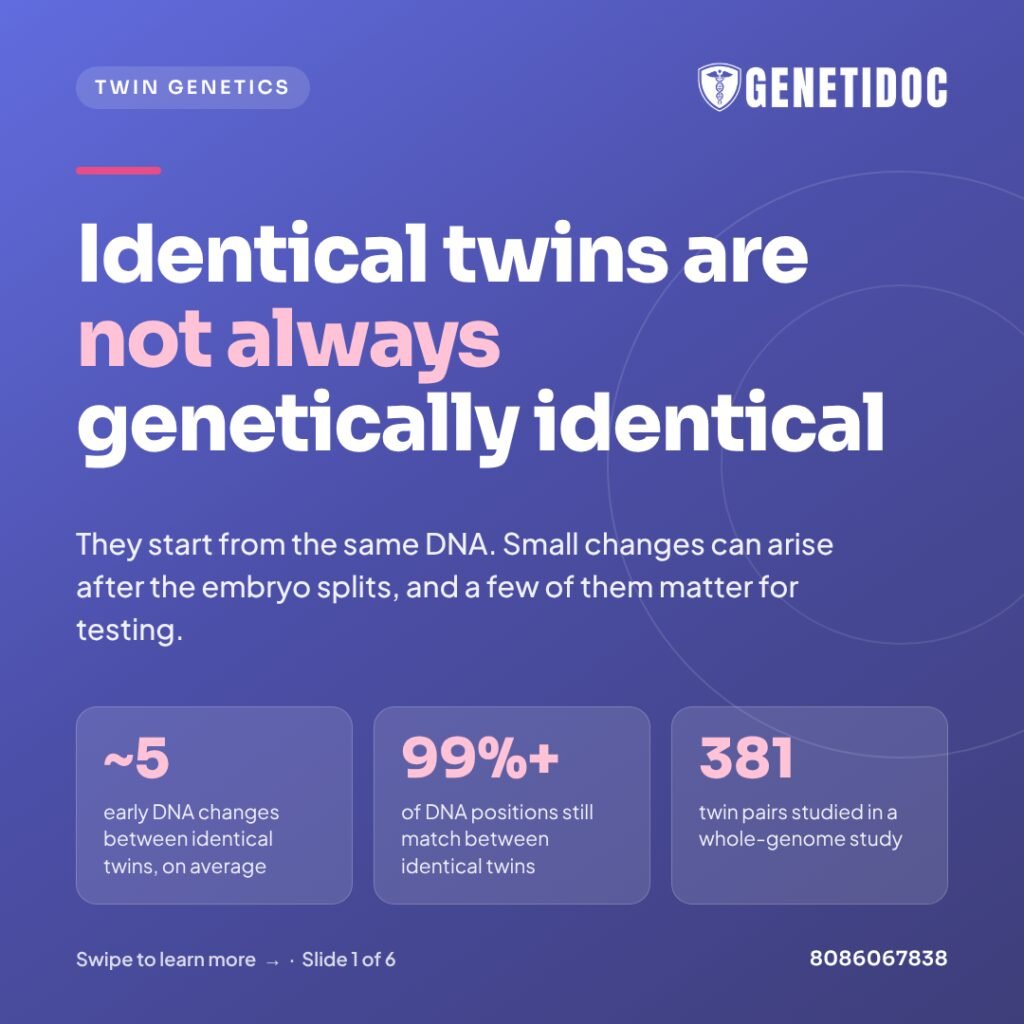
Identical twins come from one fertilised egg, so they start with the same DNA. They are nearly identical, not perfectly identical. After the embryo divides, new DNA changes can occur in one twin and not the other. Differences in how genes are switched on or off, in which X chromosome is active, and changes that build up with age can also make twins differ. A whole-genome study of 381 identical twin pairs found they differ by an average of about five early developmental DNA changes.
How Identical Twins Form
Identical twins, which doctors call monozygotic twins, begin when one egg is fertilised by one sperm. This creates a single cell called a zygote. In the first days of life, that early embryo splits into two. Each half grows into a separate baby.
Fraternal twins, called dizygotic twins, are different. They come from two separate eggs fertilised by two separate sperm. Genetically, they are no more alike than any brother and sister born at different times.
Identical twins make up roughly one in three twin births. Their rate is fairly similar worldwide, at around 3 to 4 per 1,000 births. Fraternal twinning varies much more. It is influenced by family history, the mother’s age and fertility treatment, including IVF, which is becoming more common in India.
| Feature | Identical (monozygotic) twins | Fraternal (dizygotic) twins |
| Origin | One egg, one sperm, then the embryo splits | Two eggs, two sperm |
| Starting DNA | The same at conception | About half shared, like any siblings |
| Sex | Almost always the same | Same or different |
| Placenta | Shared in about two-thirds; separate in the rest | Almost always separate |
| Later genetic differences | Small, but possible | Many, from the start |
Why the timing of the split matters
When the embryo splits decides whether identical twins share a placenta. If it splits in the first three days, each twin usually has its own placenta and its own sac. If it splits a little later, which is more common, the twins share one placenta, an arrangement called monochorionic. A very late split means they share both a placenta and a sac.
This matters for more than pregnancy care. Twins who share a placenta also share blood vessels. As you will see below, this can affect what a genetic blood test shows.
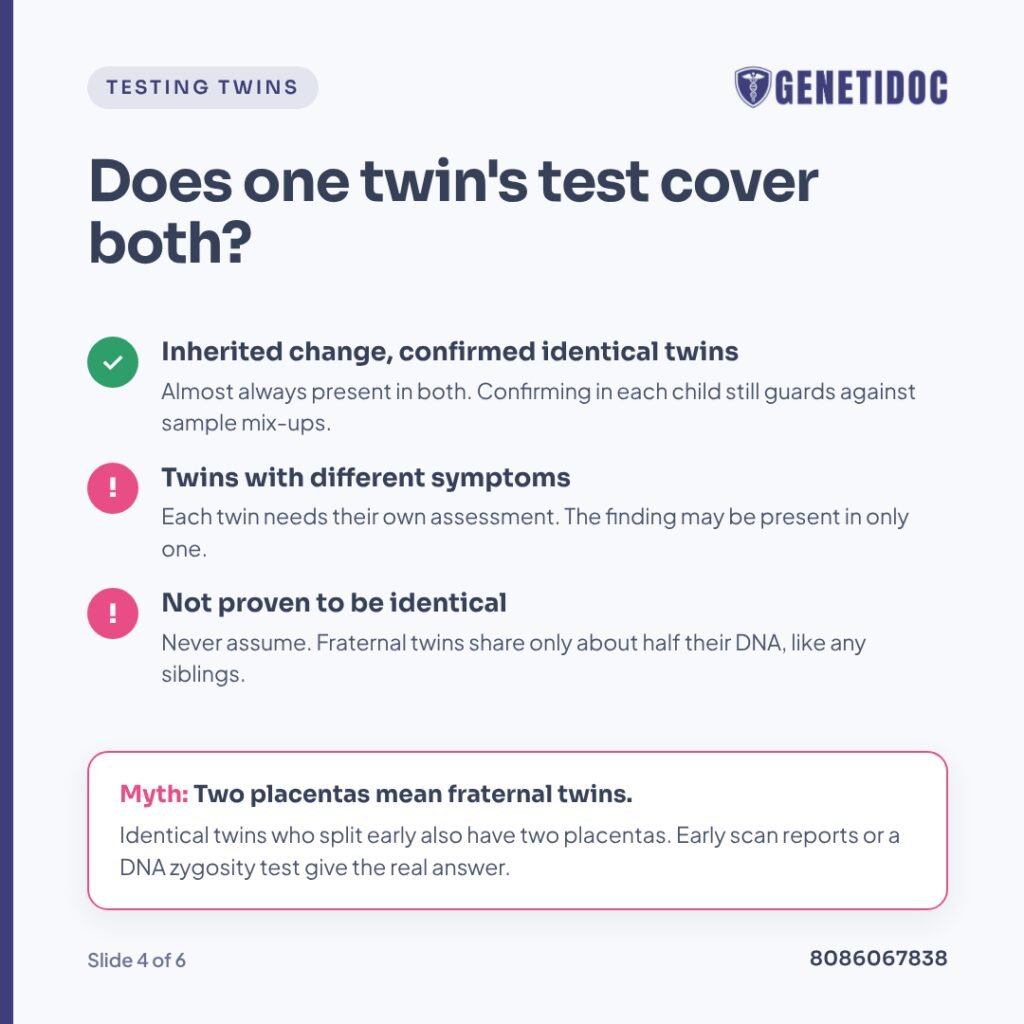
One common misunderstanding is worth clearing up here. Two separate placentas do not prove twins are fraternal. Identical twins who split early also have two placentas. The only reliable ways to know are early pregnancy scans showing a shared placenta, or a DNA test that compares the twins directly, called zygosity testing.
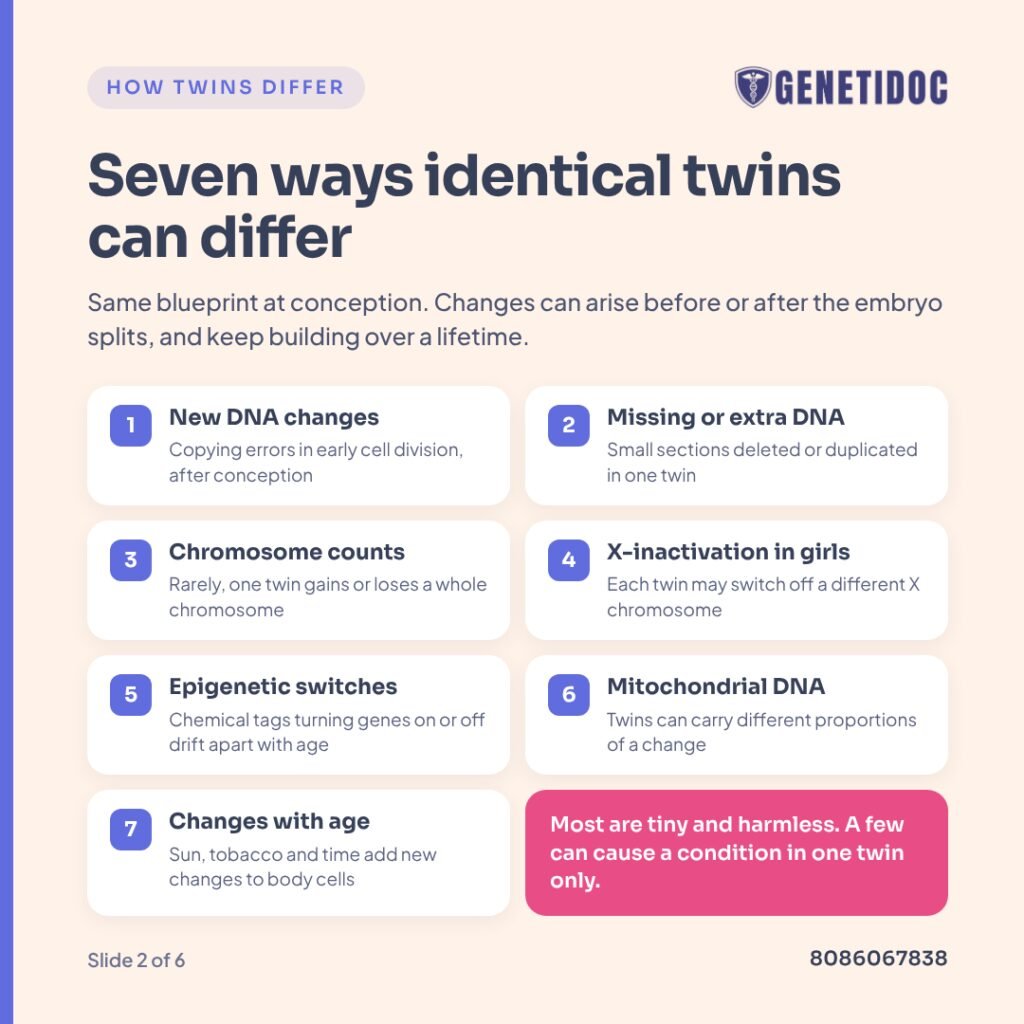
Seven Ways Identical Twins Can Differ Genetically
- New DNA changes after conception. Each time a cell divides, it copies about six billion letters of DNA. Occasionally a letter is copied wrongly. If this happens in the early embryo, only the cells that descend from that cell carry the change. These are called postzygotic mutations, meaning changes that arise after the zygote forms.
- Missing or extra pieces of DNA. Small sections of a chromosome can be lost or duplicated in one twin. These are called copy number variations.
- Different chromosome counts. Rarely, an error in early cell division gives one twin an extra or missing chromosome.
- Different X-inactivation in girls. Female twins switch off one of their two X chromosomes in each cell, and the pattern can differ between twins.
- Epigenetic differences. Chemical tags that switch genes on or off can differ from birth and drift further apart with age.
- Mitochondrial DNA differences. The small separate set of DNA in the cell’s energy factories can be present in different proportions.
- Changes that build up over a lifetime. Body cells pick up new changes with age, sun exposure, smoking and other factors, and these differ between twins.
Each of these is explained below.
1. New DNA changes in early development
The largest study of this question sequenced the whole genomes of 381 identical twin pairs in Iceland, along with their parents, partners and children. Identical twins differed by an average of 5.2 early developmental DNA changes. In about 15 percent of pairs, one twin carried a noticeably larger number of changes the other did not have.
Some of these changes were present in nearly every cell of one twin and absent from the other. In some cases, the twin passed the change on to their own children (Jonsson and colleagues, Nature Genetics, 2021).
The researchers also found that a twin can grow from just one early cell, or from several. This is part of why differences vary so much from pair to pair. A 2024 study of healthy Japanese identical twins put the overall picture simply: their genotypes matched at more than 99 percent of positions (Yamamoto and colleagues, DNA Research, 2024).
Most of these changes land in parts of the DNA that do not affect health. Very occasionally, one lands in an important gene. That can be enough to cause a genetic condition in one twin only.
2. Missing or extra pieces of DNA
Copy number variations are sections of DNA that are deleted or duplicated. A 2008 study of 19 identical twin pairs found copy number differences within pairs. They appeared both in twins who shared the same health condition and in twins where only one was affected (Bruder and colleagues, American Journal of Human Genetics, 2008).
The authors made an important point for everyday testing. A new copy number change found in one tissue, usually blood, may not reflect the rest of the body. Interpreting such a result needs care.
3. Different chromosome counts
Rarely, identical twins have different numbers of chromosomes. This happens when a chromosome is lost or gained during cell division around the time the embryo splits. Doctors call these heterokaryotypic twins.
Published reports include identical twin pairs where:
- one twin has Turner syndrome, where one X chromosome is missing, and the other does not;
- one twin has Down syndrome or another trisomy and the other does not;
- the twins are of different sex, because one lost its Y chromosome early in development.
These situations are uncommon. They matter because they break the usual rule that identical twins share every chromosome finding.
4. X-inactivation in female twins
Girls have two X chromosomes. Early in development, each cell switches off one of them at random. Usually about half the cells use the X from the mother and half use the X from the father.
Sometimes this balance tips heavily one way, which is called skewed X-inactivation. If identical twin girls both carry a change on one X chromosome, the twin whose cells mostly use the changed X may show symptoms while her sister does not. This has been described in identical female twins carrying conditions such as Duchenne muscular dystrophy (DMD gene) and fragile X syndrome (FMR1 gene). Their DNA sequence is the same. What differs is which copy their cells are reading.
5. Epigenetic differences
Epigenetics refers to chemical tags on DNA that act like switches, turning genes on or off without changing the DNA letters. The best-known tag is called DNA methylation.
A well-known 2005 study found that young identical twins have very similar epigenetic patterns. Older twins, especially those who had lived apart or had different lifestyles, showed much larger differences (Fraga and colleagues, Proceedings of the National Academy of Sciences, 2005).
Epigenetic differences can also cause a condition in one twin from birth. Beckwith-Wiedemann syndrome, an overgrowth condition, is the clearest example. It is linked to a methylation change on chromosome 11 and is seen more often in identical twins than expected. In most of these pairs, usually girls, only one twin is affected (Weksberg and colleagues, Human Molecular Genetics, 2002).
6. Mitochondrial DNA
Mitochondria are tiny structures inside cells that produce energy. They carry a small set of DNA of their own, inherited from the mother. A cell holds hundreds of copies, and sometimes a mix of changed and unchanged copies, which is called heteroplasmy. When the embryo divides, the mix may not be shared evenly. Twins can therefore carry different proportions of a mitochondrial change, which can affect whether, or how severely, symptoms appear.
7. Changes that build up over a lifetime
DNA changes do not stop at birth. Cells in the skin, gut, blood and other organs keep picking up new changes throughout life. Some are random. Others are linked to sun exposure, tobacco, infections or simply age.
These acquired changes are the main reason most cancers develop. They are also why an older person’s blood can show age-related changes in blood-forming cells, called clonal hematopoiesis. Identical twins collect these changes independently, so the longer they live, the more their body cells differ.
It Is Not Only DNA: Why Identical Twins Can Have Different Health
Many differences between identical twins have nothing to do with DNA at all. These include:
- Conditions in the womb. Twins who share a placenta may not share it equally. In twin-to-twin transfusion syndrome, blood flows unevenly between the twins through shared placental vessels. This can lead to large differences in growth and health even though their DNA is the same.
- Birth events. Differences in birth weight, oxygen supply or prematurity can affect each twin differently.
- Environment and lifestyle. Diet, infections, activity, stress, smoking and alcohol all shape health over time.
- Brain wiring, immune responses and organ development involve a large amount of randomness.
Fingerprints are a good everyday example. Identical twins have different fingerprints, because the ridges are shaped by tiny differences in pressure and position in the womb, not by DNA alone.
When One Twin Is Affected and the Other Is Not
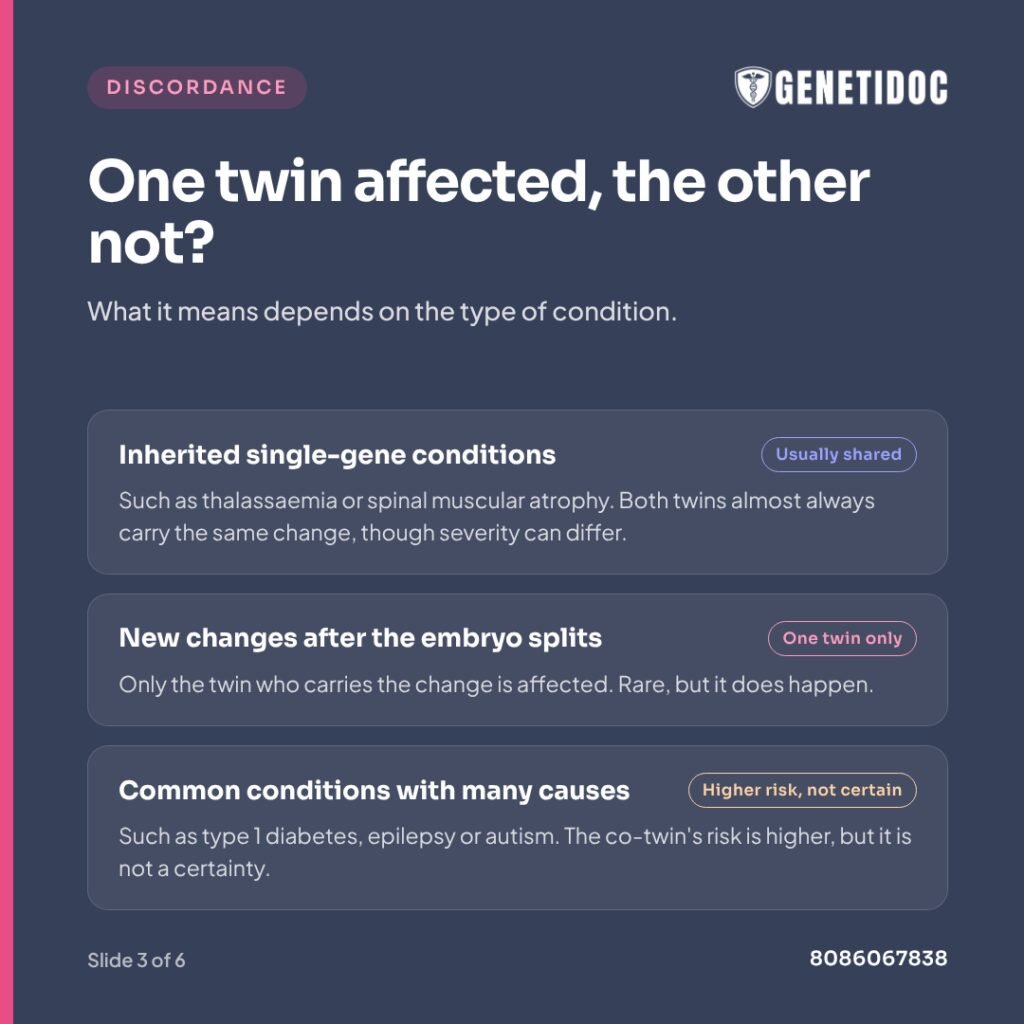
Doctors call this discordance. It is one of the most common reasons families of identical twins come for genetic counseling. The explanation depends on the type of condition.
Inherited single-gene conditions
If a condition is inherited from a parent, such as thalassaemia, spinal muscular atrophy or familial hypercholesterolaemia, both identical twins almost always carry the same genetic change. They may still show different severity because of the other factors above. But a confirmed inherited result in one twin almost always applies to the other.
New changes that arose after conception
If a genetic change arose in one twin after the embryo split, only that twin carries it. This is the clearest form of genetic discordance. It is rare, but it does happen, as shown in research on identical twins discordant for conditions such as neurodevelopmental disorders and congenital heart defects.
Common conditions with many causes
Conditions such as type 1 diabetes, epilepsy, autism, schizophrenia and many cancers involve many genes along with environment and chance. For these, having an affected identical twin raises the other twin’s risk, often substantially. But it is not a certainty, and many co-twins never develop the condition.
Illustrative scenario (not a real patient)
Five-year-old identical twin boys are seen because one has developmental delay and seizures while his brother is developing normally. The parents assume a genetic cause is impossible because the twins are “identical”. Exome sequencing of the affected twin finds a de novo change in a gene linked to epilepsy. Targeted testing then shows the change in only a small share of cells in a cheek sample from the unaffected twin, and not in his blood. The family learns that the change arose in early development, after the embryo split, and that the risk to future pregnancies is low.
What This Means for Genetic Testing in Twins
Can one twin’s result be used for both?
Sometimes, but not automatically. In general:
- Inherited changes found in one confirmed identical twin will almost always be present in the other. Even so, testing both twins is often worthwhile, because confirming a result in each child protects against sample mix-ups and rare exceptions.
- When twins have different symptoms, each twin usually needs their own assessment. The genetic finding may be present in only one.
- When it is unclear whether twins are identical, never assume one result covers both. Fraternal twins share only half their DNA, just like other siblings.
Confirm whether the twins are truly identical
Many parents are told their twins are identical or fraternal based on appearance or on the number of placentas. Neither is fully reliable. Same-sex fraternal twins can look very alike, and identical twins can have two placentas. If the answer affects testing decisions, a DNA zygosity test settles the question. Records from early pregnancy scans that describe the placenta are also very helpful, so keep them safely.
Why a blood sample can mislead in twins who shared a placenta
Twins who shared a placenta also shared blood vessels before birth. Blood-forming stem cells can cross from one twin to the other and settle in the bone marrow. As a result, each twin’s blood may carry some of the other twin’s cells. This is called blood chimerism.
In most identical twins this makes no difference, because both sets of cells have the same DNA. It matters when the twins differ, for example when one has a chromosome change. A blood test may then show a mixed or misleading picture. In these situations, a cheek swab, saliva or a small skin sample gives a truer picture of each twin’s own DNA. The same applies in the rare fraternal twins who shared a placenta.
Why some differences are hard to detect
A change that arose after the embryo split may be present in only some cells, which is called mosaicism. Standard tests such as exome sequencing or chromosomal microarray can miss changes present in only a small share of cells. The test may also miss a change found in skin or brain but not in blood.
For this reason, Team Genetidoc explains every negative result as “no reportable finding in what was tested”, never as proof that a condition is not genetic. When a genetic cause is still strongly suspected, the next step is often testing a second tissue rather than repeating the same test on blood. Re-reviewing the existing data over time, called reanalysis, can also help.

Twin Pregnancies: What Screening Can and Cannot Tell You
Expecting twins raises its own genetic questions. Here is what couples should know.
Non-Invasive Prenatal Testing in twins
Non-Invasive Prenatal Testing (NIPT) reads small fragments of DNA from the placenta that circulate in the mother’s blood. The American College of Medical Genetics and Genomics (ACMG) supports NIPT for twin pregnancies to screen for the common trisomies: Down syndrome (trisomy 21), Edwards syndrome (trisomy 18) and Patau syndrome (trisomy 13).
There are some limitations specific to twins:
- It cannot always tell which twin is affected. DNA from both placentas mixes in the mother’s blood.
- Each twin contributes less DNA, which can sometimes mean too little fetal DNA for a result. A repeat blood sample may then be offered.
- A vanishing twin can affect the result. If one twin stopped developing early in pregnancy, its placenta can still release DNA and cause a misleading result.
- Placental mosaicism can also cause a high-risk result in a baby who is unaffected.
NIPT is a screening test. A high-risk result always needs diagnostic testing, usually chorionic villus sampling or amniocentesis, before any decision is made. These are performed by your obstetrician or fetal medicine specialist.
Genetidoc offers NIPT along with the genetic counseling around it. Before testing, our team explains what NIPT can and cannot tell you in a twin pregnancy. After the result, we help you understand what it means and what the next step should be.
Diagnostic testing in twins
Diagnostic testing in twins needs extra planning, and the approach is decided by your fetal medicine specialist. As general practice, when twins have separate placentas, each twin’s sac is usually sampled separately, because each may have a different result. When identical twins share a placenta, one sample may be taken to represent both. However, if scans show a structural difference between the twins, specialists may sample both. This is because of the rare chance of a chromosome difference between identical twins.
In keeping with India’s Pre-Conception and Pre-Natal Diagnostic Techniques Act, 1994, Genetidoc does not report the sex of the baby from prenatal genetic tests.
The Indian Context
A few points are especially relevant for families in India:
- More twin pregnancies through fertility treatment. As IVF use rises, more couples are expecting twins, and more are asking how genetic screening works in a twin pregnancy.
- Consanguineous marriages. In communities where marriage between relatives is common, recessive conditions such as thalassaemia and some metabolic disorders are more frequent. These are inherited, so identical twins almost always share them. One twin’s diagnosis usually means the other needs evaluation too.
- Records are often lost. Early pregnancy scan reports describing the placenta are often not kept. Yet these are one of the best clues to whether twins are identical.
- The “same DNA” assumption. Families sometimes test only one twin to save effort or cost, assuming the other’s result will match. As this article shows, that is not always safe.
When Genetic Testing in Twins Is Useful, and When It May Add Little
Testing is useful when
- One twin has features of a genetic condition, such as developmental delay, seizures, birth defects, unusual growth or a known family condition.
- Identical twins show clearly different features of what may be the same condition.
- A family history of an inherited condition means both twins may be at risk.
- A twin pregnancy has an abnormal scan or a high-risk screening result.
- Parents are planning another pregnancy and want to know the chance of recurrence.
Testing may add little when
- Healthy twins with no symptoms and no family history are tested out of curiosity. The tiny genetic differences between healthy identical twins have no practical health meaning today.
- A consumer DNA kit is used to look for differences. These kits test a limited set of markers and are not designed to detect changes present in only some cells.
- The same test is repeated on the same tissue without a new clinical question.
Why Expert Interpretation Matters for Twins
Twins add layers of complexity that a laboratory report alone cannot resolve. The same result can mean very different things depending on:
- whether the twins are truly identical;
- whether they shared a placenta, and therefore blood;
- which tissue was tested;
- whether the change is inherited, new, or present in only some cells;
- how each child is actually developing.
Common problems when twin results are not interpreted carefully include an unaffected twin wrongly labelled from a sibling’s report, a chromosome difference missed because only blood was tested, and parents given false reassurance by a negative result. Choosing the right test, the right sample and an accredited laboratory matters. Genetic counseling is what connects the result to each child and to the family’s future plans.
At Genetidoc, every consultation ends with an individualised written summary, prepared by the genetic counselor and cross-checked by the clinical geneticist. Families can refer back to it and share it with their paediatrician or obstetrician.
Practical Steps for Parents of Twins
- Keep your pregnancy records, especially early scan reports that describe the placenta and sacs.
- Do not assume “identical” without proof if it affects a testing decision. Ask about zygosity testing.
- Watch each child as an individual. Different development or health in identical twins is a reason to seek assessment, not to dismiss genetics.
- Ask which sample is best. For twins who shared a placenta, a cheek swab or skin sample may be more accurate than blood.
- Read a negative result carefully. It means no reportable finding in what was tested, not that genetics has been ruled out.
- Keep reports and raw data for future review, reanalysis and family planning.
- See a genetic counselor before a next pregnancy if either twin has a genetic diagnosis.
Families can also ask questions and read others’ experiences on the Genetidoc Rare Disease Forum.

Frequently Asked Questions
Do identical twins have exactly the same DNA?
Almost, but not exactly. They start with the same DNA, but small changes arise after the embryo splits and throughout life. Studies show their genetic code matches at more than 99 percent of positions.
How many genetic differences do identical twins have?
A large Icelandic study found an average of about five early developmental DNA changes between identical twins. Differences acquired later in life add to this, especially with age.
Can one identical twin have a genetic disorder and the other not?
Yes, though it is uncommon. It can happen when a genetic change arises after the embryo splits, through different X-inactivation in girls, or through epigenetic differences, as in Beckwith-Wiedemann syndrome.
Can one identical twin have Down syndrome and the other not?
Rarely, yes. An error in early cell division can give one twin an extra chromosome 21. Such twins are called heterokaryotypic twins and have been reported in medical literature.
Can identical twins be a boy and a girl?
Extremely rarely. It can happen if one twin loses its Y chromosome early in development. That twin usually has features of Turner syndrome.
If one identical twin has autism, will the other have it too?
The other twin’s chance is higher than in the general population, but it is not certain. Autism involves many genes, development and chance, so each twin should be assessed individually.
Is it enough to do a genetic test on only one identical twin?
For inherited conditions, one twin’s result usually applies to both, but confirming in each twin is often wise. If the twins have different symptoms, or are not proven identical, each needs testing.
How can we find out if our twins are identical?
Early pregnancy scans showing a shared placenta indicate identical twins. Otherwise, a DNA zygosity test comparing both twins gives a definite answer. Two placentas do not rule out identical twins.
Why might a blood sample give a misleading result in twins?
Twins who shared a placenta can exchange blood-forming cells before birth, so each twin’s blood may contain the other’s cells. A cheek swab or skin sample is more reliable when the twins may differ.
Do identical twins have the same fingerprints?
No. Fingerprints are shaped by tiny differences in position and pressure in the womb, so even identical twins have different prints.
Is Non-Invasive Prenatal Testing accurate in twin pregnancies?
It is recommended for screening the common trisomies in twins. It may not show which twin is affected and can be affected by a vanishing twin. A high-risk result always needs diagnostic confirmation.
Do identical twins grow more genetically different with age?
Yes. Body cells pick up new DNA changes and epigenetic differences over a lifetime. This is one reason identical twins can develop different illnesses, including cancers, later in life.
Key Takeaways
- Identical twins start with the same DNA but are nearly, not perfectly, genetically identical.
- Differences arise from new changes after the embryo splits, chromosome errors, X-inactivation, epigenetics, mitochondrial DNA and changes acquired with age.
- One identical twin can occasionally have a genetic condition the other does not.
- Inherited conditions are almost always shared, but severity can still differ.
- Do not assume one twin’s genetic result covers both, especially if symptoms differ or zygosity is unproven.
- For twins who shared a placenta, a cheek swab or skin sample may be more accurate than blood.
- In twin pregnancies, NIPT is a screening test, and a high-risk result needs diagnostic confirmation.
Are your identical twins growing or developing differently? Or are you unsure whether one twin’s genetic report applies to both?
A Genetidoc clinical geneticist can review both children’s history and any existing reports. We can advise whether each twin needs testing, which sample will give the most accurate answer, and what the results mean for your family’s future pregnancies. Consultations are available online across India.
Posts your doubts in our genetic forum
Book a twin genetics consultation with a Genetidoc clinical geneticist.
References
- Jonsson H, Magnusdottir E, Eggertsson HP, et al. Differences between germline genomes of monozygotic twins. Nature Genetics. 2021;53(1):27–34. doi:10.1038/s41588-020-00755-1
- Yamamoto K, Lee Y, Masuda T, et al. Functional landscape of genome-wide postzygotic somatic mutations between monozygotic twins. DNA Research. 2024. doi:10.1093/dnares/dsae028
- Bruder CEG, Piotrowski A, Gijsbers AACJ, et al. Phenotypically concordant and discordant monozygotic twins display different DNA copy-number-variation profiles. American Journal of Human Genetics. 2008;82(3):763–771. doi:10.1016/j.ajhg.2007.12.011
- Ouwens KG, Jansen R, Tolhuis B, et al. A characterization of postzygotic mutations identified in monozygotic twins. Human Mutation. 2018;39(10):1393–1401. doi:10.1002/humu.23586
- Fraga MF, Ballestar E, Paz MF, et al. Epigenetic differences arise during the lifetime of monozygotic twins. Proceedings of the National Academy of Sciences of the USA. 2005;102(30):10604–10609
- Weksberg R, Shuman C, Caluseriu O, et al. Discordant KCNQ1OT1 imprinting in sets of monozygotic twins discordant for Beckwith-Wiedemann syndrome. Human Molecular Genetics. 2002;11(11):1317–1325
- Zwijnenburg PJG, Meijers-Heijboer H, Boomsma DI. Identical but not the same: the value of discordant monozygotic twins in genetic research. American Journal of Medical Genetics Part B. 2010;153B(6):1134–1149
- Vadgama N, Pittman A, Simpson M, et al. De novo single-nucleotide and copy number variation in discordant monozygotic twins reveals disease-related genes. European Journal of Human Genetics. 2019. doi:10.1038/s41431-019-0376-7
- Razzaghian HR, Shahi MH, Forsberg LA, et al. Somatic mosaicism for chromosome X and Y aneuploidies in monozygotic twins heterozygous for sickle cell disease mutation. American Journal of Medical Genetics Part A. 2010;152A(10):2595–2598
- Dungan JS, Klugman S, Darilek S, et al. Noninvasive prenatal screening (NIPS) for fetal chromosome abnormalities in a general-risk population: an evidence-based clinical guideline of the American College of Medical Genetics and Genomics (ACMG). Genetics in Medicine. 2023;25(2):100336
- American College of Obstetricians and Gynecologists. Multifetal gestations: twin, triplet, and higher-order multifetal pregnancies. Practice Bulletin No. 231. Obstetrics & Gynecology. 2021;137(6):e145–e162
Related Reading on Genetidoc
- Personalized Medicine: The Role of Genetic Testing in Your Care
- Genetic Eye Disease in Children: When to Test
- Facial Features and Genetic Syndromes: A Guide for Parents
- Is Genetic Testing Useful for Unexplained Infertility?
- Family History of Dementia: When to Seek Genetic Counseling
- APOE and Alzheimer’s Risk: Separating Fact from Fear