
Quick answer
Consider a genetic evaluation if your child is behind in two or more areas of development (such as movement, speech, understanding or social skills), has lost skills they once had, or has delay together with seizures, unusual facial features, a very large or small head, poor growth, birth defects, a family history of similar problems, or parents who are related by blood. Start therapy straight away. Do not wait for test results before starting therapy.
Every parent compares. Your neighbour’s son walked at eleven months. Your niece was speaking in sentences by two. Your child is still not doing these things, and the advice you keep hearing is “wait, he will catch up.”
Sometimes that advice is right. Children develop at different speeds, and many late starters do catch up. But sometimes waiting costs time that matters. For a meaningful number of children, the delay has a genetic cause. Finding that cause can change care, protect future pregnancies, and end years of uncertainty.
This guide explains what developmental delay is, which signs mean you should act now, which genetic tests are used, and what a diagnosis can and cannot do for your child.
What is developmental delay?
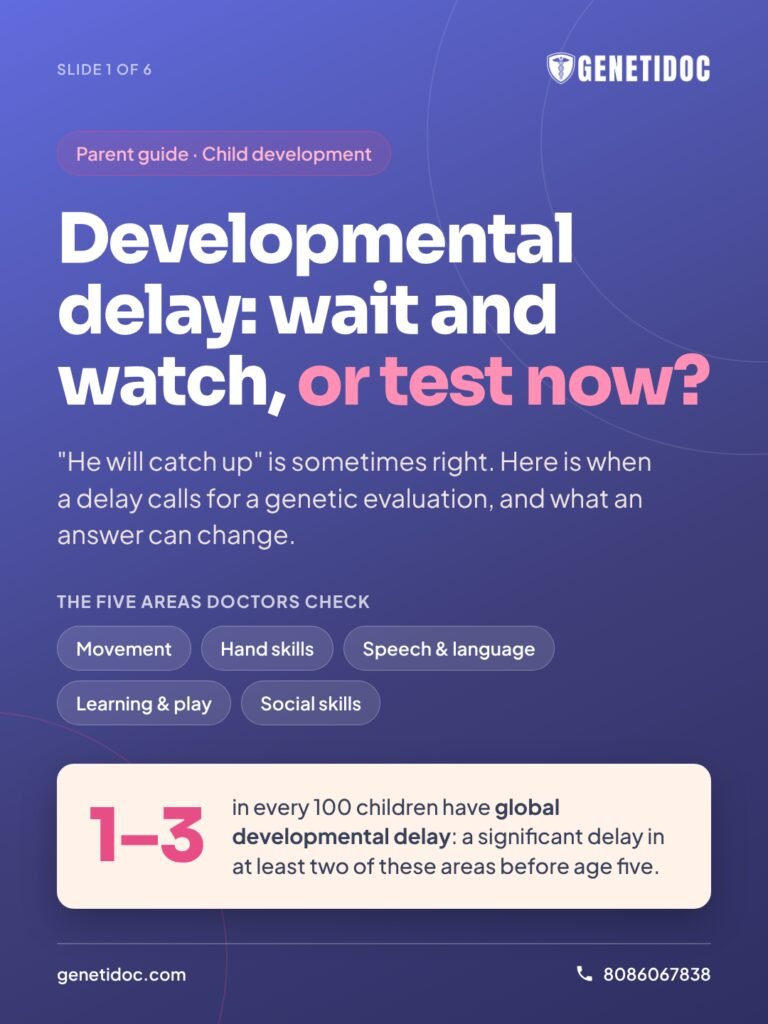
Developmental delay means a child is reaching milestones much later than expected for their age. Doctors look at five main areas, called developmental domains:
- Gross motor: sitting, crawling, standing, walking
- Fine motor: grasping, holding a spoon, scribbling
- Speech and language: babbling, first words, understanding what is said
- Cognition: problem-solving, learning, play
- Social and personal skills: eye contact, smiling, interacting, self-care
Global developmental delay: the definition
Global developmental delay is a significant delay in at least two of these areas in a child under five years of age. The Indian Academy of Pediatrics defines “significant” as a score at least two standard deviations below the average on a standardized developmental test. In simple terms, this means the child is clearly behind most children of the same age, not just a little slow.
Global developmental delay is common. International estimates suggest it affects about 1 to 3 in every 100 children.
After the age of five, when formal testing of intelligence becomes more reliable, some children with global developmental delay are diagnosed with intellectual disability. Others improve a great deal with therapy. A genetic diagnosis can help predict which path is more likely. We cover older children in our article on the genetic causes of intellectual disability.
Is developmental delay genetic?
Often, yes, but not always. Developmental delay has many possible causes:
- Genetic causes: chromosome changes (such as Down syndrome), changes in single genes, and inherited metabolic conditions
- Problems around birth: lack of oxygen during delivery, very early birth, severe newborn jaundice, or brain infections
- Problems after birth: brain infections, injuries, severe malnutrition, or untreated low thyroid hormone
- Environmental factors: very little stimulation or interaction at home
What Indian studies show
Research from Indian hospitals shows how important genetic causes are here:
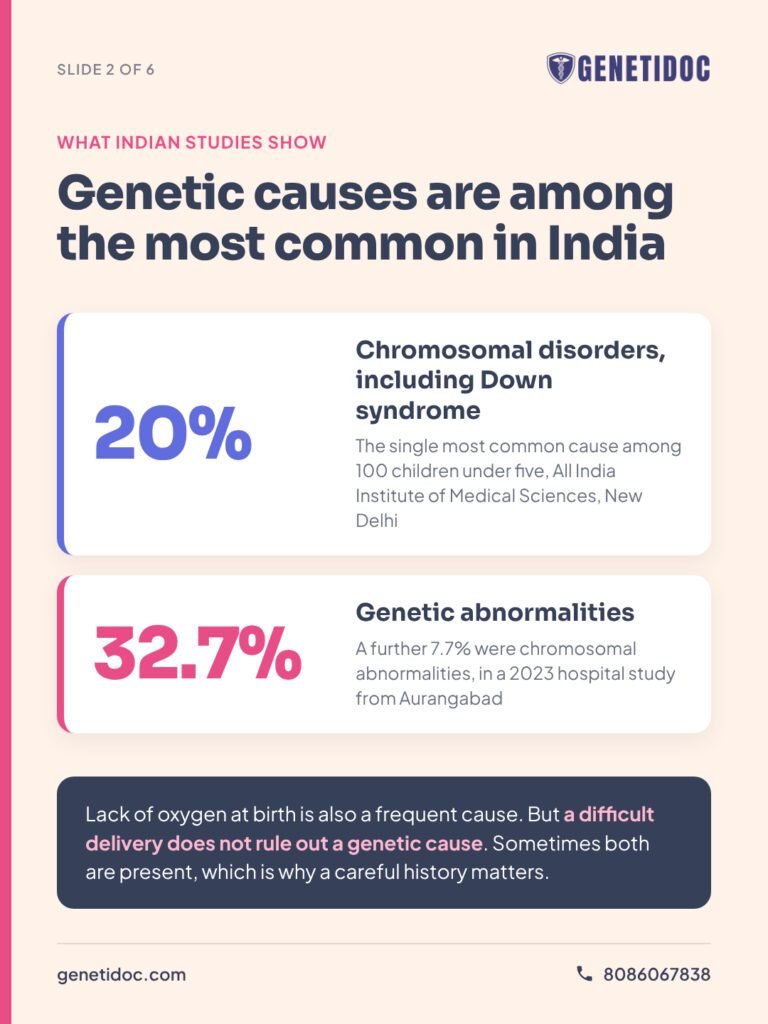
- At the All India Institute of Medical Sciences, New Delhi, a study of 100 children under five with global developmental delay found that chromosomal disorders, including Down syndrome, were the most common cause (20%). Lack of oxygen around birth (15%), syndromes with multiple birth defects (14%) and abnormal brain development (11%) followed.
- A 2023 study from Aurangabad found that genetic abnormalities accounted for 32.7% and chromosomal abnormalities for 7.7% of cases. Problems around birth, mostly lack of oxygen at delivery, accounted for about a third.
Two lessons stand out. First, genetic causes are among the most common causes of developmental delay in India. Second, lack of oxygen at birth is a real and frequent cause, so a careful history matters. A difficult delivery does not automatically rule out a genetic cause, and a genetic cause does not mean the birth history was irrelevant. Sometimes both are present.
“We don’t start with the test. We start with the child. The history, the examination and the family tree tell us how broad the testing needs to be.”
— Team Genetidoc
When should you consider a genetic evaluation? 10 red flags
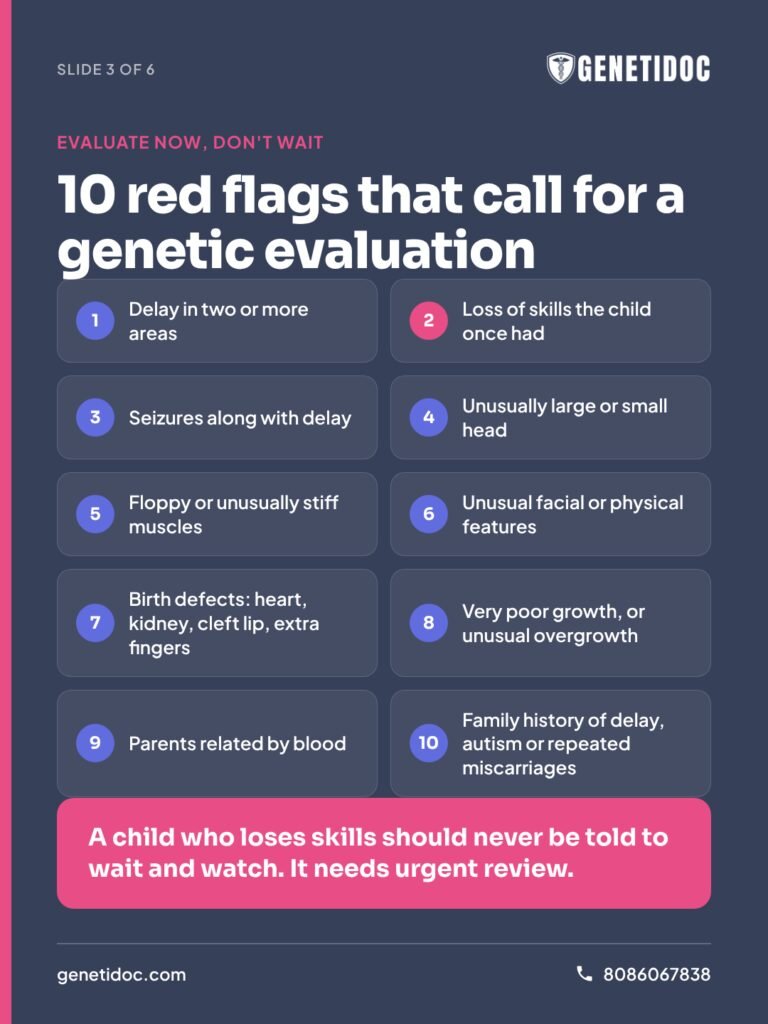
The following signs mean “evaluate now” rather than “wait and watch.” They are based on the Indian Academy of Pediatrics consensus guidelines and international recommendations.
- Delay in two or more areas, for example both walking and talking are late.
- Loss of skills (developmental regression). A child who stops saying words they used to say, or stops walking, needs urgent review.
- Seizures along with delay.
- A head that is unusually large or small for the child’s age.
- Low muscle tone (a “floppy” baby) or unusually stiff muscles.
- Unusual facial features or physical differences that make the child look different from other family members.
- Birth defects such as a heart defect, kidney problem, cleft lip or palate, or extra fingers.
- Poor growth (very short, or not gaining weight), or unusual overgrowth.
- Parents who are related by blood, such as first cousins or uncle and niece.
- A family history of developmental delay, intellectual disability, autism, unexplained childhood deaths or repeated miscarriages.
Other features that point towards a possible metabolic (body chemistry) condition include episodes of illness with drowsiness or vomiting that are out of proportion to the infection, unusual body or urine odour, strong food refusal, and problems in several organs at once.
“A child who loses skills should never be told to wait and watch. Loss of skills is a reason to act now.”
— Team Genetidoc
Wait and review, or evaluate now?
| Situation | Usual next step |
| Mild delay in one area, otherwise healthy, no family history | Hearing and vision checks, start therapy, review progress closely with your pediatrician |
| Delay in two or more areas with no clear cause | Start therapy and arrange a genetic evaluation |
| Delay with seizures, unusual features, birth defects or abnormal head size | Genetic evaluation, plus brain imaging or other tests as advised |
| Loss of previously gained skills | Urgent medical review first, then genetic and metabolic evaluation |
| Delay and parents related by blood, or a similar problem in the family | Genetic evaluation, including counseling about future pregnancies |
| Delay in a child who has had very little stimulation at home | Stimulation and therapy, then reassessment after 6 to 9 months |
What about speech delay alone, or mild delay?
Isolated speech delay
Speech delay is the most common worry parents bring to doctors. When speech is the only area that is behind, and the child understands well, plays normally, makes good eye contact and has no other medical concerns, a genetic cause is less likely. The first steps are usually:
- A proper hearing test. A simple screen can miss hearing loss, and even partial hearing loss can delay speech.
- Assessment by a speech therapist, and starting therapy.
- Checking for features of autism, such as limited eye contact, not responding to their name, or repetitive behaviour.
A genetic evaluation becomes more useful if the child has other features, if speech does not improve as expected with therapy, if other areas start falling behind, or if there is a family history.
Isolated motor delay
A child who is late to sit or walk but is developing normally in other areas still needs a careful examination. Muscle tone, reflexes and muscle strength matter here. Some muscle and nerve conditions, such as spinal muscular atrophy and Duchenne muscular dystrophy, first show up as motor delay. These conditions have specific tests and, increasingly, specific treatments. Any motor delay with weakness, frequent falls or difficulty climbing stairs should be reviewed promptly.
Mild delay
Guidelines differ on mild delay. In the United Kingdom, the National Health Service no longer offers routine genetic testing for isolated mild intellectual disability or isolated autism, because the chance of finding a genetic cause is low. In contrast, the Indian study from AIIMS concluded that a step-by-step evaluation is justified in every child with developmental delay, whatever the severity.
In practice, the decision depends on the whole picture: the child’s features, the family history, how the child responds to therapy, and what the family wants to know. This is a decision to make with a clinical geneticist, not something to rule in or out based on severity alone.
Checks that come before or alongside genetic testing
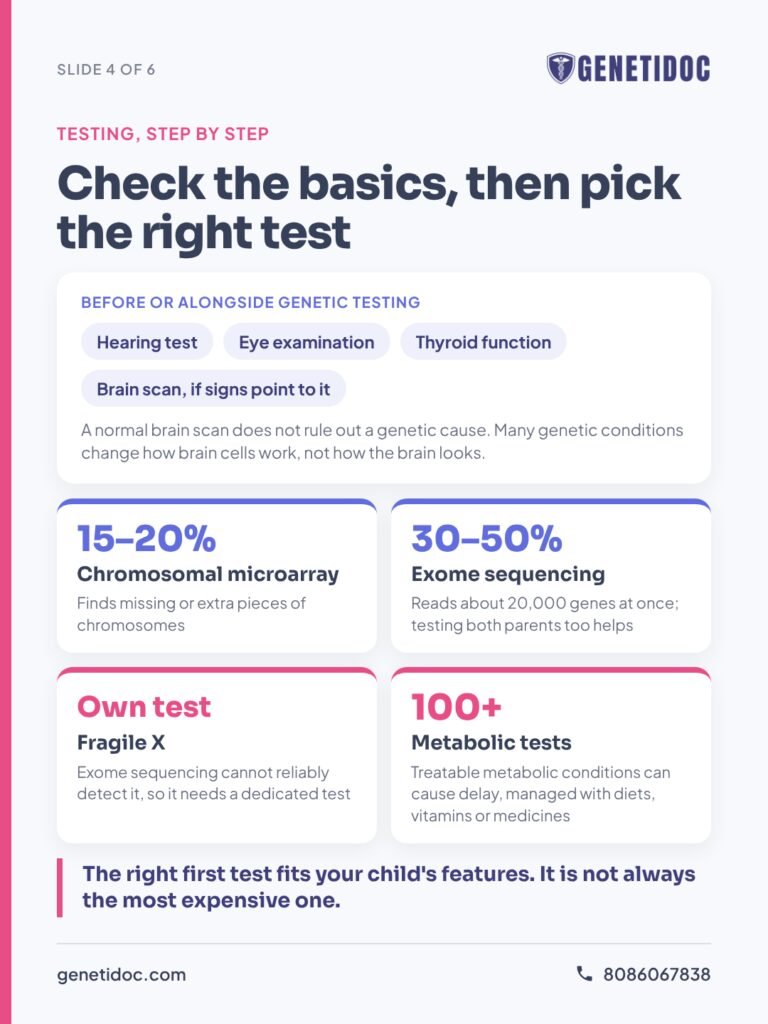
Several simple checks should not be skipped, because they can find causes that are treatable or that change how therapy is given:
- Hearing: recommended for every child with developmental delay. Objective tests such as otoacoustic emissions (OAE, a quick test of how the inner ear responds to sound) or brainstem evoked response audiometry (BERA, a test of how the hearing nerve carries sound signals) are preferred.
- Vision: a full eye examination by an eye specialist.
- Thyroid function: especially if newborn screening was not done. Untreated low thyroid hormone can slow development and is easy to treat.
- Brain imaging: magnetic resonance imaging (MRI) is preferred over a computed tomography (CT) scan. It is recommended when there are specific signs, such as seizures, abnormal head size or abnormal neurological findings. It may not be needed in mild delay without these signs.
A normal MRI does not rule out a genetic cause. Many genetic conditions affect how brain cells work, not how the brain looks on a scan.
Which genetic tests are used for developmental delay?
No single test finds every genetic cause. Each test looks at DNA in a different way. Choosing the right test, in the right order, is one of the most important parts of a genetic evaluation.
1. Chromosomal microarray
This test looks for small missing or extra pieces of chromosomes (called deletions and duplications) that are too small to see under a microscope. It finds a cause in about 15% to 20% of children with unexplained developmental delay. It cannot detect changes in the spelling of individual genes, and it cannot detect balanced rearrangements (where chromosome pieces swap places without anything missing).
2. Exome sequencing
This test reads the protein-coding parts of about 20,000 genes at once. It finds a cause in about 30% to 50% of children with developmental delay or intellectual disability, depending on the child’s features. It works especially well when other features are present, or when the family tree suggests an inherited pattern.
When the child and both parents are tested together, this is called a trio exome. Testing the parents helps the laboratory tell whether a change in the child is new or inherited. This often makes a clear answer more likely.
3. Fragile X testing
Fragile X syndrome is the most common inherited cause of developmental delay and intellectual disability in boys. It is caused by an expanded repeat in the FMR1 gene. Exome sequencing cannot reliably detect this type of change, so fragile X needs its own dedicated test. It is especially relevant in boys with moderate to severe delay, autism-like behaviour or hyperactivity, and in families where relatives on the mother’s side have learning difficulties.
4. Karyotype
A karyotype looks at the whole set of chromosomes under a microscope. It is still useful when a specific chromosome condition is suspected, such as Down syndrome, or to check for balanced rearrangements in parents. On its own, it finds far fewer causes than microarray or exome sequencing in children with unexplained delay.
5. Metabolic tests
Inherited metabolic conditions are problems with how the body breaks down food or produces energy. They are uncommon causes of developmental delay, but they matter a great deal because many are treatable. A 2021 review identified more than 100 treatable metabolic conditions that can cause developmental delay or intellectual disability. These are treated with special diets, vitamins or medicines. Metabolic tests on blood and urine are usually requested when there are specific clues, such as loss of skills, episodes of illness, parents related by blood, or a missed newborn screen.
6. Genome sequencing and specialised tests
Genome sequencing reads almost all of the DNA. At Genetidoc, it is usually an escalation step when a genetic condition is still strongly suspected after earlier testing has not found the answer. Some conditions, such as Angelman syndrome and Prader-Willi syndrome, may need special methylation tests because standard sequencing can miss them.
What international guidelines now recommend
- In 2021, the American College of Medical Genetics and Genomics strongly recommended exome or genome sequencing as a first- or second-tier test for children with developmental delay, intellectual disability or birth defects.
- In 2025, the American Academy of Pediatrics recommended exome or genome sequencing together with chromosomal microarray as first-tier tests when the history and examination do not point to a specific diagnosis. Fragile X testing and metabolic testing come next, unless there are specific clues that make them more urgent.
- The Indian Academy of Pediatrics recommends genetic testing when a genetic condition is suspected or no clear cause is found. It still recommends fragile X as a first-line test in boys with moderate to severe delay.
How Genetidoc chooses a test
- If the child’s features clearly point to one condition, we choose a targeted test for that condition, such as a fragile X test or a single-gene test.
- If several conditions are possible, as is common in developmental delay, we choose a broader test such as exome sequencing, often together with microarray.
- Genome sequencing is reserved for when a genetic condition is still strongly suspected after earlier tests.
“The most expensive test is not always the right first test. The right test is the one that fits your child’s features.”
— Team Genetidoc
Turnaround time and cost
Typical turnaround times: fragile X testing takes about 21 days. Gene panels take about 3 to 4 weeks. Exome sequencing takes about 1 to 2 months. Genome sequencing, including interpretation, can take 1 to 3 months.
Cost: single-gene tests usually cost the least. Exome sequencing costs more. Genome sequencing and trio exome sequencing are in a similar, higher price range. Your genetic counselor will explain the cost of the specific test recommended for your child before anything is ordered.
Sample: most tests use a small blood sample. Some tests can be done on a cheek swab, and your counselor will tell you whether this applies to your child’s test.
Do not wait for results to start therapy
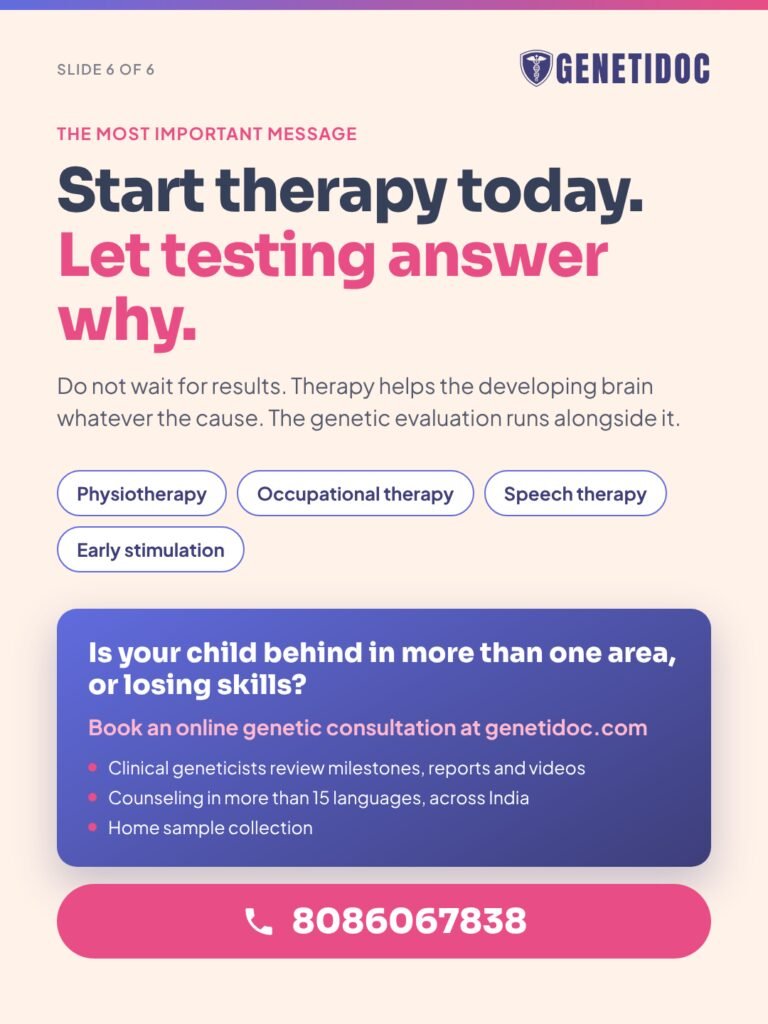
This is the most important practical message in this article. The Indian Academy of Pediatrics guidelines say therapy should begin soon after the delay is recognised, without waiting for a formal diagnosis.
Physiotherapy, occupational therapy, speech therapy and early stimulation help the developing brain, whatever the cause. A genetic evaluation runs alongside therapy, not before it. If a diagnosis is found, it often helps therapists set more realistic goals and choose the right approach.
“Testing and therapy are not a choice between two paths. Start therapy today. Let the genetic evaluation answer the question of why.”
— Team Genetidoc
What a genetic diagnosis can change
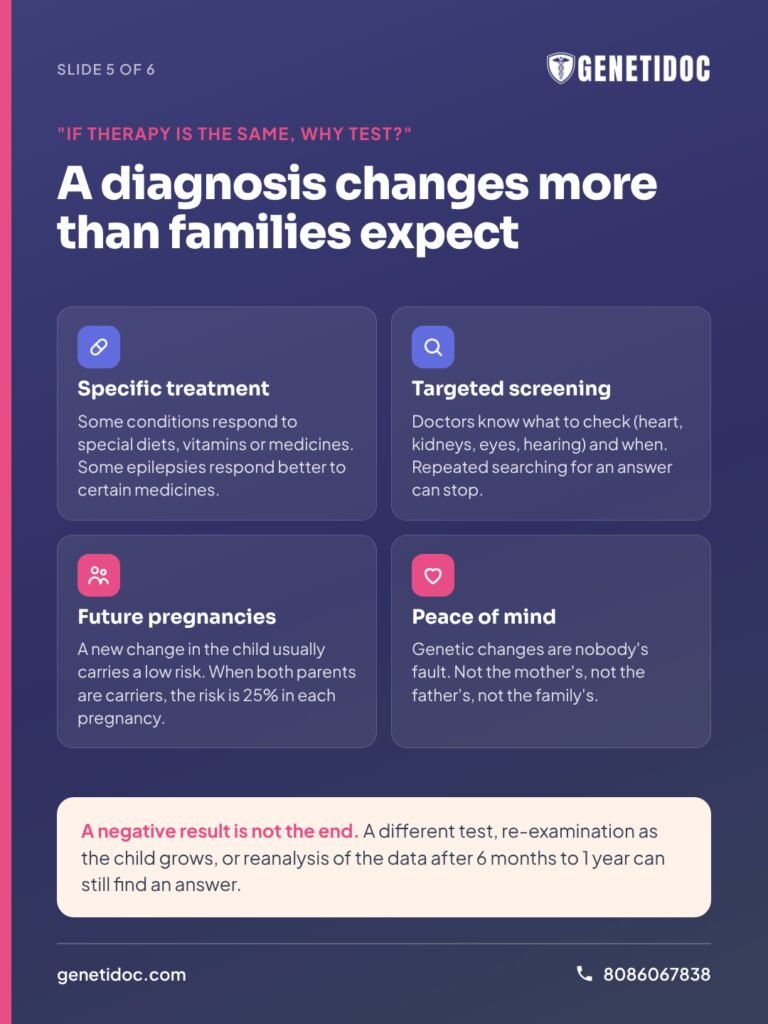
Parents often ask, “If therapy is the same anyway, why test?” A diagnosis changes more than most families expect.
For your child’s treatment
- Treatable conditions: some metabolic and genetic conditions respond to specific diets, vitamins or medicines. Finding them early can protect the brain from further harm.
- Seizure treatment: some genetic epilepsies respond better to certain medicines and worse to others.
- Screening for hidden problems: many syndromes carry risks to the heart, kidneys, eyes, hearing, thyroid or spine. A diagnosis tells doctors what to check, and when.
- Fewer unnecessary tests: once a cause is found, repeated scans, blood tests and hospital visits searching for an answer can often stop.
For your child’s future
- A clearer picture of what to expect, which helps with school planning and long-term support.
- Access to condition-specific information, specialist clinics, research studies and support groups.
- Connection with other families living with the same condition.
For your family
- Recurrence risk: a diagnosis tells you the chance of the same condition in a future pregnancy. For a change that arose new in the child (de novo), the risk is usually low, though not zero. For a recessive condition where both parents are carriers, the risk is 25% in each pregnancy.
- Options for future pregnancies: once a definite diagnosis is made, couples can consider prenatal diagnosis or preimplantation genetic testing with in vitro fertilisation (IVF).
- Relatives: brothers, sisters and cousins can be offered targeted testing for the specific change found in the family, where relevant.
For your peace of mind
Many parents carry years of guilt, wondering whether something they did caused the delay. A diagnosis often answers that question clearly.
“Genetic changes are nobody’s fault. Not the mother’s, not the father’s, not the family’s. That is often the first thing parents need to hear.”
— Team Genetidoc
When genetic testing may not be the right first step
Genetic testing is powerful, but it is not always the first answer:
- When the delay is clearly explained by another cause, such as a documented severe brain injury or meningitis, with a typical pattern on imaging.
- When the main problem is hearing or vision loss that has not yet been checked or corrected.
- When a child has had very little stimulation and has not yet had a fair chance to respond to therapy.
- When a family is not ready for the result. Pre-test counseling should always come first, so that families understand what testing may and may not show.
Even then, a genetic evaluation may still be worth doing later. This is especially true if the child does not progress as expected or new features appear.
If the test result is negative
A negative result does not mean the cause is not genetic. It means no reportable finding was identified in what was tested. Every test has blind spots, and scientific knowledge grows each year.
- Some children need a different type of test. For example, fragile X or methylation testing after a negative exome.
- Features often become clearer as a child grows, so re-examination by a clinical geneticist is valuable.
- Reanalysis of existing exome data after 6 months to 1 year can find answers as new genes are discovered.
- Keep your reports and raw data safe, keep your contact details updated with the clinic, and return if new symptoms appear.
Some results show a variant of uncertain significance. This is a DNA change whose effect is not yet known. It should not be treated as a diagnosis, and it is not used to make decisions about future pregnancies or testing of relatives until it is clarified.
Common misconceptions about developmental delay and genetics
- “He will catch up on his own.” Some children do, but delay in two or more areas, or loss of skills, needs evaluation rather than waiting.
- “Boys always talk late.” Boys may speak slightly later on average, but significant delay is not explained by being a boy.
- “Testing is only for severe cases.” Testing is guided by the overall pattern, not severity alone.
- “The MRI is normal, so it is not genetic.” Many genetic conditions do not show on brain scans.
- “A negative test means it is not genetic.” It means no cause was found in what was tested.
- “A diagnosis means therapy will not help.” Therapy helps children with and without a genetic diagnosis. A diagnosis helps direct it.
- “Nobody in our family has this, so it cannot be genetic.” Many genetic changes arise new in the child, and recessive conditions can appear without any previous family history.
Why the right test, laboratory and interpretation matter
A genetic report is only as useful as the decisions it leads to. Problems we commonly see in families who come to us after testing elsewhere include:
- The wrong first test, such as an exome ordered for a boy with clear signs of fragile X.
- A “normal” microarray treated as the final answer, when exome sequencing has never been done.
- A variant of uncertain significance mistaken for a diagnosis, causing false reassurance or unnecessary worry.
- Reports read without examining the child. A DNA change only makes sense when it fits the child’s features.
- Low-cost tests with no counseling, leaving families with a report but no plan.
Genetidoc works with accredited partner laboratories that confirm reportable findings. Every result is interpreted by a clinical geneticist who has assessed your child and explained through genetic counseling.
What happens in a genetic evaluation at Genetidoc
- Before the consultation: gather all reports (birth records, newborn screening, hearing and vision tests, MRI, EEG, blood tests), clear photographs of your child, and short videos showing movement, speech or any unusual episodes.
- Consultation: a clinical geneticist takes a detailed history, including pregnancy and birth details, milestones, and a three-generation family tree. They then assess your child’s features.
- Pre-test counseling: what each test can and cannot find, possible results, cost, timelines, and your choices.
- Sample collection: home sample collection is available.
- Post-test counseling: what the result means for your child, for treatment, and for your family, with a written summary you can share with your pediatrician and therapists.
- Follow-up: reanalysis, testing of relatives where relevant, and planning for future pregnancies.
Consultations are online, so both parents can attend together from home. Grandparents or other family members can join if you wish.
Illustrative scenarios
The following are composite examples created to explain common situations. They are not real patients.
Scenario 1: “The delivery was difficult”
A 20-month-old girl is not yet walking and says no words. She was floppy as a baby. Her delay was put down to a long, difficult delivery, although she cried soon after birth and did not need intensive care. Her MRI is normal. Microarray and trio exome sequencing find a new change in a single gene known to cause developmental delay, which neither parent carries.
The diagnosis ends the search, guides screening for related health problems, and tells the parents that the chance of the same condition in a future child is low. Her therapy continues with clearer goals.
Scenario 2: A boy with speech delay and hyperactivity
A three-year-old boy speaks only a few words, avoids eye contact and is very restless. His mother’s brother had learning difficulties. A dedicated fragile X test confirms fragile X syndrome.
His mother is found to carry the change. Genetic counseling helps her understand her own health and the options for future pregnancies. Her sister, who is planning a family, is offered testing.
Scenario 3: Loss of skills in a child of cousin parents
A 15-month-old who had started crawling and babbling begins losing these skills after two episodes of illness with unusual drowsiness. His parents are first cousins. After urgent review, metabolic tests and exome sequencing confirm a treatable inherited metabolic condition.
A special diet and supplements are started, and further loss of skills is prevented. Both parents are carriers, with a 25% chance of an affected child in each pregnancy. They discuss prenatal diagnosis for their next pregnancy.
Scenario 4: Speech delay that was not genetic
A two-and-a-half-year-old girl uses very few words but plays well, understands gestures and is developing normally otherwise. Before any genetic test, a formal hearing assessment shows moderate hearing loss in both ears.
With hearing aids and speech therapy, her speech improves steadily. Hearing loss itself can be genetic, so genetic counseling may still be offered later. But the first step was simply to check her hearing.
The emotional side
Parents of a child with developmental delay often feel worried, guilty, and judged by relatives who offer opinions or look for someone to blame. Some fear that a genetic “label” will follow their child, or affect how the family is seen.
Genetic counseling makes space for these feelings. We explain results in plain language, help you decide how and whether to share information with relatives, and respect your choices at every step. Final decisions about testing and family planning always belong to the family. Our role is to inform, not to direct.
Frequently asked questions
1. Is developmental delay always genetic?
No. Developmental delay can be caused by genetic conditions, problems around birth, infections, thyroid problems, hearing or vision loss, or lack of stimulation. Indian studies show genetic and chromosomal causes are among the most common, which is why a genetic evaluation is often recommended.
2. At what age is global developmental delay diagnosed?
Global developmental delay is diagnosed in children under five years of age who are significantly behind in at least two areas of development. Many children are first assessed in the first two to three years of life.
3. Will my child outgrow developmental delay?
Some children catch up, especially with mild delay in one area and early therapy. Children with delay in several areas, or with a genetic cause, are less likely to catch up fully but can still make real progress. A diagnosis helps predict what to expect.
4. Which genetic test is best for developmental delay?
There is no single best test. Exome sequencing with chromosomal microarray finds the most causes in children with unexplained delay. Fragile X and metabolic tests are added when there are specific clues. The right test depends on your child’s features.
5. Should I wait for test results before starting therapy?
No. Start physiotherapy, occupational therapy or speech therapy as soon as delay is recognised. The genetic evaluation runs alongside therapy.
6. My child’s MRI is normal. Could the delay still be genetic?
Yes. Many genetic conditions affect how brain cells work without changing how the brain looks on a scan.
7. Does my child need genetic testing for speech delay alone?
Not usually as a first step. A hearing test and speech therapy come first. Genetic evaluation is considered if other areas are also delayed, if other features are present, if there is a family history, or if speech does not improve as expected.
8. How long do genetic test results take?
Fragile X testing takes about 21 days, gene panels about 3 to 4 weeks, exome sequencing about 1 to 2 months, and genome sequencing 1 to 3 months including interpretation.
9. Can developmental delay happen again in our next baby?
It depends on the cause. A new change in the child usually carries a low risk. A recessive condition carries a 25% risk in each pregnancy. A genetic diagnosis is the only way to know your family’s actual risk.
10. We are cousins. Does that increase the chance of developmental delay?
Parents who are related by blood are more likely to carry the same recessive gene change, which raises the chance of certain genetic conditions in their children. If your child has developmental delay, a genetic evaluation is especially useful.
11. What does a negative genetic test result mean?
It means no reportable cause was found in what was tested. It does not rule out a genetic cause. Re-examination, a different test, or reanalysis after 6 months to 1 year may still find an answer.
12. Can developmental delay be treated if it is genetic?
Therapy helps every child. In addition, some genetic and metabolic conditions have specific treatments, such as special diets, vitamins or medicines. A diagnosis also guides screening for related health problems.
Key takeaways
- Delay in two or more areas, loss of skills, seizures, unusual features, birth defects, abnormal head size, cousin parents or a family history are reasons to consider a genetic evaluation now.
- Check hearing, vision and thyroid function in every child with developmental delay.
- Exome sequencing with microarray finds the most causes; fragile X and metabolic conditions need their own tests.
- Start therapy immediately. Do not wait for results.
- A diagnosis can guide treatment, prevent unnecessary tests, and inform future pregnancies.
- A negative result is not the end of the road.
Is your child behind in more than one area, or losing skills?
Book a developmental delay genetic evaluation with Genetidoc. Our clinical geneticists will review your child’s milestones, reports and videos, recommend the right test (not the most expensive one), and explain every result through genetic counseling, including what it means for your next pregnancy.
Online consultations are available across India in more than 15 languages, with home sample collection.
Book your child’s genetic evaluation
Have a question you would like to ask other parents or our doctors? Join the discussion on the genetidoc rare disease forum
Related reading
- What Defines a Rare Genetic Disease? A Clear Guide
- Skipping Generations: What Families Should Know
- Unusual Inheritance Patterns: Mitochondrial DNA Explained
- Congenital Insensitivity to Pain: When a Child Cannot Feel Pain
- Nutrigenomics: How Your Genes Shape Your Response to Diet
- Parkinson’s Disease: When Genetics Plays a Role
References
- Rodan LH, Stoler J, Chen E, Geleske T; Council on Genetics. Genetic evaluation of the child with intellectual disability or global developmental delay: clinical report. Pediatrics. 2025;156(1):e2025072219.
- Manickam K, McClain MR, Demmer LA, et al. Exome and genome sequencing for pediatric patients with congenital anomalies or intellectual disability: an evidence-based clinical guideline of the American College of Medical Genetics and Genomics (ACMG). Genetics in Medicine. 2021;23(11):2029–2037.
- Growth, Development and Behavioral Pediatrics Chapter, Neurology Chapter and Neurodevelopment Pediatrics Chapter of the Indian Academy of Pediatrics. Diagnosis and management of global development delay: consensus guidelines. Indian Pediatrics. 2022;59(5):401.
- Tikaria A, Kabra M, Gupta N, et al. Aetiology of global developmental delay in young children: experience from a tertiary care centre in India. National Medical Journal of India. 2010;23(6):324–329.
- Sharma et al. The etiological profile of global developmental delay at a tertiary care hospital in India: an observational study. Cureus. 2023;15(6):e41066.
- Hoytema van Konijnenburg EMM, Wortmann SB, Koelewijn MJ, et al. Treatable inherited metabolic disorders causing intellectual disability: 2021 review and digital app. Orphanet Journal of Rare Diseases. 2021;16:170.
- Miller DT, Adam MP, Aradhya S, et al. Consensus statement: chromosomal microarray is a first-tier clinical diagnostic test for individuals with developmental disabilities or congenital anomalies. American Journal of Human Genetics. 2010;86(5):749–764.
- Srivastava S, Love-Nichols JA, Dies KA, et al. Meta-analysis and multidisciplinary consensus statement: exome sequencing is a first-tier clinical diagnostic test for individuals with neurodevelopmental disorders. Genetics in Medicine. 2019;21(11):2413–2421.
- NHS England Genomics Education Programme. Presentation: child with developmental delay or intellectual disability. GeNotes.
This article is for general education and does not replace medical advice. Please consult a qualified clinical geneticist about your child’s individual situation.