
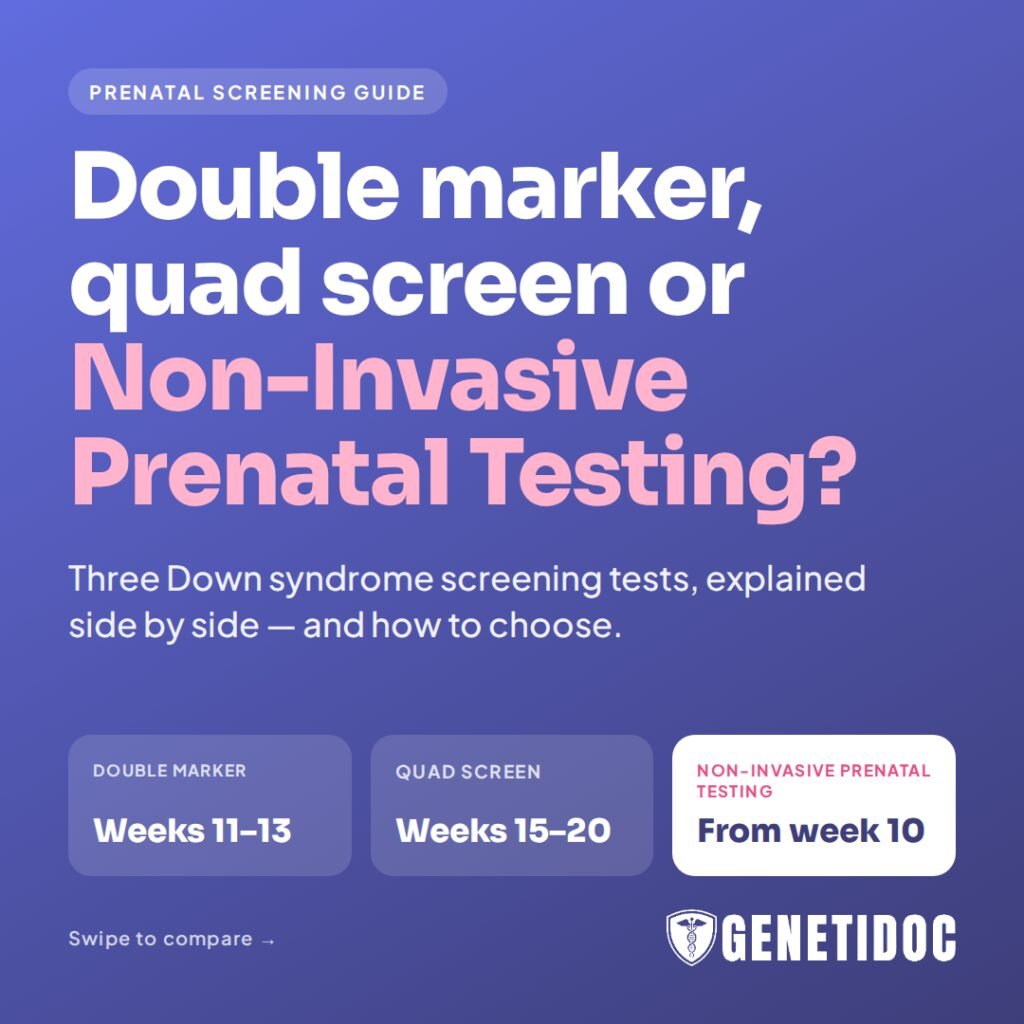
If your obstetrician has mentioned a “double marker test,” a “triple marker test,” or NIPT and you’re not entirely sure which one you actually need — or whether you need more than one — you are far from alone. These three screening options are often introduced at different points in pregnancy, sometimes by different doctors, and rarely explained side by side.
This guide walks through what each test actually measures, in plain language, how accurate each one really is, what none of them can tell you, who is actually at higher risk of having a baby with Down syndrome, and how to think through the decision practically — including where genetic counseling fits in at each step.
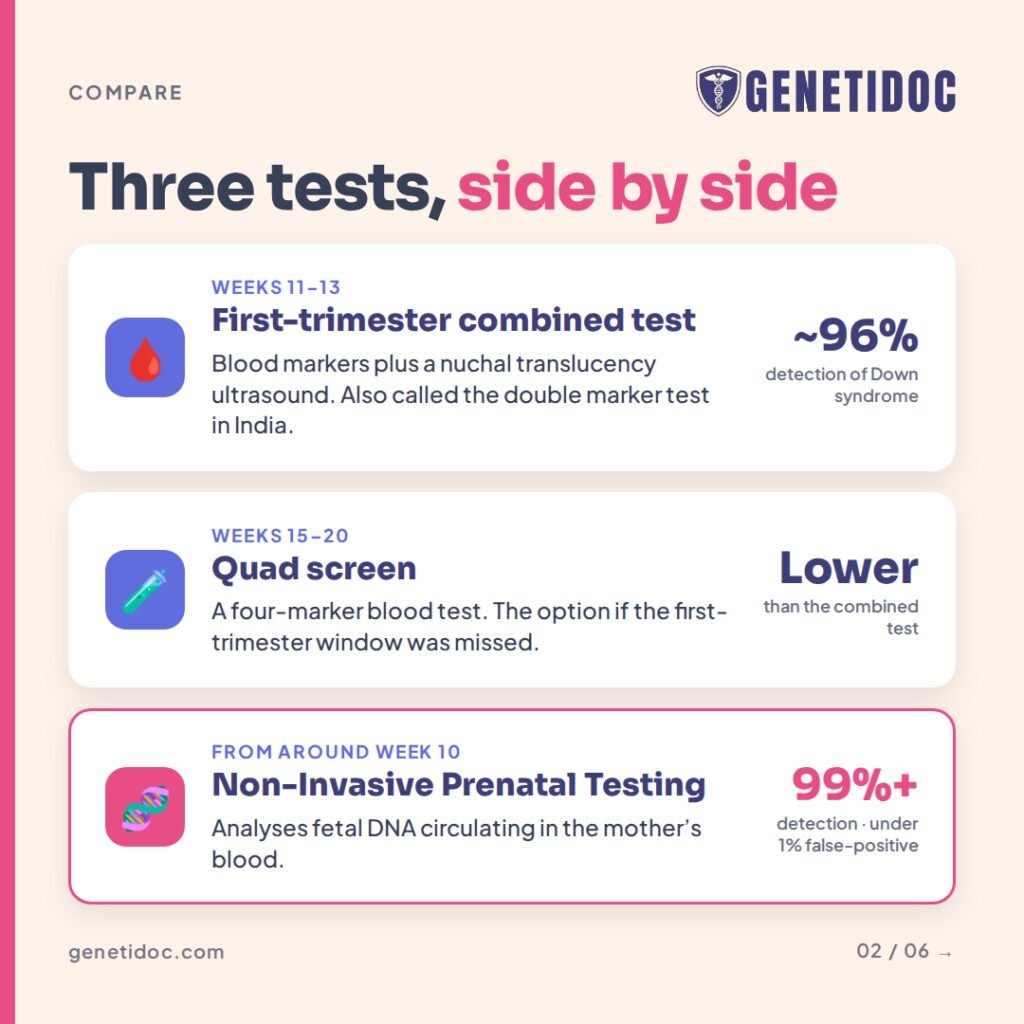
Quick answer: The first-trimester combined test (also called the double marker test in India, done around weeks 11–13) and the quad screen (done around weeks 15–20) are both screening tests based on an ultrasound measurement and/or blood markers. NIPT, available from around week 10, analyzes fetal DNA circulating in the mother’s blood and has the highest detection rate of the three — over 99 percent for Down syndrome, with a low false-positive rate. None of the three is diagnostic. A high-risk result on any one of them — you do not need to complete all three — can be taken directly to a confirmatory diagnostic test, chorionic villus sampling or amniocentesis, before any medical decision is made. And none of them, including NIPT, replaces the routine anomaly ultrasound your obstetrician orders, since that scan — along with the quad screen’s alpha-fetoprotein (AFP) component — is what screens for structural findings like neural tube defects. A genetic counselor can help you choose between them and interpret what any result actually means for your pregnancy.
Why This Decision Feels More Complicated Than It Should
Part of the confusion is that these three tests aren’t always presented as alternatives. In practice, many patients in India first encounter Down syndrome screening through their obstetrician, as part of standard first-trimester care — the double marker test, paired with a nuchal translucency ultrasound. Only later, if at all, does NIPT come up, sometimes from the same obstetrician and sometimes from a genetic counselor or clinical geneticist the patient is referred to afterward.
“In our experience, most patients who come to us for prenatal genetic counseling have already had their first-trimester combined test — the double marker test — done by their obstetrician as standard care,” explains Team Genetidoc. “Because NIPT has such a high detection rate and such a low false-positive rate, that’s usually what we recommend next, rather than repeating a marker test that’s already been done.”
That referral pattern is worth naming upfront, because it changes the practical question for most readers. You are rarely choosing among all three tests from a blank slate. More often, you’re deciding whether to stop at the test your obstetrician already ordered, or to add NIPT on top of it for a more accurate answer — a decision a genetic counselor can help you think through based on your own history, not just the general accuracy numbers.
The Three Screening Options, Explained
The First-Trimester Combined Test (Double Marker Test)
Done between roughly 11 and 13 weeks of pregnancy, this test combines two things: a blood test measuring two substances the placenta releases into the mother’s blood, and an ultrasound measurement.
- Free beta-human chorionic gonadotropin (beta-hCG): a hormone the placenta starts producing early in pregnancy — the same hormone a home urine pregnancy test detects. Its level in the blood is unusually high or low in some chromosomal conditions.
- Pregnancy-associated plasma protein A (PAPP-A): a protein the placenta produces, whose blood level normally rises steadily through early pregnancy. This two-marker combination — beta-hCG and PAPP-A — is why Indian labs commonly call this the “double marker test.”
- Nuchal translucency: an ultrasound measurement of the thickness of a small, normal fluid pocket at the back of the developing baby’s neck. A thicker-than-expected measurement is one of several factors folded into the overall risk estimate.
A specialized calculation combines your age, the two blood marker levels, and the ultrasound measurement into a single risk estimate. Detection rate for Down syndrome with this combination is commonly cited around 96 percent, with nuchal translucency measurement alone detecting closer to 70 percent when done without the blood markers. It also screens for trisomy 18 and trisomy 13, two other chromosomal conditions, generally with somewhat higher detection rates than for Down syndrome. This test does not screen for neural tube defects. If your obstetrician has already ordered this test and you want to read other patients’ questions about it, the Genetidoc Rare Disease Forum has a dedicated first-trimester screening test discussion board.
The Quad Screen (Triple or Quad Marker Test)
Done later, typically between weeks 15 and 20, the quad screen is a blood test measuring four substances (or three, in the triple marker version), all produced by the placenta and the baby together:
- Alpha-fetoprotein (AFP): a protein made by the baby’s liver that crosses into the mother’s blood. This is the marker that matters most for neural tube defects — an unusually high level can flag a defect like spina bifida, while an unusually low level can flag a chromosomal condition like Down syndrome.
- Human chorionic gonadotropin (hCG): the same pregnancy hormone measured in the first-trimester test, now measured in its second-trimester pattern.
- Unconjugated estriol (uE3): a form of estrogen produced jointly by the placenta and the baby’s own liver and adrenal glands, reflecting how well the two are functioning together.
- Inhibin-A: a hormone produced by the placenta and the ovaries, added in the “quad” version of this test to improve accuracy over the three-marker “triple” version.
Because it’s a second-trimester test, the quad screen is the option available to someone who missed the first-trimester window entirely. Its detection rate for Down syndrome is lower than the first-trimester combined test’s, and meaningfully lower than NIPT’s. What it does offer, and what the other two options don’t, is a check for open neural tube defects such as spina bifida, through its alpha-fetoprotein (AFP) component — a genuine point of difference worth understanding on its own, covered further below. Patients navigating this second-trimester window can also read others’ experiences on the forum’s second-trimester screening discussion board.
NIPT
NIPT is a blood test, available from around week 10 of pregnancy, that analyzes small fragments of cell-free DNA circulating in the mother’s blood. Most of this fetal-origin DNA comes from the placenta. A laboratory measures the proportion of material from each chromosome and flags any chromosome present in an unexpected amount.
Detection rate for Down syndrome is commonly cited above 99 percent, with a false-positive rate under 1 percent — the highest accuracy of the three screening options by a wide margin. Genetidoc’s standard panel screens for aneuploidy across all chromosomes, not only trisomy 21, 18, and 13, and an expanded panel is also available that adds screening for a set of common microdeletion syndromes, for patients who want broader coverage or have a specific clinical reason to request it. Like the double marker test, NIPT does not screen for neural tube defects. Patients who want to read other people’s questions about NIPT specifically can visit the forum’s NIPT discussion board.
Comparing the Three: Detection, Timing, and Coverage
Laid out side by side, the practical differences come down to four things: how accurate each test is, when it can be done, what it screens for beyond Down syndrome, and what happens if a result comes back high-risk.
- Accuracy for Down syndrome: NIPT (over 99 percent detection, under 1 percent false-positive rate) is meaningfully more accurate than the first-trimester combined test (around 96 percent), which in turn outperforms the quad screen.
- Timing: NIPT can start earliest, from around week 10. The first-trimester combined test has a narrow window, roughly weeks 11 to 13. The quad screen is the only second-trimester option, done roughly weeks 15 to 20.
- What else it covers: The quad screen is the only one of the three that screens for open neural tube defects, through its alpha-fetoprotein (AFP) component. Neither the first-trimester combined test nor NIPT screens for neural tube defects at all — that coverage comes from the routine anomaly ultrasound instead.
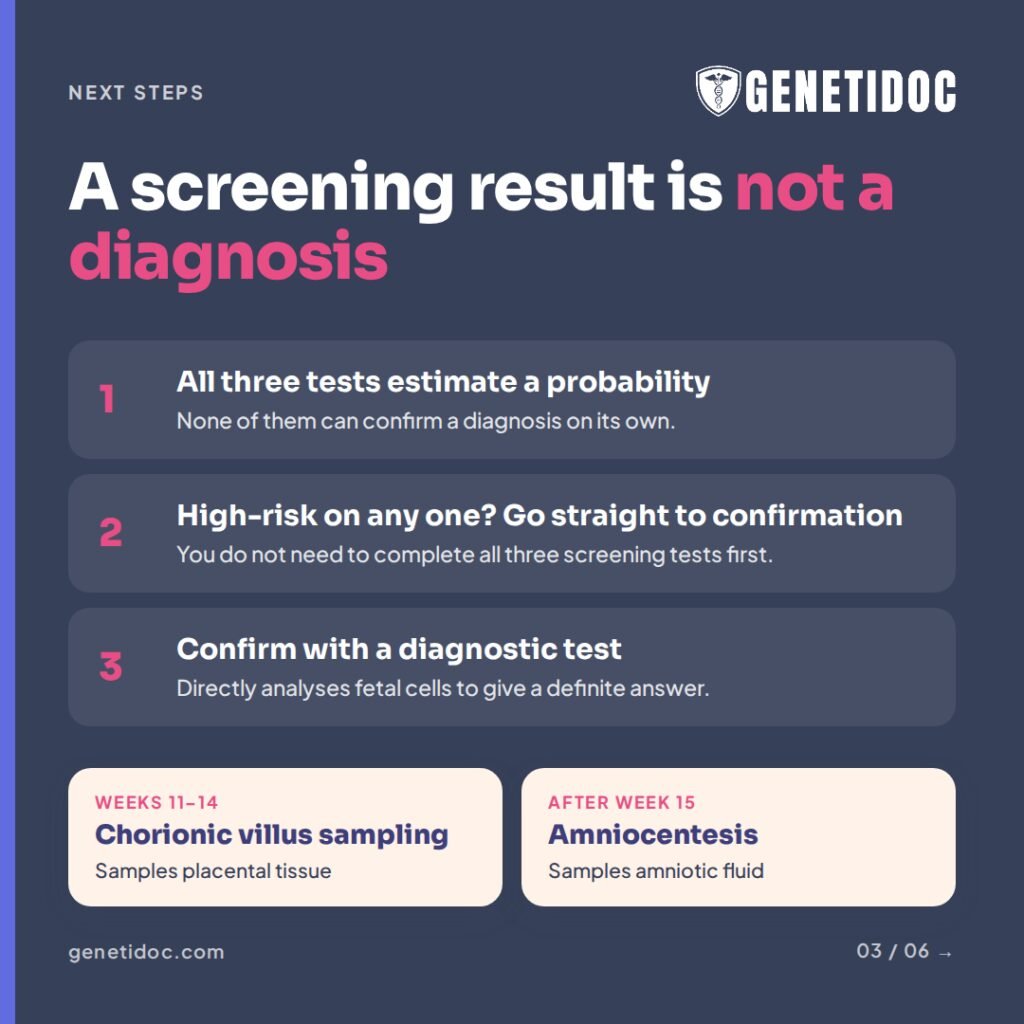
- All three are screens, not diagnoses: Every one of these three tests estimates a probability. None of them can confirm a diagnosis on its own. A high-risk result on any of the three routes to the same next step: diagnostic confirmation — and you can go straight there, without needing to complete either of the other two screening tests first.
Who Is Actually at Higher Risk of Having a Baby With Down Syndrome?
Understanding who these tests are designed for helps explain why screening is now offered widely, not just to a narrow group of “high-risk” patients.
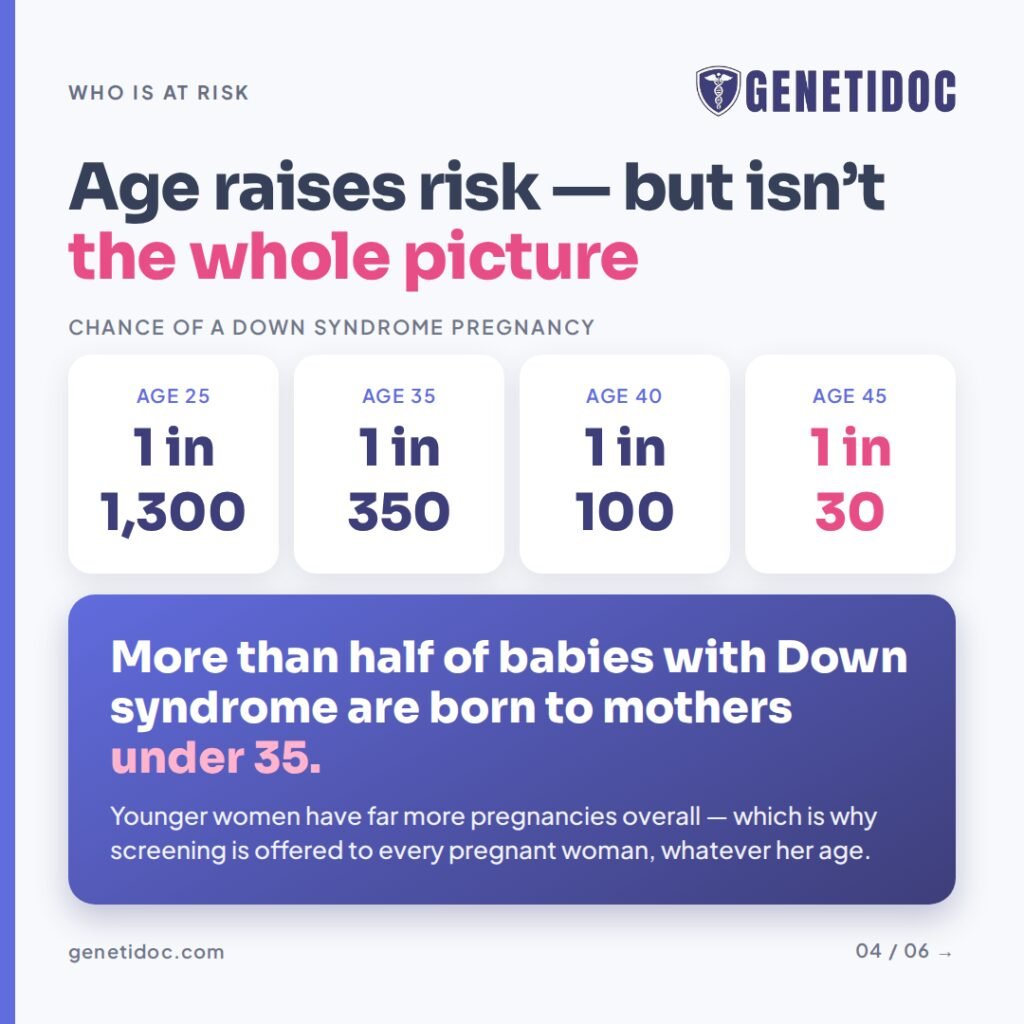
Maternal age is the single most studied factor. The chance of a Down syndrome pregnancy rises gradually through the 20s and 30s, then more steeply after that. Commonly cited incidence figures are approximately 1 in 1,300 at age 25, roughly 1 in 350 at age 35, about 1 in 100 at age 40, and approximately 1 in 30 at age 45.
But age is not the whole picture. Because younger women have far more pregnancies overall, more than half of babies born with Down syndrome are born to mothers under 35. This is exactly why screening is now recommended for all pregnant women, regardless of age, rather than reserved only for those over 35.
A previous pregnancy with trisomy 21 raises the recurrence risk in a future pregnancy to roughly 1 in 100 up to age 40, above and beyond the age-related baseline risk.
A parent who carries a balanced chromosomal translocation involving chromosome 21 faces a different kind of risk that isn’t captured by age at all. Recurrence risk depends on which parent carries the translocation and which chromosomes are involved — commonly cited figures are approximately 3 percent if the father is the carrier and roughly 10 to 15 percent if the mother is the carrier. This is identified through parental karyotyping, typically recommended after a translocation form of Down syndrome is found in a pregnancy or child, and is exactly the kind of finding a genetic counselor helps a family understand and plan around.
Family history matters differently depending on the type of Down syndrome involved. If a relative has the standard (non-translocation) form, the added risk to other family members is minimal. If a relative’s Down syndrome involves a translocation, other family members may benefit from genetic counseling and karyotype testing to check their own carrier status.
None of these risk factors make a Down syndrome pregnancy certain, and their absence doesn’t rule one out either — which is precisely why screening is offered broadly rather than only to patients who fit a specific risk profile. Families who want to connect with others navigating a Down syndrome diagnosis or risk assessment can also visit the Down syndrome forum on the Genetidoc Rare Disease Forum.
Why Genetic Counseling Matters at Every Step of This Decision
The comparisons above — detection rates, timing windows, what each test covers — answer the general question. They don’t answer your specific one, which is exactly where genetic counseling comes in.
A genetic counselor takes your age, obstetric history, family history, and any prior screening results, and uses that to help you choose which test actually makes sense next — rather than defaulting to “the most accurate one” for everyone regardless of situation. Just as importantly, a counselor interprets a result in context: the same “1 in 180” risk number means something different for a 25-year-old with no other risk factors than it does for a 40-year-old with an abnormal ultrasound finding, because a screening result’s real-world meaning depends on the baseline risk it started from, not the number alone.
This matters most at two points: before testing, when choosing the right test for your situation avoids paying for or waiting on a test that isn’t actually the best fit, and after a high-risk result, when a counselor can walk you through what chorionic villus sampling or amniocentesis actually involves, what the wait for results feels like, and what your options are once a diagnosis is confirmed one way or the other. Choosing where you test matters here too — the value isn’t only in running the right test, but in having someone qualified to explain what it found.
What Genetidoc Actually Offers, and Why
“We don’t run the double, triple, or quad marker tests ourselves,” says Team Genetidoc. “What we offer is prenatal screening built around NIPT, along with the genetic counseling that goes with interpreting it. Patients typically bring us their first-trimester result from their obstetrician, and from there we talk through whether NIPT makes sense as the next step.”
This is a genuinely common pattern in Indian prenatal care: the first-trimester combined test is often already part of standard obstetric care, ordered as routine, while NIPT is the option a patient actively opts into — sometimes because the first-trimester result came back at intermediate or high risk, and sometimes simply because they want the added accuracy and reassurance it offers, regardless of what the earlier result showed.
The One Thing NIPT Doesn’t Cover
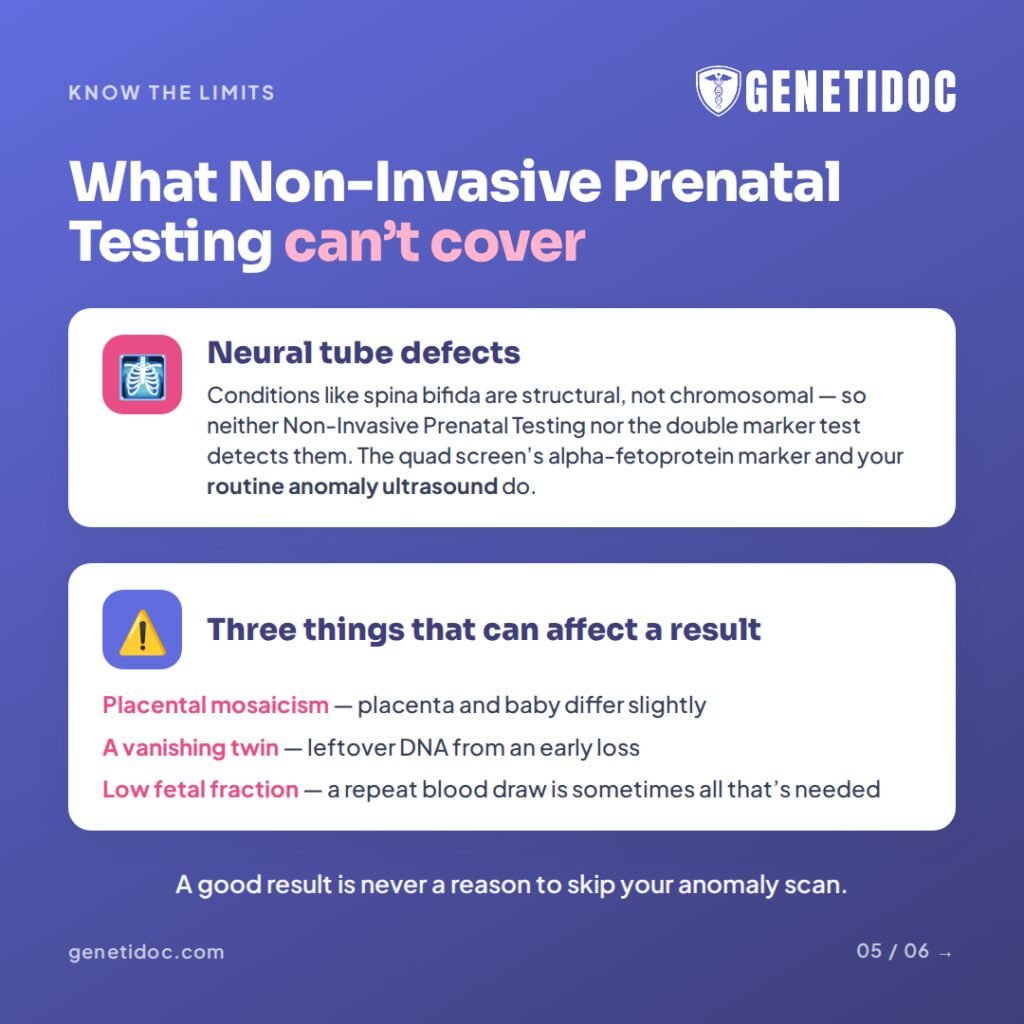
Because NIPT is so often described as the most accurate option, it’s easy to assume it covers everything the older tests did. It doesn’t. Neural tube defects — conditions like spina bifida, where the spine or brain doesn’t form completely — are a structural finding, not a chromosomal one, so no blood-based chromosomal screening test, including NIPT, detects them. Only the quad screen’s alpha-fetoprotein (AFP) component, and separately the routine anomaly ultrasound, screen for this. That’s a genuine coverage gap worth understanding, and one that’s often glossed over in the way NIPT gets marketed.
“NIPT doesn’t rule out neural tube defects, so we’re always clear with patients that they still need the prenatal ultrasound scans their obstetrician advises, on the usual schedule,” says Team Genetidoc. “A good NIPT result is not a reason to skip or space out your regular obstetric follow-up — the two aren’t a substitute for each other, they cover different things.”
In practice, this means the routine second-trimester anomaly (or anatomy) ultrasound — not the quad screen and not NIPT — is what checks for neural tube defects and other structural findings, unless you’ve specifically chosen the quad screen, whose alpha-fetoprotein (AFP) component covers this too. If you’ve chosen NIPT over the quad screen for its higher chromosomal accuracy, that’s a reasonable choice, but it makes the anomaly scan more important to keep, not less.
What NIPT Can Miss, Explained Honestly
No screening test is perfect, and NIPT’s very high accuracy shouldn’t be mistaken for certainty. A handful of specific, well-documented situations can affect its reliability.
“We go through the limitations before the blood draw, not after a confusing result,” says Team Genetidoc. “Things like placental mosaicism, a history of a vanishing twin, or a low fetal fraction can all affect the result. A low fetal fraction — where there isn’t enough fetal-origin DNA in the sample to analyze reliably — is common enough, especially very early in pregnancy or at a higher maternal body weight, that a repeat blood draw is sometimes simply what’s needed, not a sign that anything is wrong.”
- Placental mosaicism: Occasionally, the placenta’s chromosomes differ slightly from the baby’s own chromosomes. Since NIPT analyzes placental DNA, this can produce a result that doesn’t reflect the fetus.
- A vanishing twin: If a twin pregnancy loses one fetus early on, residual DNA from that twin can linger and affect results, even though only one pregnancy continues.
- Low fetal fraction: Very early testing, higher maternal body weight, or certain medications can reduce the proportion of fetal-origin DNA in the sample below the threshold needed for a reliable result, leading to a “no result” outcome and a recommended redraw.
None of this makes NIPT unreliable — it remains the most accurate of the three screening options for Down syndrome by a clear margin. It does mean that “highly accurate” and “flawless” aren’t the same thing, and that a redraw request or an unusual result is worth discussing with your doctor or genetic counselor rather than panicking over.
Myths That Cause the Most Confusion
“The two mix-ups we see most often are patients treating a screening result as if it were a diagnosis, and treating a high-risk result as if it means their baby is definitely affected,” says Team Genetidoc. “Neither is true. And without proper counseling to unpack what the numbers actually mean, that confusion tends to get worse, not better.”
Myth 1: A screening result is the same as a diagnosis. It isn’t, for any of the three tests. Each one produces a probability — low-risk or high-risk — not a yes-or-no answer. Even NIPT, despite its high accuracy, is explicitly a screening test. Only a diagnostic test — chorionic villus sampling or amniocentesis, followed by laboratory analysis of fetal cells — can confirm a chromosomal condition.
Myth 2: A high-risk result means the baby is definitely affected. A high-risk result means the probability is elevated enough to warrant a diagnostic test, not that the condition is confirmed. How elevated that probability actually is depends on the individual pregnancy’s baseline risk factors, not just the screening result in isolation — which is exactly why interpretation by a genetic counselor matters as much as the test itself.
Myth 3: A low-risk result guarantees a healthy baby. A low-risk result substantially reduces the likelihood of the specific conditions screened, but no screening test rules out every genetic or structural condition. It narrows risk; it doesn’t eliminate it.
Myth 4: Since NIPT analyzes fetal DNA, it can also be used to find out the baby’s sex. Technically, NIPT could identify fetal sex from the same blood sample — but that’s not what it’s offered for, and it isn’t something a reputable Indian lab will report to you. Prenatal sex determination for any purpose other than a specific, medically justified indication is prohibited under India’s Preconception and Prenatal Diagnostic Techniques (PCPNDT) Act, 1994. Genetidoc does not disclose fetal sex as part of an NIPT result, and patients who ask about it directly are told why. Treating NIPT as a “gender test” misses the point of the test entirely — it exists to screen for chromosomal conditions, not to answer an unrelated question the law doesn’t allow it to answer.
Myth 5: Down syndrome screening is only relevant for women over 35. As the risk factors above show, more than half of babies born with Down syndrome are born to mothers under 35, simply because younger women have more pregnancies overall. This is why screening is now offered to all pregnant women, not only those considered “high-risk” by age.
If Your Result Comes Back High-Risk: What Happens Next
“If a result comes back high-risk, we advise confirmatory diagnostic testing — chorionic villus sampling or amniocentesis — followed by karyotyping or, increasingly, chromosomal microarray analysis, which is today’s standard for confirming the finding,” says Team Genetidoc.
An important practical point first: you do not need to work through all three screening tests before you’re allowed to confirm a result. If any single screening test — the first-trimester combined test, the quad screen, or NIPT — comes back high-risk, the recommended next step is diagnostic confirmation directly, not a second or third screening test. Repeating screening on top of an already high-risk result generally adds time and anxiety without adding the certainty that only a diagnostic test can provide. This is also a point where genetic counseling helps most, since going straight into a diagnostic procedure can feel like a big jump without someone to walk you through why it’s the appropriate next step.
Amniocentesis is the diagnostic test most commonly used to confirm a high-risk result. It’s typically done after 15 weeks of pregnancy and involves collecting a small sample of amniotic fluid — the fluid surrounding the baby — under ultrasound guidance, using a thin needle passed through the abdomen. The fluid contains fetal cells that can be analyzed directly, which is what allows amniocentesis to confirm a diagnosis rather than estimate a probability. It carries a small procedural risk of miscarriage, which your doctor will discuss with you specifically, but this is a risk shared with any invasive diagnostic test and is why amniocentesis is reserved for confirming an already elevated risk rather than offered as a routine first step.
Chorionic villus sampling is the other diagnostic option, typically done earlier — between weeks 11 and 14 — and analyzes a small sample of placental tissue instead of amniotic fluid. It’s sometimes preferred when an earlier result is wanted, including in the first trimester, while amniocentesis is generally used when testing happens later in pregnancy or when a first-trimester result already exists and confirmation is being pursued in the second trimester.
Once a sample is collected through either procedure, laboratories commonly offer a rapid preliminary result — through a technique such as fluorescence in situ hybridization or quantitative fluorescent polymerase chain reaction — within roughly 24 to 48 hours, checking specifically for the most common chromosomal conditions including Down syndrome. A full karyotype, which examines all chromosomes in detail, or a chromosomal microarray analysis, which can also detect smaller chromosomal changes a standard karyotype might miss, typically follows and is considered the complete diagnostic confirmation.
Genetic counseling before this step is strongly recommended, both to understand what the diagnostic procedure involves and to process what a confirmed result would mean — this is a decision-heavy moment, and going into it with clear information from a counselor generally makes it easier to navigate, whatever the result turns out to be.
How to Actually Decide
With the individual tests explained, here’s how the decision tends to break down in practice. A genetic counselor can walk through this with you directly, but this gives you a starting framework.
If you’re early in pregnancy and haven’t had any screening yet: NIPT, from around week 10, gives you the highest accuracy and the earliest reliable window. If cost or availability makes that difficult, the first-trimester combined test between weeks 11 and 13 is a reasonable, well-established alternative — just with a lower detection rate and a narrower ultrasound-dependent timing window.
If your obstetrician has already done the first-trimester combined test: A low-risk result doesn’t obligate you to do anything further, but many patients choose to add NIPT anyway for the higher accuracy and added reassurance. A high-risk or intermediate-risk result is a stronger reason to pursue either NIPT or move directly to diagnostic testing, depending on how high the risk estimate is and what your genetic counselor recommends.
If you missed the first-trimester window entirely: The quad screen is the second-trimester option built for this scenario, and NIPT remains available too, with no upper gestational age limit for testing, though earlier testing generally allows more time to act on the result if needed.
If any screening test comes back high-risk: You can move directly to a confirmatory diagnostic test — amniocentesis or chorionic villus sampling — rather than working through the remaining screening options first.
Whichever test you choose: None of the three replaces your routine anomaly ultrasound, and a high-risk result on any of them means the same next step — diagnostic confirmation, ideally with genetic counseling alongside it, rather than a decision made on the screening result alone.
Key Takeaways
- All three options — the first-trimester combined (double marker) test, the quad screen, and NIPT — are screening tests, not diagnostic tests
- NIPT has the highest detection rate for Down syndrome (over 99 percent) and the lowest false-positive rate of the three
- Only the quad screen checks for open neural tube defects, through its alpha-fetoprotein (AFP) component; the routine anomaly ultrasound is what covers this if you choose NIPT or the combined test instead
- Maternal age raises risk, but most babies with Down syndrome are born to mothers under 35 — which is why screening is offered to all pregnant women, not only those over 35
- A good NIPT result doesn’t replace your regular obstetric follow-up or anomaly scan
- NIPT has real, well-documented limitations — placental mosaicism, a vanishing twin, and low fetal fraction can all affect a result, and a repeat draw is sometimes simply needed
- A high-risk result on any one of the three screening tests can go directly to diagnostic confirmation — amniocentesis or chorionic villus sampling, followed by karyotyping or chromosomal microarray analysis — without needing to complete the other screening options first
- Genetic counseling helps at both ends of this process — choosing the right test for your situation, and interpreting what a result actually means once you have it
Already have a first-trimester screening result and want expert help deciding what to do next? Talk to a genetic counselor about whether NIPT is the right next step for your pregnancy.
Book a Prenatal Genetic Counseling Session
Frequently Asked Questions
If your question isn’t covered below, the forum’s Frequently Asked Questions board post your all your genetic related doubts has answers to other common patient questions, and you’re welcome to post your own.
What’s the difference between the first-trimester combined test, the quad screen, and NIPT?
The first-trimester combined (double marker) test, done around weeks 11–13, combines a blood test and a nuchal translucency ultrasound measurement. The quad screen, done around weeks 15–20, is a four-marker blood test. NIPT, available from around week 10, analyzes fetal DNA in the mother’s blood and is the most accurate of the three for Down syndrome.
Which Down syndrome screening test is most accurate?
NIPT, with a detection rate commonly cited above 99 percent and a false-positive rate under 1 percent, is the most accurate of the three screening options for Down syndrome specifically.
Is Down syndrome screening only necessary for older mothers?
No. Maternal age does raise the chance of a Down syndrome pregnancy, but because younger women have far more pregnancies overall, more than half of babies born with Down syndrome are born to mothers under 35. Screening is now recommended for all pregnant women, regardless of age.
Can I skip the double marker test and go straight to NIPT?
Yes. NIPT doesn’t require a prior screening test and can be done from around week 10 of pregnancy. Many patients choose it as their first and only screening test for this reason.
Does NIPT replace my regular ultrasound scans?
No. NIPT screens for chromosomal conditions only. Structural findings, including neural tube defects, are checked through your routine anomaly ultrasound (or the quad screen’s alpha-fetoprotein component, if that’s the test you chose), which remains necessary regardless of your NIPT result.
What happens if my screening test comes back high-risk?
A high-risk result on any of the three screening tests can go directly to diagnostic confirmation — amniocentesis or chorionic villus sampling — without needing to complete the other screening options first, along with genetic counseling to help interpret what the result means for your specific pregnancy.
What is the difference between amniocentesis and chorionic villus sampling for confirming a result?
Amniocentesis, typically done after 15 weeks, samples amniotic fluid and is the more commonly used diagnostic test to confirm a high-risk screening result. Chorionic villus sampling, typically done between weeks 11 and 14, samples placental tissue instead and is sometimes chosen when an earlier confirmation is wanted. Both directly analyze fetal cells and can confirm a diagnosis, unlike any of the three screening tests.
Is NIPT diagnostic? Does a high-risk result mean my baby has Down syndrome?
No. NIPT is a screening test, not a diagnostic one. A high-risk result means the probability is elevated enough to warrant diagnostic confirmation — it does not confirm the condition on its own.
What is the quad screen, and is it still used?
The quad screen is a second-trimester blood test, done around weeks 15–20, measuring four markers. It remains relevant mainly for patients who missed the first-trimester screening window, and it is the only one of the three options that also screens for open neural tube defects, through its alpha-fetoprotein component.
Why does NIPT sometimes come back with “no result”?
This is usually due to a low fetal fraction — not enough fetal-origin DNA in the maternal blood sample to analyze reliably. It’s more common very early in pregnancy or with a higher maternal body weight, and a repeat blood draw is the standard next step.
Can NIPT detect neural tube defects like spina bifida?
No. Neural tube defects are structural findings, not chromosomal ones, so no blood-based chromosomal screening test detects them. Only the quad screen (through its alpha-fetoprotein component) and the anomaly ultrasound screen for this.
When is the best time to get each of these tests?
NIPT can start from around week 10. The first-trimester combined test has a narrow window of roughly weeks 11–13, tied to the nuchal translucency ultrasound. The quad screen is done roughly weeks 15–20 and is the option available if you missed the first-trimester window.
Is NIPT safe for my baby?
Yes. It requires only a standard maternal blood draw and carries no procedural risk to the pregnancy, unlike amniocentesis or chorionic villus sampling, which carry a small procedural risk.
Does NIPT work the same way in twin pregnancies?
NIPT can be offered in twin pregnancies, but validated performance data is more limited than for a single pregnancy, and results typically reflect the pregnancy overall rather than each twin individually unless the laboratory specifically supports fetal-specific reporting. Discuss this directly with your genetic counselor if you’re carrying twins.
Related Reading on Genetidoc
- Family History of a Genetic Condition? Here’s What to Ask Before You Conceive
- What Does “Variant of Uncertain Significance” Mean — And Why It’s Not a Diagnosis
- NGS Panel Testing Explained: How Gene Sequencing Finds Inherited Diseases
- Genetic Counseling Online vs. In-Person: Does It Make a Difference?
- What Happens in a Genetic Counseling Session? A Step-by-Step Guide
- Biopsy Testing 101: How Doctors Choose the Right Cancer Treatment for You
References
- American College of Medical Genetics and Genomics — Prenatal screening for trisomy 21 (Down syndrome) using first- and second-trimester biochemistry and nuchal translucency: a technical standard. Genetics in Medicine. gimjournal.org
- Malone FD, et al. First-Trimester or Second-Trimester Screening, or Both, for Down’s Syndrome (the FASTER trial). New England Journal of Medicine. nejm.org
- Wald NJ, et al. Integrated Screening for Down’s Syndrome Based on Tests Performed during the First and Second Trimesters. New England Journal of Medicine. nejm.org
- First and second trimester serum tests with and without first trimester ultrasound tests for Down’s syndrome screening — systematic review. PMC. pmc.ncbi.nlm.nih.gov/articles/PMC6464364
- Johns Hopkins Medicine — First Trimester Screening, Nuchal Translucency and NIPT. hopkinsmedicine.org
- National Down Syndrome Society — About Down Syndrome (maternal age incidence and recurrence risk data). ndss.org
- Driscoll DA, Gross S. Prenatal Screening for Fetal Chromosomal Abnormalities. American Family Physician. aafp.org
- Three Misconceptions About Prenatal Screening. The Jackson Laboratory. jax.org
- Pre-Conception and Pre-Natal Diagnostic Techniques (Prohibition of Sex Selection) Act, 1994, Government of India.