
You have been told you need a genetic test. Then comes the next question, often from a laboratory price list: should you test one gene, or a panel of 50, 100 or even 500 genes?
Many families assume that more genes must mean a better test. Others pick the cheapest option to keep costs down. Both approaches can go wrong.
The truth is simpler, and more reassuring. There is no single “best” genetic test. There is only the right test for your question. This article explains what single gene testing and panel testing are, when each one makes sense, what each one can miss, and how genetic specialists in India decide between them.
Quick answer
A single gene test looks at one gene and is best when your symptoms or family history point clearly to one condition caused by one gene, or when a specific variant is already known in your family. A gene panel test looks at many genes linked to the same type of condition at once, and is best when several different genes could cause the same symptoms. Neither is automatically better. The right choice depends on your clinical picture, your family history and the type of genetic change being looked for.
What Is Single Gene Testing?
Your DNA contains around 20,000 genes. Each gene is a set of instructions for making a protein the body needs. A change (variant) in one of these genes can cause an inherited condition.
A single gene test examines just one of these genes in detail. It answers a focused question: does this person have a disease-causing change in this particular gene?
Single gene testing works well when the doctor already has a strong idea of the diagnosis, and that diagnosis is caused by changes in only one gene.
Single variant testing: the most focused test of all
There is an even narrower form of testing. When one family member has already been found to carry a disease-causing variant, relatives usually do not need the whole gene examined. They only need to be checked for that one known family variant.
This is called single variant (or single-site) testing, and it is the basis of cascade testing, where at-risk relatives are tested one after another. At Genetidoc, when a hereditary cancer variant is known in a family, relatives are usually tested for that single variant only. A broader panel is offered instead only if the relative has their own unexplained cancer history, or specifically wants wider testing. Single variant testing typically takes about one week.
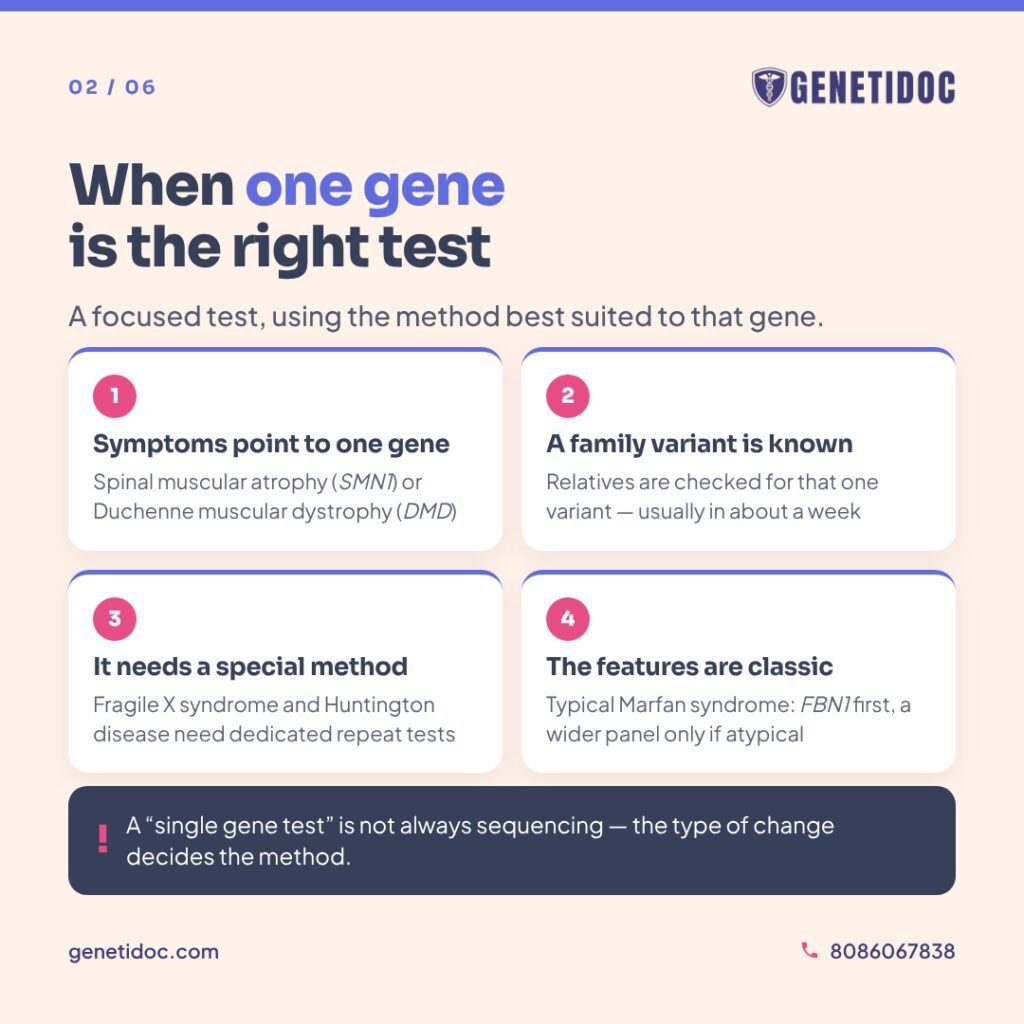
A “single gene test” is not always sequencing
This point is often missed, even by doctors outside genetics. Some genes are not best tested by reading their code letter by letter (sequencing). The type of change that causes the disease decides the method:
- Spinal muscular atrophy: about 95% of affected people are missing both copies of a section of the SMN1 This is found with a deletion test, such as multiplex ligation-dependent probe amplification (MLPA), a method that counts how many copies of a gene section are present. A nearly identical neighbouring gene, SMN2, makes ordinary sequencing unreliable here.
- Duchenne and Becker muscular dystrophy: most disease-causing changes in the DMD gene are large deletions or duplications of whole sections of the gene. A deletion and duplication test such as MLPA is usually done first, with sequencing added if that is negative.
- Fragile X syndrome: more than 99% of cases are caused by a short piece of DNA (a CGG repeat) in the FMR1 gene being repeated far too many times. This “repeat expansion” needs a special repeat test. Standard sequencing panels and even exome sequencing cannot reliably detect it.
So when a specialist orders a “single gene test,” they are often choosing a specific method as well as a specific gene.
What Is a Gene Panel Test?
A gene panel test looks at a group of genes that are all known to cause the same type of condition, in a single test. For example, a hereditary cancer panel may include BRCA1, BRCA2, PALB2, TP53, the Lynch syndrome genes and others. An epilepsy panel may include dozens of genes linked to seizures in children.
Panels are made possible by next-generation sequencing (NGS), a technology that reads many genes at the same time. Before NGS, doctors had to test genes one after another, waiting weeks for each result before deciding on the next. Panels replaced that slow, stepwise process for many conditions.
Not all panels are equal
Two panels with the same name can be very different. The American College of Medical Genetics and Genomics (ACMG), in its technical standard on gene panels, points out that panels vary widely between laboratories in:
- Which genes are included, and how strong the scientific evidence is that each gene actually causes the condition
- How thoroughly each gene is read, since some parts of some genes are technically hard to sequence
- Which types of change can be detected, such as large deletions and duplications
This is why the number of genes on a panel tells you very little on its own. A well-designed panel of 30 genes with strong evidence can be more useful than a 500-gene panel padded with genes that are only weakly linked to the condition.
Single Gene Testing vs Panel Testing: Side-by-Side Comparison
| Feature | Single gene test | Gene panel test |
| What it looks at | One gene, using the method best suited to that gene | A group of genes linked to one type of condition |
| Best when | Symptoms clearly fit one condition caused by one gene, or a family variant is already known | Many different genes could cause the same symptoms |
| Chance of an uncertain result | Lower | Higher, and rises with the number of genes |
| Risk of missing the cause | High if the diagnosis was guessed wrongly | Lower for sequence changes; may miss repeat expansions and some deletions |
| Typical turnaround at Genetidoc | About 1 week for a known family variant; about 3 weeks for some single genes (such as FBN1 or the fragile X test) | About 3 to 4 weeks, depending on panel size |
| Cost | Usually the least expensive genetic test | Varies widely with the laboratory and the number of genes |
When Is Single Gene Testing the Right Choice?
A single gene test makes the most sense in these situations:
- The clinical picture points clearly to one gene. At Genetidoc, conditions with a single well-established cause, such as spinal muscular atrophy (SMN1), Duchenne muscular dystrophy (DMD) and familial adenomatous polyposis (APC), are tested with a targeted single-gene approach.
- A disease-causing variant is already known in the family. Relatives are tested for that one variant. This is faster, simpler and easier to interpret than repeating a full panel.
- The condition needs a special method. Fragile X syndrome and other repeat expansion conditions, such as Huntington disease, need dedicated repeat tests that standard panels cannot replace.
- The features are classic. For example, in a person with the typical features of Marfan syndrome, our team tests the FBN1 gene first, and moves to a wider panel only if the picture is atypical.
- A specific inherited blood disorder is suspected. Conditions such as beta-thalassemia and sickle cell disease, both important in India, are often investigated with targeted testing of the relevant gene once blood tests suggest the diagnosis.
When Is Panel Testing the Better Choice?
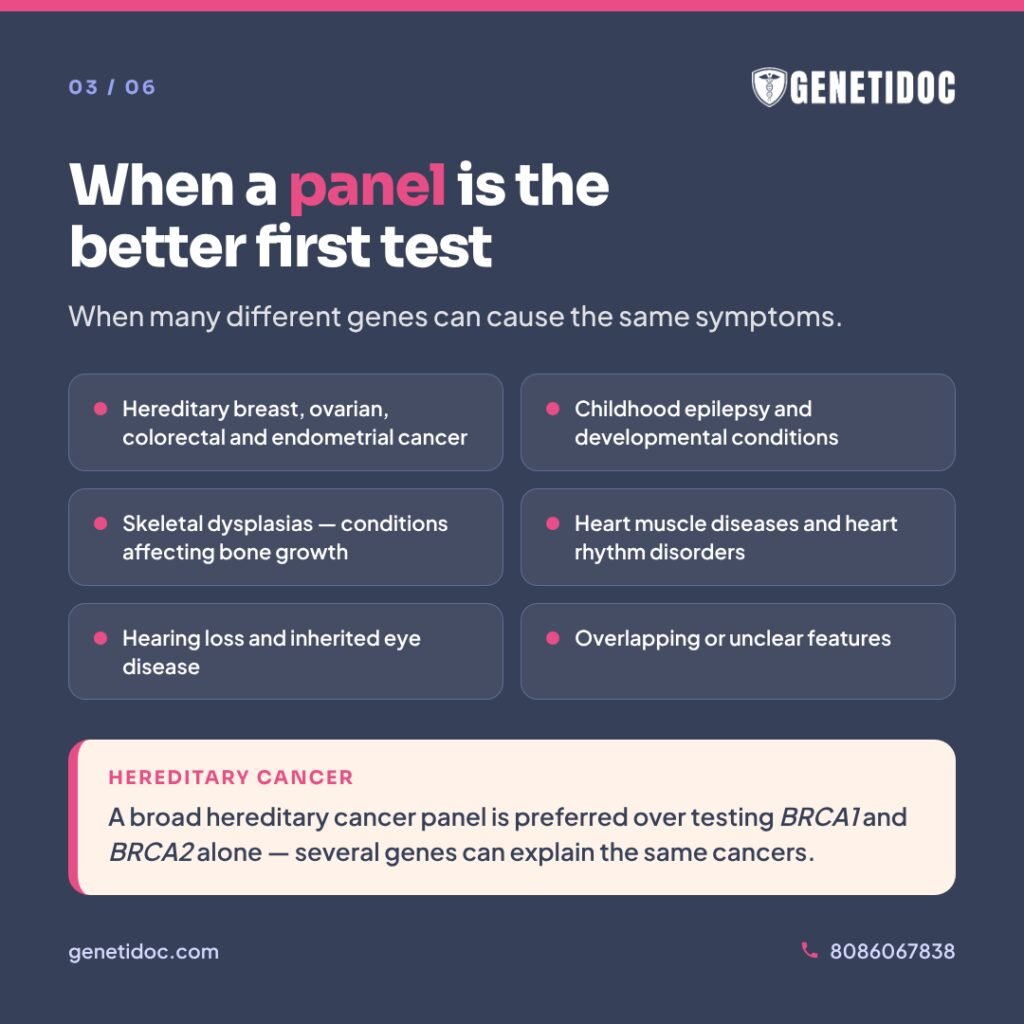
A panel is usually the better first test when the same symptoms can be caused by many different genes. Common examples include:
- Hereditary cancer. Many genes raise the risk of breast, ovarian, colorectal and endometrial cancer, and their effects overlap. For these cancers, our team orders a broad hereditary cancer panel rather than a test for only BRCA1 and BRCA2, or only the Lynch syndrome genes. This matches the approach of the National Comprehensive Cancer Network (NCCN), whose guidelines our team follows for hereditary cancer.
- Childhood epilepsy and developmental conditions, where dozens of genes can cause similar seizures or delays.
- Skeletal dysplasias (inherited conditions affecting bone growth), where many possible genes are involved and our team uses a broader panel or whole exome sequencing.
- Inherited heart conditions, such as cardiomyopathies (heart muscle diseases) and arrhythmias (heart rhythm disorders). A family history of young sudden deaths often does not point to a single gene.
- Hearing loss and inherited eye disease, which each have a large number of known causative genes.
- Overlapping or unclear features, where more than one condition is possible and guessing one gene could waste time and money.
What the evidence shows
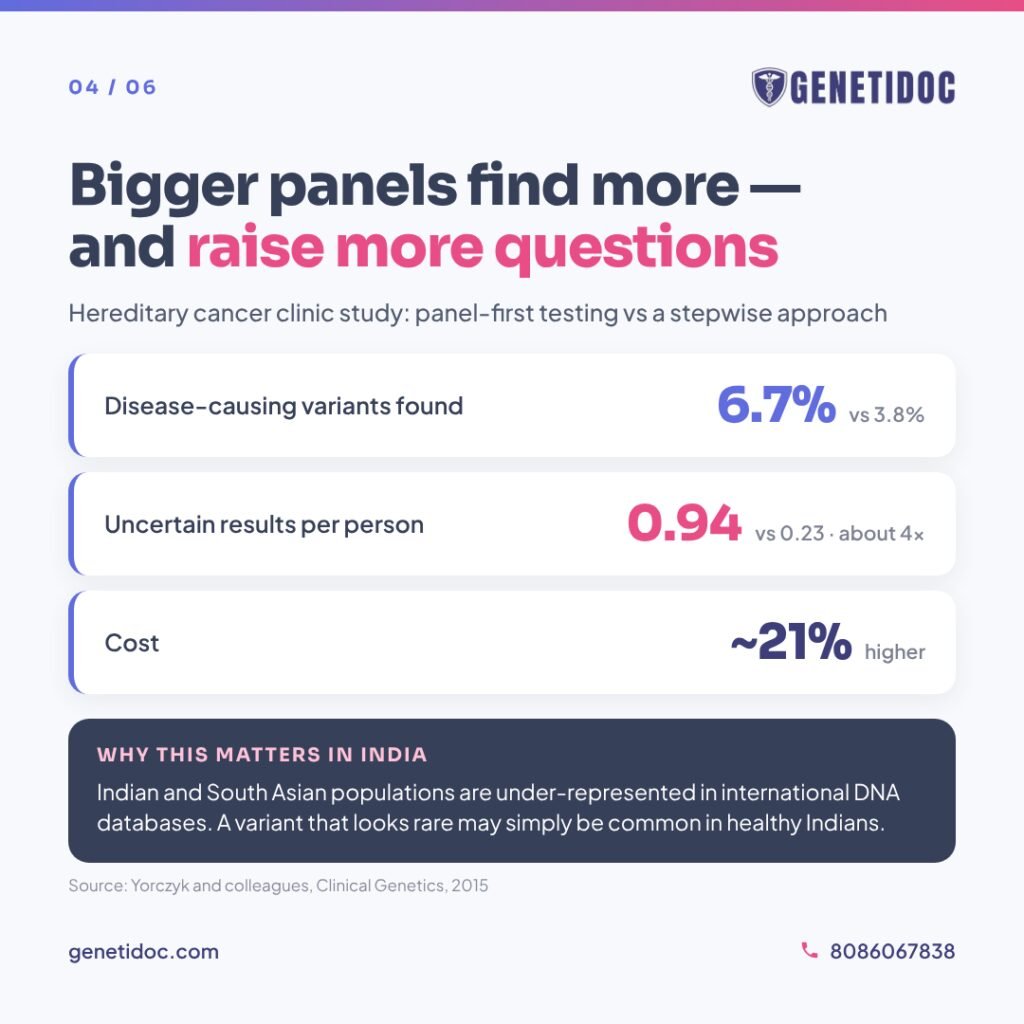
Studies in hereditary cancer clinics show the trade-off clearly. A 2015 study in Clinical Genetics compared offering a panel straight away with a two-step approach, where a panel was offered only after stricter criteria were met. Panel-first testing found more disease-causing variants (6.7% vs 3.8% of patients). It also produced about four times as many uncertain results per person (0.94 vs 0.23) and cost about 21% more.
The lesson is not that one approach always wins. It is that a panel finds more, and also raises more questions. That makes expert interpretation and counseling more important, not less.
The Hidden Trade-Offs of Bigger Panels
More genes, more uncertain results
Every person carries many harmless DNA differences. The more genes a test examines, the more likely it is to find a variant of uncertain significance, a change whose effect science cannot yet explain.
Our team finds these results the hardest to explain to families. A variant of uncertain significance is not a diagnosis, and medical decisions should not be based on it alone. This problem is greater in India, because Indian and South Asian populations are still under-represented in the international databases that laboratories use to decide whether a variant is rare or common. A variant that looks unusual may simply be common in healthy Indians.
Genes with weak evidence
Some panels include genes that have only limited evidence of causing the condition. Expert groups such as the Clinical Genome Resource (ClinGen) grade how strong each gene–disease link is. Results in poorly supported genes are hard to act on and can cause unnecessary worry.
Unexpected findings
Broader cancer panels may find a disease-causing variant in a gene unrelated to the cancer that prompted testing. This can be useful, because it may reveal a risk that would otherwise have gone unnoticed. But it needs careful explanation, which is why these possibilities should be discussed before the test, not after.
What a Standard Panel Can Miss
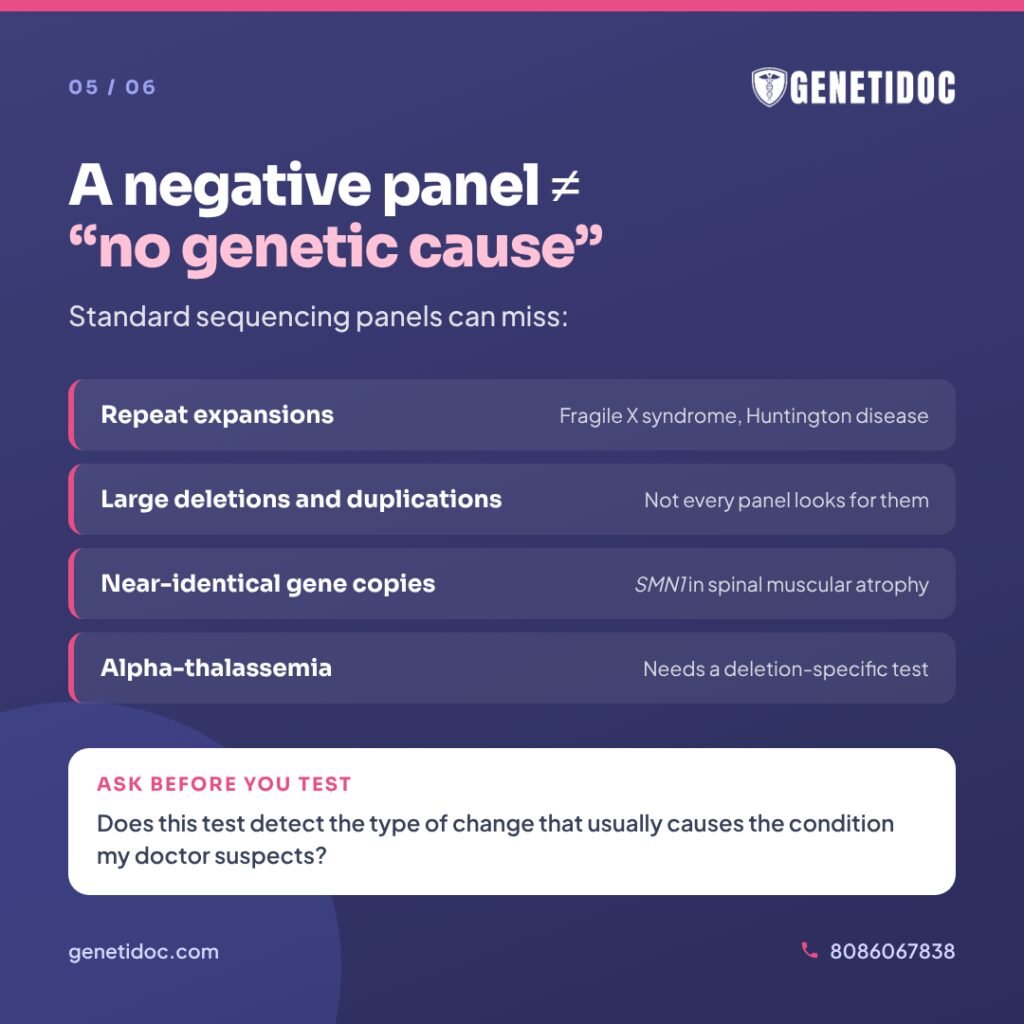
A negative panel result is not the same as “no genetic cause.” Standard sequencing panels are very good at finding small spelling changes in genes. They are much less reliable for some other types of change:
- Repeat expansions, as in fragile X syndrome, Huntington disease and some inherited ataxias (balance disorders). These need dedicated repeat tests.
- Large deletions and duplications, where whole sections of a gene are missing or doubled. Some panels include this analysis, and some do not.
- Genes with near-identical copies elsewhere in the DNA, such as SMN1 in spinal muscular atrophy, which make sequencing data hard to read accurately.
- Alpha-thalassemia, which is usually caused by deletions of the alpha-globin genes and needs a deletion-specific test.
- Changes outside the tested regions, such as deep within the non-coding parts of genes.
This is one reason why the “biggest” test is not always the most accurate one. A child with suspected spinal muscular atrophy needs an SMN1 deletion test, not a large panel. A boy with developmental delay may need a fragile X repeat test alongside, or before, sequencing.
Before you test, ask:
Does this test detect deletions and duplications? Does it cover the type of change that usually causes the condition my doctor suspects? If not, is a separate test needed?
Where Do Exome and Genome Sequencing Fit In?
Single gene tests and panels sit at one end of a range of tests. At the other end are whole exome sequencing, which reads the protein-coding parts of almost all 20,000 genes, and whole genome sequencing, which reads almost the entire DNA code.
At Genetidoc, the scope of testing is matched to how closely the patient’s features fit a known condition:
- Clear fit with one gene: targeted single-gene testing
- Fits a group of conditions with many possible genes: a targeted panel, or whole exome sequencing
- Features that do not fit any one group, or several possibilities: whole exome sequencing
- Strongly suspected genetic condition with a negative or incomplete exome: whole genome sequencing as a next step, not a first test
Turnaround rises with the scope of the test. At Genetidoc, panels usually take about 3 to 4 weeks and exome sequencing about 1 to 2 months. In terms of cost, a single gene test is usually the least expensive option, and exome and genome sequencing sit at the higher end.
How Genetic Specialists Choose the Right Test: Step by Step
- Take a detailed history. The clinical geneticist reviews symptoms, age of onset, investigations already done and previous treatment.
- Draw a family tree. A three-generation family history shows who is affected, how the condition may be passed on and whether parents are related by blood.
- Examine the clinical picture. Physical features, scans and reports help decide how closely the patient fits a known condition.
- Define the question. Is the goal to confirm a suspected diagnosis, find an unknown cause, test a relative for a known variant, or assess cancer risk?
- Choose the gene or genes, and the method. This includes checking whether the condition needs a deletion test, a repeat test or sequencing.
- Pre-test counseling. The patient learns what the test can and cannot find, the chance of an uncertain result, and what each possible result would mean for them and their family.
- Expert interpretation and post-test counseling. The result is matched against the patient’s actual features, explained clearly, and linked to a concrete plan.
Why This Choice Matters for Families in India
Most families in India pay for genetic testing themselves. That makes choosing the right first test especially important. A poorly chosen test can mean paying twice: once for a test that could not answer the question, and again for the test that should have been done first.
Some patterns we see often:
- Choosing the cheapest single test without a clear diagnosis. If the guess is wrong, the result is negative, the cause remains unknown and a second test is needed anyway.
- Ordering the largest panel from a price list. Without counseling, families may receive a long report full of uncertain variants they cannot act on.
- Assuming relatives need the same big panel. Once a family variant is known, relatives usually need only a quick, focused single variant test.
- Overlooking family structure. In families where parents are related by blood, recessive conditions are more common, and this shapes which genes and methods make sense.
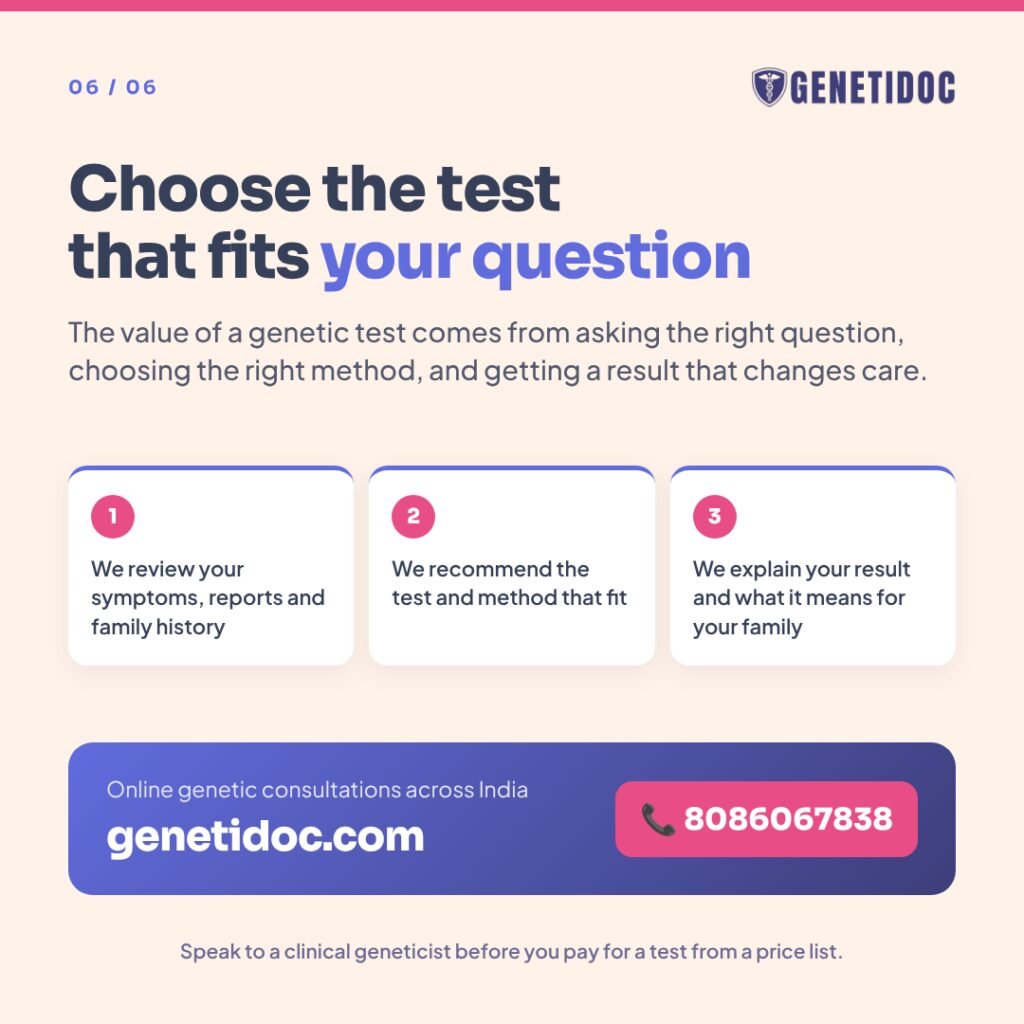
The value of genetic testing does not come from the size of the test. It comes from asking the right question, choosing the right method and getting a result that changes care.
How the Right Test Changes Care
When the right test gives a clear answer, the benefits reach well beyond the report:
- Treatment: some diagnoses open the door to specific treatments, such as targeted therapies for spinal muscular atrophy, or influence cancer surgery and treatment choices.
- Screening and prevention: people with a hereditary cancer variant can start earlier and more frequent screening, often before any cancer develops.
- Prognosis: knowing the exact condition helps doctors explain what to expect and which complications to watch for.
- Family members: relatives can be offered focused single variant testing. Those who test negative for the family variant can often be spared unnecessary extra screening.
- Future pregnancies: once a definite diagnosis is made, couples can consider prenatal diagnosis or preimplantation genetic testing for the known family variant.
Illustrative Examples
The following are illustrative examples created to explain common situations. They are not the stories of real patients.
Example 1: A baby with weak muscles
A six-month-old baby has poor head control and weak, floppy limbs. The doctor suspects spinal muscular atrophy. The family has seen a large neuromuscular panel advertised online and wonders if it would be “more complete.”
The clinical geneticist instead orders an SMN1 deletion test. This is the right test because almost all spinal muscular atrophy is caused by a deletion that standard sequencing panels can miss. The result confirms the diagnosis quickly, and the child can be referred for treatment without delay.
Example 2: Breast cancer with a family history
A 38-year-old woman is diagnosed with breast cancer. Her aunt had ovarian cancer and her father had pancreatic cancer. Her oncologist asks whether she should have a BRCA1 and BRCA2 test.
Because several genes can explain this pattern of cancers, the team recommends a broad hereditary cancer panel. The panel finds a disease-causing variant in a gene that a BRCA-only test would not have examined. Her screening plan is adjusted, and her relatives are offered single variant testing for that one variant, with results in about a week.
Example 3: A brother who does not need the full panel
A man’s sister has tested positive for a Lynch syndrome variant. He is healthy and assumes he needs the same large panel she had.
After counseling, he has a single variant test for his sister’s variant. The result is negative. He is told that his risk from this family condition is very low and that he can follow general population screening guidelines. He has avoided a larger, slower test and the uncertain findings it might have produced.
Common Misconceptions
Myth: “More genes always means a better test.”
Fact: Larger panels find more uncertain results, and some include genes with weak evidence. A focused test that matches the clinical question is often more useful.
Myth: “A negative panel means my condition is not genetic.”
Fact: It means no reportable finding was found in what was tested. The cause may be a type of change the panel cannot detect, or a gene not on the panel.
Myth: “A single gene test is an old or inferior test.”
Fact: For conditions like spinal muscular atrophy or fragile X syndrome, a targeted test using the right method is the most accurate choice.
Myth: “My relatives need the same panel I had.”
Fact: Once a family variant is known, relatives usually need only a single variant test.
Myth: “Any laboratory’s panel is the same.”
Fact: Panels with the same name can differ in gene content, coverage and whether they detect deletions and duplications.
Questions to Ask Before Any Genetic Test
- What condition is being looked for, and why this test?
- Does the test detect the type of change that usually causes this condition?
- Does it include deletion and duplication analysis?
- How likely is an uncertain result, and what happens if I get one?
- If the result is negative, what is the next step?
- What will the result mean for my family members?
- Who will interpret the report and explain it to me?
Frequently Asked Questions
What is the difference between single gene testing and panel testing?
A single gene test examines one gene. A panel test examines a group of genes linked to the same type of condition, in one test. The right choice depends on how clearly your symptoms point to one gene.
Is a gene panel better than a single gene test?
Not always. A panel is better when many genes could cause the same symptoms. A single gene test is better when the diagnosis clearly points to one gene, or a family variant is already known.
Why did my doctor order only one gene?
Usually because your features strongly suggest a condition caused by one gene, or because that condition needs a special testing method that a panel cannot replace.
Can a gene panel miss a diagnosis?
Yes. Standard panels may miss repeat expansions, some large deletions and duplications, and genes not included on the panel. A negative panel does not rule out a genetic cause.
Should I take a BRCA test or a hereditary cancer panel?
For most people with breast, ovarian, colorectal or endometrial cancer, a broad hereditary cancer panel is preferred because several genes can explain the same cancers. If a family variant is already known, a single variant test is enough.
What is single variant testing?
It checks for one specific variant already found in a family member. It is used to test relatives and typically takes about one week at Genetidoc.
How long do single gene and panel tests take?
At Genetidoc, single variant testing takes about one week, some single gene tests about three weeks, and panels about three to four weeks, depending on size.
Is panel testing more expensive than single gene testing in India?
A single gene test is usually the least expensive genetic test. Panel prices vary widely by laboratory and number of genes. Testing the wrong single gene first can end up costing more overall.
Why do larger panels give more uncertain results?
Every person has many harmless DNA differences. The more genes tested, the more likely one of these will be found whose meaning is not yet known.
What happens if my single gene test is negative?
If a genetic condition is still suspected, the next step may be a panel, whole exome sequencing or a different testing method. A clinical geneticist decides based on your features.
When is whole exome sequencing better than a panel?
When features do not fit one group of conditions, several conditions are possible, or a panel was negative but a genetic cause is still strongly suspected.
Do I need genetic counseling before choosing a test?
It is strongly recommended. Counseling helps choose the right test and method, and prepares you for every possible result, including uncertain ones.
Key Takeaways
- There is no single best genetic test, only the right test for your clinical question.
- Single gene testing suits a clear diagnosis linked to one gene, conditions that need a special method, and relatives testing for a known family variant.
- Panel testing suits conditions with many possible genes, such as hereditary cancer, epilepsy, skeletal dysplasias and inherited heart conditions.
- Bigger panels find more, but also produce more uncertain results.
- Standard panels can miss repeat expansions and some deletions, so a negative panel does not rule out a genetic cause.
- Expert test selection, interpretation and counseling are what turn a report into better care.
Not sure whether you need a single gene test, a panel or something broader?
Before you pay for a test from a price list, speak to a clinical geneticist. Our team will review your symptoms, reports and family history, recommend the test and method that actually fit your question, and explain your result clearly once it is ready. Consultations are available online across India.
Book a pre-test genetic counseling consultation.
Join the Conversation
- Genetic Testing forum
- Next-Generation Sequencing forum
- Whole Exome Sequencing forum
- Cascade Testing forum
- Hereditary Cancer Syndrome forum
Related Reading on Genetidoc
- Why Identical Twins Are Not Always Genetically Identical
- Personalized Medicine: The Role of Genetic Testing in Your Care
- Genetic Eye Disease in Children: When to Test
- Facial Features and Genetic Syndromes: A Guide for Parents
- Is Genetic Testing Useful for Unexplained Infertility?
- Family History of Dementia: When to Seek Genetic Counseling
References
- Bean LJH, Funke B, Carlston CM, et al. Diagnostic gene sequencing panels: from design to report—a technical standard of the American College of Medical Genetics and Genomics (ACMG). Genetics in Medicine. 2020;22(3):453–461.
- Richards S, Aziz N, Bale S, et al. Standards and guidelines for the interpretation of sequence variants: a joint consensus recommendation of the American College of Medical Genetics and Genomics and the Association for Molecular Pathology. Genetics in Medicine. 2015;17(5):405–424.
- Yorczyk A, Robinson LS, Ross TS. Use of panel tests in place of single gene tests in the cancer genetics clinic. Clinical Genetics. 2015;88(3):278–282.
- Strande NT, Riggs ER, Buchanan AH, et al. Evaluating the clinical validity of gene-disease associations: an evidence-based framework developed by the Clinical Genome Resource. American Journal of Human Genetics. 2017;100(6):895–906.
- National Comprehensive Cancer Network. NCCN Clinical Practice Guidelines in Oncology: Genetic/Familial High-Risk Assessment: Breast, Ovarian, Pancreatic, and Prostate. Current version.
- Hunter JE, Berry-Kravis E, Hipp H, Todd PK. FMR1 In: GeneReviews®. University of Washington, Seattle.
- Spector E, Behlmann A, Kronquist K, et al. Laboratory testing for fragile X, 2021 revision: a technical standard of the American College of Medical Genetics and Genomics (ACMG). Genetics in Medicine. 2021;23(5):799–812.
- Prior TW, Leach ME, Finanger E. Spinal Muscular Atrophy. In: GeneReviews®. University of Washington, Seattle.
- Darras BT, Urion DK, Ghosh PS. Dystrophinopathies. In: GeneReviews®. University of Washington, Seattle.